Online Math Tutoring for AP Precalculus | Personalized AP Support

Ready to make AP Precalculus less overwhelming? How Personalized Support Can Help Students Master the Course

In this guide
AP Precalculus is often treated as the class students take immediately before calculus.
That description is technically true—but academically, it misses the bigger picture.
AP Precalculus is where students are expected to move from solving familiar equations to thinking about mathematics through functions, representations, modeling, transformations, logarithms, trigonometry and increasingly sophisticated reasoning.
That transition can be difficult.
A student may understand how to manipulate an equation but struggle when the same mathematical idea appears as a graph.
Another student may know the formula but not know which representation or method to use.
Someone else may be comfortable with polynomial functions but suddenly struggle when exponential, logarithmic, trigonometric and polar functions are introduced.
This is where online math tutoring for AP Precalculus can become much more than homework help.
The right tutoring approach can identify why a student is getting stuck, repair the underlying mathematics, and then build the problem-solving habits needed for AP-level questions.
And because AP Precalculus is designed around mathematical representations, modeling, reasoning and communication—not simply memorizing procedures—personalized instruction can be particularly valuable.
College Board describes AP Precalculus as equivalent to a college precalculus or college algebra-with-trigonometry course and recommends a solid foundation in algebra, geometry and related function concepts before beginning it.
What Makes AP Precalculus Different From Regular Precalculus?
The word “precalculus” can make the course sound like a collection of topics students need to finish before calculus.
AP Precalculus is more intentional than that.
The course is organized around functions and their use in modeling and mathematical reasoning.
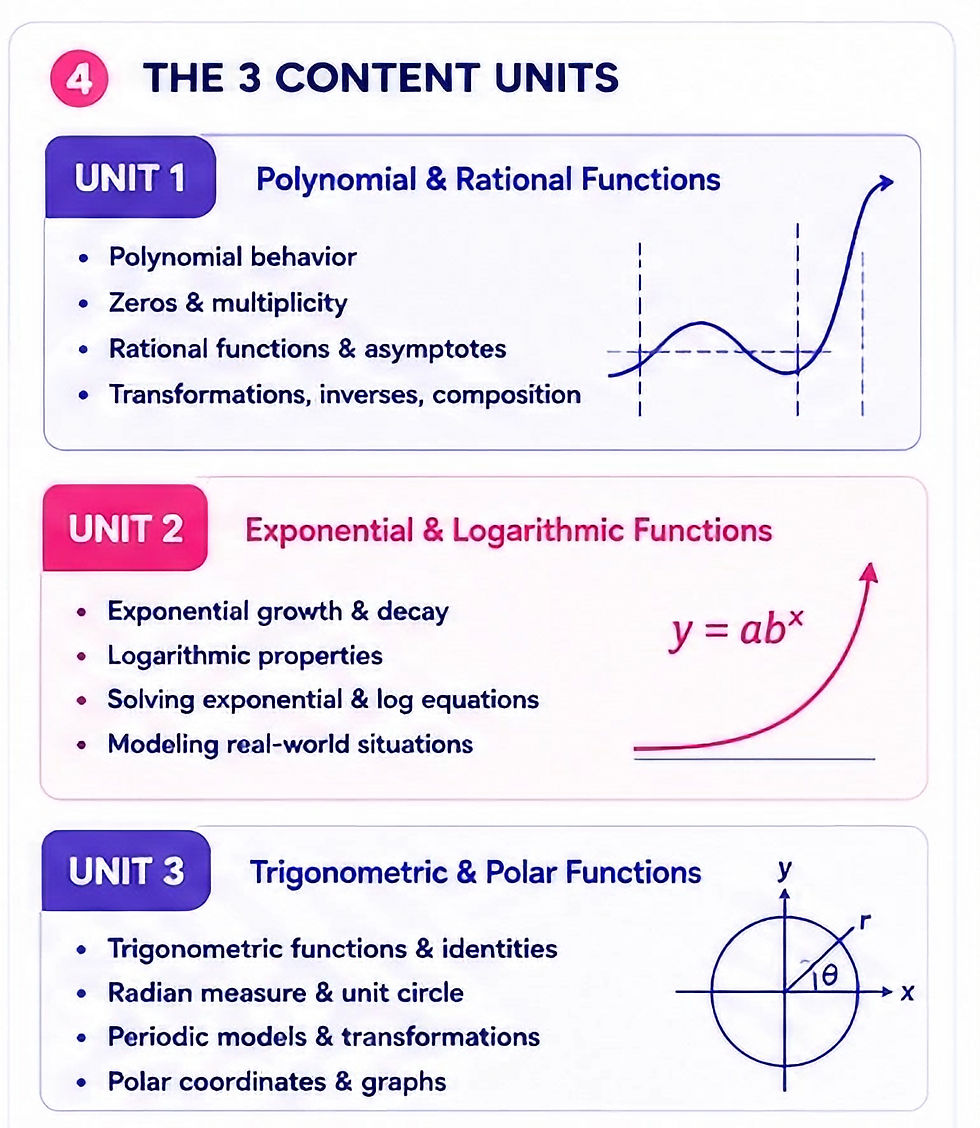
College Board identifies four units:
Polynomial and Rational Functions
Exponential and Logarithmic Functions
Trigonometric and Polar Functions
Functions Involving Parameters, Vectors, and Matrices
Units 1–3 are assessed on the AP Exam; Unit 4 is not assessed on the AP Exam under the current course framework, although schools may teach it.
That creates an important distinction.
A student isn't simply expected to know:
“What is the formula?”
They may need to understand:
What does this function represent?
How does its graph change?
What assumptions are being made?
Which representation is most useful?
Does the model actually make sense in context?
That is a different level of mathematical thinking.
Why Students Struggle With AP Precalculus
Most AP Precalculus struggles don't begin with the hardest AP question.
They often begin much earlier.
A student may have a small weakness in algebra that becomes a major obstacle once functions become more complicated.
For example:
A student who is slightly uncomfortable with factoring may struggle with rational functions.
A student who doesn't understand inverse functions may struggle with logarithms.
A student who memorized trigonometric ratios without understanding the unit circle may struggle with sinusoidal modeling.
A student who can calculate a value but cannot interpret a graph may struggle with AP-style modeling questions.
This creates a dangerous cycle:
Small gap → harder lesson → confusion → incomplete homework → more confusion → loss of confidence.
Good tutoring tries to interrupt that cycle early.
What an AP Precalculus Tutor Should Actually Do

Online tutoring should not mean:
Student shares screen → tutor solves problem → student copies answer.
That may get homework finished.
It doesn't necessarily create mathematical independence.
Effective AP Precalculus tutoring should instead move through several stages.
Diagnose
Find out exactly where the student is struggling.
Repair
Review the prerequisite concept causing the problem.
Model
Demonstrate how an expert approaches the problem.
Practice
Have the student solve a similar problem independently.
Explain
Ask the student to justify the reasoning.
Transfer
Give a different-looking problem requiring the same underlying concept.
That final step is especially important.
A student hasn't truly mastered a concept simply because they can reproduce the example shown by a tutor.
They need to recognize the concept when the problem is presented differently.
Online Math Tutoring for AP Precalculus Is a Functions Course at Its Core
Students often think of AP Precalculus as dozens of unrelated topics.
It is more useful to think of the course as a study of how functions describe relationships and change.
That perspective connects the entire course.
A function can be represented:
Algebraically
Graphically
Numerically
Verbally
Through a real-world model
A strong student learns to move between these representations.
College Board specifically identifies translating mathematical information between representations as one of the skills students develop in AP Precalculus.
This is one reason personalized tutoring can be useful.
A tutor can identify whether a student understands the mathematics itself—or has simply learned one representation.
Online Tutoring for

Unit 1: Polynomial and Rational Functions
The first major AP Precalculus unit focuses on polynomial and rational functions.
Students work with concepts such as:
Polynomial behavior
End behavior
Zeros
Factors
Rational functions
Asymptotes
Holes
Function modeling
Rates of change
Model assumptions and limitations
College Board currently assigns Unit 1 approximately 30%–40% of the multiple-choice section score, making it a major component of the assessed course.
This is where tutoring can focus on something many students miss:
structure rather than isolated procedures.
Instead of memorizing:
“Vertical asymptote means denominator equals zero.”
the student should understand what is actually happening to the function and why certain values are excluded.
Instead of simply finding roots, the student should understand what those roots mean in the context of the function.
Unit 2: Exponential and Logarithmic Functions
This unit creates a different type of challenge.
Students move between exponential and logarithmic thinking.
They study:
Exponential functions
Logarithmic functions
Inverse functions
Composition
Growth and decay
Modeling
Residuals
College Board currently places Unit 2 at approximately 25%–40% of the multiple-choice section score.
A student who learned logarithms purely as:
“Use the log button.”
can quickly become overwhelmed.
AP Precalculus requires a deeper understanding.
Students need to recognize the relationship between exponential and logarithmic functions and understand how models describe data.
Unit 3: Trigonometric and Polar Functions
For many students, this is the unit where AP Precalculus becomes substantially more challenging.
Topics include:
Sine and cosine functions
Tangent
Transformations
Inverse trigonometric functions
Sinusoidal modeling
Periodic phenomena
Polar coordinates
Polar graphs
College Board currently assigns Unit 3 approximately 30%–35% of the multiple-choice section score.
The challenge isn't simply remembering identities.
Students need to understand:
Amplitude
Period
Phase shifts
Midline
Domain and range
Context
Graph behavior
A tutor can help connect the symbolic equation to the graph and then to the real-world situation.
That three-way connection is much more powerful than memorization.
Why the Algebra Foundation Matters So Much
College Board recommends that AP Precalculus students already have proficiency with topics including linear functions, polynomial operations, factoring, quadratic equations, systems, trigonometry, exponent rules, radicals, complex numbers and piecewise functions.
This is one of the biggest reasons students sometimes feel that AP Precalculus suddenly became “impossible.”
The course may not actually be the original problem.
The problem may be unfinished prerequisite mathematics.
For example:
If algebraic manipulation takes a student five minutes, a complicated function problem becomes exhausting.
If factoring is automatic, the same problem may take seconds.
If unit-circle values are memorized but not understood, trigonometric modeling becomes fragile.
If transformations are understood conceptually, graphing becomes much easier.
This is why an effective tutor shouldn't simply teach today's AP lesson.
They should constantly ask:
“What prerequisite skill is making today's problem difficult?”
Online AP Precalculus Tutoring Should Be Personalized
There is no single “AP Precalculus student.”
Consider three students.
Student 1: Strong Algebra, Weak Trigonometry
This student may move quickly through polynomial functions but struggle with sinusoidal models.
Their tutoring should spend less time repeating algebra and more time strengthening:
Unit circle
Radians
Transformations
Periodic functions
Trig modeling
Student 2: Strong Concepts, Weak Execution
This student understands what a function represents but makes frequent algebraic mistakes.
Their tutoring should focus on:
Accuracy
Notation
Algebraic fluency
Checking work
Multi-step organization
Student 3: Strong Classroom Performance, Weak AP Questions
This student earns good grades but struggles with unfamiliar AP-style questions.
Their issue may not be content knowledge.
It may be transfer.
They need practice recognizing concepts when the problem is presented through unfamiliar graphs, tables, contexts or wording.
A personalized program should look different for each student.
Why One-to-One Online Tutoring Can Be Different
A classroom has to move forward.
Even if ten students understand a concept and two don't, the teacher eventually has to continue.
One-to-one tutoring creates a different environment.
The tutor can stop.
Ask another question.
Change the explanation.
Draw the graph.
Use a numerical example.
Return to a prerequisite.
Then ask the student to explain it back.
That flexibility is particularly useful in mathematics because a misunderstanding can remain hidden for weeks.
The Tutor Should Ask More Questions Than They Answer
This is one of the principles we emphasize at IMRSB.
A tutor who immediately says:
“Here's how you solve it.”
may make the student dependent.
A better tutor might ask:
“What information do we know?”
“What type of function is this?”
“What does this point represent?”
“What changes when the coefficient changes?”
“Why did you choose that equation?”
“Does your answer make sense in this context?”
Those questions develop mathematical thinking.
The objective isn't simply to produce the correct answer.
It is to make the student capable of producing the next correct answer independently.
Online Math Tutoring for AP Precalculus Should Include Modeling
Modeling is one of the most important ideas in AP Precalculus.
Students aren't only solving abstract equations.
They may be asked to use functions to describe real situations.
For example:
Population growth
Revenue
Depreciation
Temperature
Periodic motion
Seasonal patterns
Scientific measurements
Data trends
The mathematical model is only useful if the student understands what its parameters mean.
A good tutor should constantly connect:
Equation → Graph → Table → Context
That is where mathematical understanding becomes much stronger.
AP Precalculus Is Not Just About Getting the Right Number
This is a major shift from traditional classroom mathematics.
Imagine a student calculates:
42.7
That's not necessarily the end.
The student may need to explain:
What does 42.7 represent?
What are the units?
Is 42.7 reasonable?
Does the model make sense?
Is the answer within the domain?
What assumptions were made?
College Board emphasizes precise communication and providing rationales for conclusions as AP Precalculus skills.
That means tutoring should include mathematical communication, not only computation.
Preparing for the AP Precalculus Exam
The AP Precalculus exam is not simply a giant multiple-choice test.

For the current exam format, College Board describes a hybrid digital exam lasting 2 hours 55 minutes.
The multiple-choice section contains 42 questions and accounts for approximately 63% of the score.
The free-response section contains four questions and accounts for approximately 37%.
Calculator and non-calculator portions are included, and the free-response section includes both modeling and symbolic tasks.
That means students need multiple forms of preparation.
Content preparation
Do you understand the mathematics?
Representation preparation
Can you interpret graphs, tables and equations?
Modeling preparation
Can you build and evaluate a model?
Communication preparation
Can you justify your reasoning?
Timing preparation
Can you complete the work within the available time?
Calculator preparation
Can you use your graphing calculator strategically rather than depend on it?
Why Calculator Skills Matter
A calculator should be a tool.
It shouldn't be a substitute for understanding.
Students need to know when a calculator is helpful and when it can actually slow them down.
For example, a calculator can help:
Graph functions
Explore intersections
Evaluate complicated expressions
Investigate numerical behavior
But students still need to understand:
What they are calculating
Why they're calculating it
What the result means
Whether the result is reasonable
The current AP Precalculus exam includes calculator-required portions as well as portions where calculators are not permitted.
So tutoring should deliberately practice both modes.
A Better AP Precalculus Study Strategy
Instead of studying for three hours the night before a test, students can use a cycle.
Learn
Understand the concept.
Practice
Solve straightforward problems.
Apply
Solve unfamiliar problems.
Explain
Describe why the method works.
Review
Identify mistakes.
Revisit
Return to weak concepts later.
This creates something more valuable than short-term memorization:
retrievable understanding.
What a Personalized AP Precalculus Tutoring Plan Could Look Like
A student might begin with a diagnostic assessment.
The tutor identifies:
Algebra gaps
Function weaknesses
Trigonometry gaps
Graph interpretation
Modeling ability
Communication
Time management
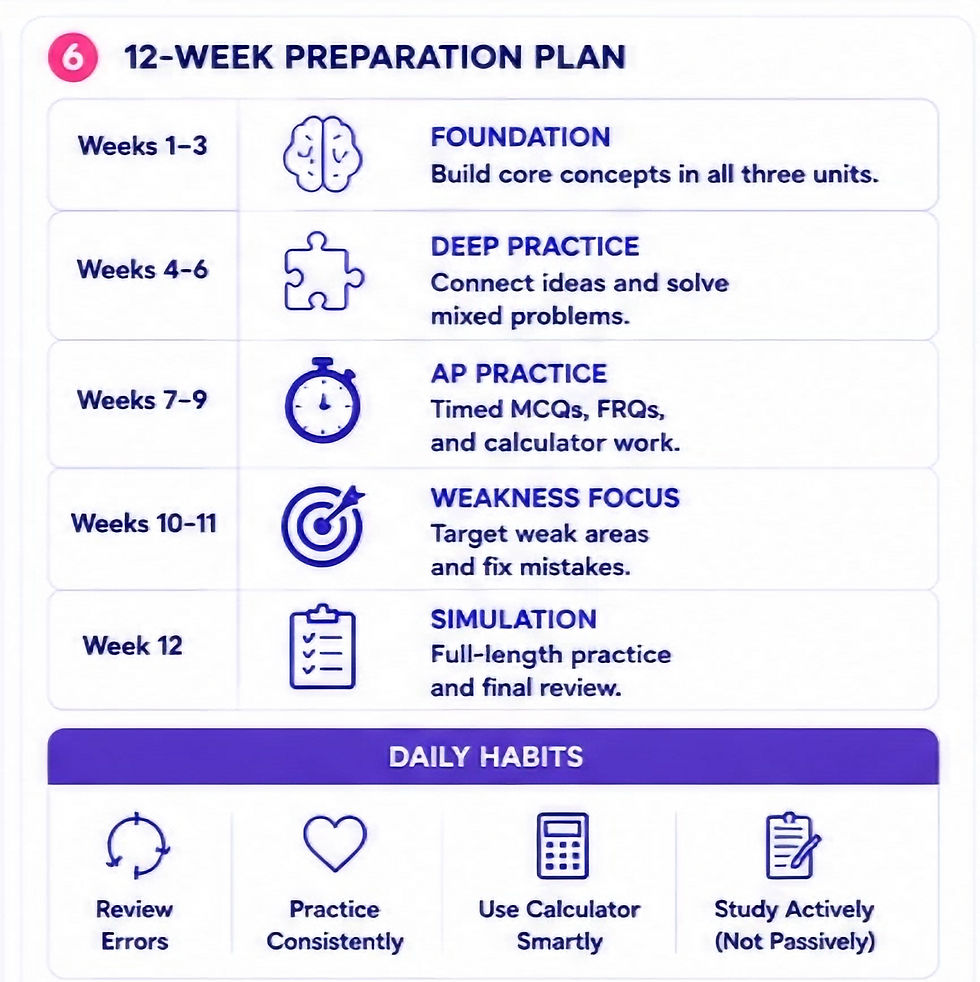
Then the tutoring plan can be divided into phases.
Phase 1: Foundation
Repair prerequisite mathematics.
Phase 2: Course Mastery
Work through current AP Precalculus content.
Phase 3: Application
Practice multi-representation and modeling problems.
Phase 4: AP Preparation
Work through AP-style questions and timed sets.
Phase 5: Final Review
Target the student's remaining weaknesses instead of reviewing everything equally.
This is much more efficient than giving every student the same worksheet.
Tutoring Should Follow the Student's School Schedule
One of the biggest advantages of online tutoring is flexibility.
If a student's class is currently studying exponential functions, tutoring should reinforce that topic.
If the student has a trigonometry test next week, tutoring should prioritize trigonometry.
If the student is preparing for the AP exam, the focus should gradually shift toward mixed-topic practice.
The tutor should be working with the student's academic calendar, not operating as an isolated course.
What Parents Should Look for in an AP Precalculus Tutor
Parents should ask more than:
“Do you teach AP Precalculus?”
Almost anyone can say yes.
Instead ask:
Does the tutor understand the current AP Precalculus framework?
Can they teach functions conceptually?
Can they work with graphs, tables and equations?
Do they understand modeling?
Can they prepare students for free-response reasoning?
Do they diagnose prerequisite gaps?
Will the student solve problems independently?
Is the instruction personalized?
Does the tutor track progress?
Can they explain difficult mathematics clearly?
The quality of the questions you ask before hiring a tutor can determine the quality of the tutoring experience.
Online Math Tutoring vs. AP Precalculus Test Prep
These aren't necessarily the same thing.
Tutoring focuses on learning.
Test preparation focuses on performance.
A strong AP Precalculus program should combine both.
If a student doesn't understand logarithms, doing 100 AP questions isn't the solution.
If a student understands everything but can't finish a timed section, more lectures aren't the solution.
The intervention needs to match the problem.
When Should Students Start AP Precalculus Tutoring?
There is no universal start date.
But waiting until the week before the AP exam is rarely ideal for a student with significant gaps.
A useful approach is:
Early year: Build foundations.
Middle of course: Reinforce difficult units.
Several months before exam: Begin mixed AP-style practice.
Final weeks: Focus on timing, weak areas and exam strategy.
Students who are already struggling should start earlier.
Students who are performing strongly may need tutoring only for targeted areas.
What If a Student Is Already Behind?
Don't immediately try to “cover everything.”
That often makes the problem worse.
Instead:
Step 1
Identify the highest-impact missing concept.
Step 2
Repair it.
Step 3
Connect it to the current course.
Step 4
Practice until the student can use it independently.
Step 5
Move to the next bottleneck.
This is essentially mathematical triage.
Not every weakness has equal importance.
A good tutor identifies which weaknesses are blocking the most progress.
What If the Student Is Already Getting an A?
An A doesn't automatically mean tutoring is unnecessary.
A high-performing student may want tutoring for:
Deeper conceptual understanding
AP-style problems
Competition-level thinking
Exam efficiency
Preparation for AP Calculus AB
Confidence with unfamiliar problems
The objective changes.
Instead of remediation, tutoring becomes acceleration and enrichment.
AP Precalculus as Preparation for AP Calculus
One of the strongest reasons to take AP Precalculus seriously is what comes next.

A student who understands:
Functions
Transformations
Composition
Inverses
Exponential functions
Logarithms
Trigonometry
Modeling
will enter calculus with a stronger foundation.
AP Calculus then introduces limits, derivatives, integration and applications of those ideas. College Board describes AP Calculus AB as equivalent to a first-semester college calculus course.
So AP Precalculus should not be viewed as a course to “get through.”
It should become the mathematical bridge to calculus.
The Difference Between Memorizing and Understanding
Consider transformations.
A student might memorize:
f(x)+k moves a graph upward.
That's useful.
But a stronger student understands the structural reason.
Then they can handle unfamiliar forms.
The same principle applies throughout AP Precalculus.
Memorization gives you a procedure.
Understanding gives you adaptability.
AP-style questions reward adaptability.
Why Personalized Feedback Matters
One of the biggest benefits of tutoring isn't simply explanation.
It's feedback.
A student may make the same mistake repeatedly without realizing it.
For example:
They may reverse a transformation.
Use degrees instead of radians.
Misinterpret a parameter.
Forget a domain restriction.
Misread a graph.
Give a numerical answer without interpretation.
A tutor can identify the pattern.
Once the pattern is visible, the student can correct it.
How IMRSB Approaches Online AP Precalculus Tutoring
At IMRSB, the goal isn't to turn tutoring into an answer-delivery service.

The goal is to build a student who can think mathematically.
Our approach centers on:
Conceptual understanding
Personalized instruction
Problem-solving
Mathematical communication
AP-style application
Targeted remediation
Confidence through mastery
And importantly, we don't believe every student needs the same number of tutoring hours.
The right amount depends on:
Current level
Course pace
Goals
Weaknesses
School expectations
AP exam timeline
The objective should always be progress, not simply accumulating tutoring hours.
How This Connects With Other IMRSB AP Resources
If you're preparing for AP Precalculus, don't treat every resource as a separate island.
Our related articles can work together as a learning sequence:
AP Precalculus
Then, as the student progresses:
AP Calculus AB
For personlised guidance with an IMRSB Math Tutor
Frequently Asked Questions
Is online tutoring effective for AP Precalculus?
It can be highly effective when the instruction is genuinely personalized. The value comes from targeted explanations, immediate feedback, prerequisite repair and practice—not simply from the fact that tutoring happens online.
What does an AP Precalculus tutor teach?
A tutor can help with polynomial and rational functions, exponential and logarithmic functions, trigonometric and polar functions, modeling, representations, problem-solving and AP exam preparation. The current College Board framework organizes the course into four units, with Units 1–3 assessed on the AP Exam.
Is AP Precalculus harder than regular precalculus?
That depends on the school and course, but AP Precalculus is designed as an introductory college-level course and places substantial emphasis on functions, modeling, representations and reasoning.
Does AP Precalculus prepare students for AP Calculus?
Yes. Strong AP Precalculus preparation can provide an important foundation for calculus by strengthening students' understanding of functions, algebra, trigonometry and mathematical modeling.
When should I start AP Precalculus tutoring?
Ideally before major gaps become entrenched. Students who are already doing well may need only targeted support, while students struggling with prerequisite mathematics may benefit from beginning earlier.
Can tutoring help a student get a 5?
Tutoring can help a student improve understanding, practice strategically and address weaknesses, but no tutor can guarantee a particular AP score. The student's preparation, effort and performance ultimately determine the result.
Should tutoring focus on homework or AP exam preparation?
Ideally both, depending on the student's needs. Homework can reveal conceptual gaps, while AP-style practice develops transfer, modeling, reasoning and timing.
Is online tutoring good for students who are already strong in math?
Yes. Strong students can use tutoring for deeper conceptual understanding, enrichment, advanced problem solving and preparation for AP Calculus.
Final Takeaway
AP Precalculus isn't simply the class that comes before calculus.
It is a course where students learn to see mathematics through functions, representations and models.
That is why students who struggle often don't need someone to simply give them more problems.
They need someone to identify what they don't yet understand.
The right online math tutor can help a student move from:
“I know the formula.”
to:
“I understand why it works.”
Then from:
“I can solve this example.”
to:
“I can recognize and solve a new problem.”
And finally from:
“I hope I get a good score.”
to:
“I know how to approach unfamiliar mathematics.”
That is the real purpose of AP Precalculus tutoring.
Learn the mathematics. Build the reasoning. Master the course. Prepare for what comes next.

Related IMRSB Guides
College Admissions
SAT Preparation
Advanced Placement
School Math
About IMRSB
At IMRSB, mathematics is not about memorizing procedures and hoping the next question looks familiar. Our approach focuses on:
Understanding → Reasoning → Representation → Application → Confidence
For AP Pre Calculus students, that means preparing not only for familiar calculus exercises, but also for the unfamiliar problems that separate procedural knowledge from genuine mathematical understanding.
Comments