Best Online Math Tutor for High School Students (2026): How to Choose the Right Tutor: 7 Things Parents Should Look For

Updated: Sep 10
A Complete Guide for Students and Parents

In this guide
Finding the best online math tutor for a high school student is not simply about choosing someone who knows mathematics. The right tutor should understand where a student is struggling, explain difficult concepts clearly, and adapt lessons to the student's individual needs.
Whether your child needs help with Algebra I, Algebra II, Geometry, Precalculus, AP Math, or is preparing for the SAT, the quality of instruction and the fit between student and tutor matter.
For parents, the challenge is knowing what to look for. Is the tutor experienced with the right math courses? Do they provide personalized 1:1 instruction? Can they identify learning gaps and track progress? Does the student feel comfortable asking questions?
This guide explains how to evaluate an online math tutor for high school students, compare different learning options, and choose tutoring support that matches your child's academic goals. Our best guide Best Online Math Tutor for Middle School Students did the same for Middle School Student
How to Find the Right Online Math Tutor for High School Students for Academic Success
Choosing an online math tutor can feel overwhelming.
There are thousands of tutors, hundreds of websites, and countless promises about improving grades or achieving perfect scores.
But the most important question isn't:
"Who is the best tutor?"
Instead, ask:
"Which tutor is the best fit for this student's learning style, goals, and academic needs?"
A great tutoring experience is built on expertise, communication, consistency, and a teaching approach that helps students develop confidence—not just complete homework.
This guide explains how students and parents can evaluate online math tutors thoughtfully and choose the support that best matches their goals.
Why Choosing the Right Tutor Matters
Online Math Tutor vs. Group Class vs. Self-Study
Choosing the right learning format depends on the student's academic needs, confidence, schedule, and learning style.
Learning Option | Best For | Main Advantage | Possible Limitation |
1:1 Online Math Tutor | Students needing personalized support | Lessons can adapt to the student's exact needs | Usually costs more than group learning |
Group Math Class | Students who enjoy structured classroom learning | Peer interaction and structured instruction | Less individual attention |
Self-Study | Independent and motivated students | Flexible pace and schedule | Students must identify and correct their own mistakes |
For students who are struggling with specific concepts, preparing for advanced mathematics, or need consistent individual feedback, 1:1 tutoring can provide a more targeted learning experience.
Self-study can also be valuable, particularly when combined with tutoring. A student can use independent practice to reinforce concepts while using tutoring sessions to address difficult topics, misconceptions, and problem-solving strategies.
The most effective choice is the format that matches the student's current needs rather than simply choosing the least expensive or most convenient option.
Mathematics builds on prior knowledge.
If a student develops gaps in foundational concepts, later topics often become more challenging.
A tutor can help by:
Explaining concepts in different ways.
Identifying learning gaps.
Building confidence.
Encouraging consistent practice.
Developing effective problem-solving strategies.
Preparing students for future coursework and examinations.
The right tutor supports understanding rather than memorization.
What Makes a Great Online Math Tutor?
Not every experienced mathematician is an effective teacher.
Strong tutors typically combine subject knowledge with the ability to explain ideas clearly and adapt to different learners.

Students often benefit from tutors who are:
Patient.
Well organized.
Encouraging.
Skilled at asking questions.
Comfortable teaching online.
Able to adjust lessons based on student progress.
Effective teaching is as much about communication as it is about content knowledge.
Need personalized math support?
Every student learns mathematics differently. IMRSB provides personalized 1:1 online math tutoring designed around a student's academic needs, whether they need support with high school math, advanced coursework, or exam preparation.
Different Students Need Different Tutors
There is no single tutoring style that works for everyone.
Before choosing an Online Math Tutor for High School Students, consider the student's goals and preferred learning style.
Student Profile 1 — Building Confidence
Some students understand mathematical ideas but lose confidence after making mistakes.
They may benefit from:
Positive reinforcement.
Step-by-step explanations.
Regular review.
Guided practice.
For these learners, confidence can be just as important as content knowledge.
Student Profile 2 — High Achievers
Students already performing well may seek tutoring to:
Deepen conceptual understanding.
Prepare for advanced courses.
Explore challenging problems.
Strengthen mathematical reasoning.
These students often benefit from enrichment rather than remediation.
Student Profile 3 — Preparing for Exams
Students preparing for:
SAT Math
AP Precalculus
AP Calculus AB
AP Calculus BC
School examinations
may require structured review, timed practice, and targeted feedback aligned with the exam format.
Student Profile 4 — Students With Learning Gaps
Some learners struggle because earlier concepts were never fully understood.
For these students, effective tutoring often involves:
Revisiting prerequisite topics.
Strengthening foundational skills.
Gradually increasing difficulty.
Connecting new ideas to familiar concepts.
Addressing foundational gaps can make advanced topics more approachable.
Our guide on Online Math Tutoring for Algebra, Online Math Tutoring for Geometry and Online Math Tutoring for Algebra II tells parents exaclty how to choose and decide better.
One-to-One Tutoring vs Group Learning
Different instructional formats suit different students.

One-to-One Tutoring
Often provides:
Personalized pacing.
Immediate feedback.
Flexible scheduling.
Lessons adapted to individual needs.
Students who require targeted support or have specific goals may appreciate this individualized approach.
Group Classes
Group learning may offer:
Structured lessons.
Opportunities for peer discussion.
Lower cost per student.
A classroom-style environment.
Some students enjoy learning alongside others, while others prefer individualized attention.
Qualities to Look For During a Trial Lesson
A trial lesson can reveal much more than a tutor's résumé.
Consider questions such as:
Does the tutor explain concepts clearly?
Are questions encouraged?
Does the student feel comfortable asking for help?
Is the lesson well organized?
Does the tutor adapt explanations when something isn't understood?
Is the session engaging rather than simply a lecture?
The student's experience during the lesson is often one of the best indicators of long-term success.
How Online Math Tutoring Works
Online tutoring has evolved significantly over the past decade.
Today's lessons often use interactive digital tools that allow students and tutors to solve problems together in real time, share notes, review previous work, and revisit challenging concepts.
When designed thoughtfully, online tutoring can provide a structured and engaging learning experience without requiring students to travel.
A Typical Online Lesson
Although every tutor has a different teaching style, many effective sessions follow a similar structure:
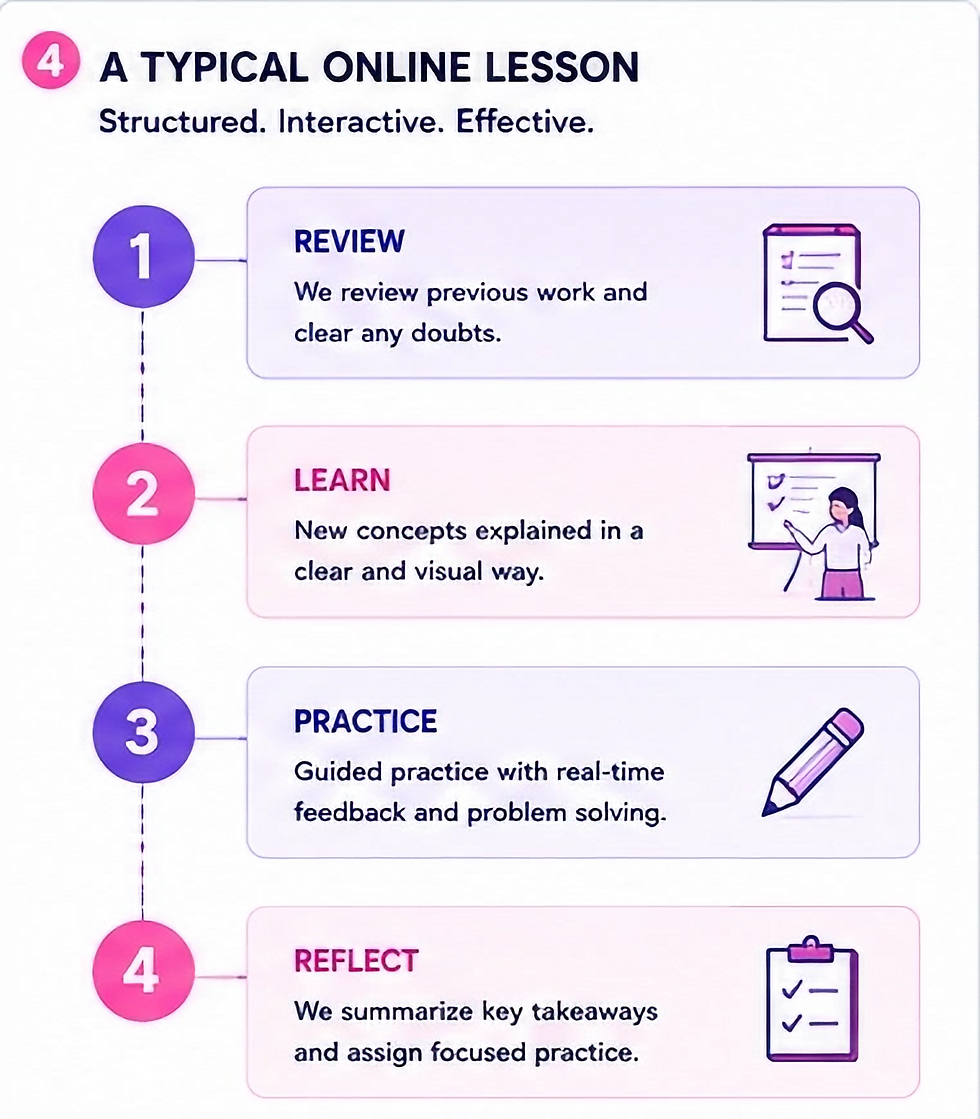
1. Review Previous Learning
Students revisit homework, clarify doubts, and reinforce key concepts before moving to new material.
2. Learn New Concepts
Rather than memorizing formulas, students explore:
Why mathematical rules work.
Multiple solution methods.
Common misconceptions.
Connections between different topics.
Understanding the reasoning behind mathematics often leads to stronger long-term retention.
3. Guided Practice
Students solve progressively challenging problems while receiving immediate feedback.
Instead of simply giving answers, effective tutors encourage students to explain their thinking and develop independent problem-solving skills.
4. Reflection and Homework
At the end of each lesson, students review what they have learned and identify areas for further practice.
Homework reinforces concepts and provides direction for the next session.
The Importance of Personalized Learning
One of the greatest advantages of one-to-one tutoring is personalization.
Instead of following a fixed curriculum, lessons can adapt to each student's needs.
For example:
Student A
Needs additional practice with:
Factoring
Quadratic equations
Functions
The tutor may spend several lessons strengthening these foundations before moving ahead.
Student B
Already understands Algebra but needs support with Calculus.
Lessons can focus primarily on advanced topics without spending unnecessary time reviewing familiar material.
Personalized instruction helps students spend more time where they need it most.
Beyond Homework Help
Many people think tutoring is only for completing homework.
In reality, effective tutoring often focuses on developing long-term mathematical understanding.
Students may work on:
Problem-solving strategies.
Logical reasoning.
Mathematical communication.
Exam preparation.
Confidence under timed conditions.
Independent thinking.
The goal is to help students become more confident learners, not simply finish assignments.
Technology That Supports Learning
Modern online tutoring may include tools such as:
Interactive digital whiteboards.
Screen sharing.
Shared documents.
Graphing software.
Online calculators where appropriate.
Practice platforms.
Recorded notes for later review.
These resources can make mathematical ideas easier to visualize and revisit after the lesson.
Technology is most effective when it supports learning rather than distracting from it.
Cost vs Educational Value
Families naturally consider cost when selecting a tutor.
However, educational value depends on more than the hourly rate.

Factors worth considering include:
Teaching quality.
Student engagement.
Personalized instruction.
Consistency.
Communication.
Progress over time.
A tutoring program that matches the student's learning needs may provide greater long-term value than one chosen solely because it is less expensive.
Questions Every Parent Should Ask Before Hiring a Tutor
Before making a decision, consider asking:

About Teaching
How do you explain difficult concepts?
How do you adapt lessons for different learners?
How do you measure progress?
About Experience
Which mathematics courses do you teach?
Have you worked with students at this level before?
Do you prepare students for SAT or AP Mathematics if needed?
About Communication
How often do you provide progress updates?
What should students do between lessons?
How are homework and practice assignments handled?
About Expectations
What level of commitment is expected from the student?
How should families support learning outside tutoring sessions?
These questions help families evaluate teaching philosophy rather than relying only on marketing claims.
Common Mistakes When Choosing an Online Math Tutor
Mistake 1 — Choosing Only Based on Price
Lower cost does not always provide better value, and higher cost does not guarantee better teaching.
Focus on the quality of instruction and how well the tutor fits the student's needs.
Mistake 2 — Looking Only at Qualifications
Academic credentials are important, but the ability to explain mathematics clearly is equally essential.
Excellent tutors combine subject expertise with strong communication skills.
Mistake 3 — Expecting Instant Results
Mathematical understanding develops over time.
Steady improvement through regular practice is generally more sustainable than expecting dramatic changes after only a few lessons.
Mistake 4 — Ignoring Student-Tutor Compatibility
A supportive learning environment often depends on good communication and mutual understanding.
Students who feel comfortable asking questions are more likely to engage actively during lessons.
Mistake 5 — Treating Tutoring as a Replacement for Independent Study
Tutoring is most effective when combined with consistent practice outside scheduled sessions.
Students continue developing skills by solving problems independently and reviewing previous work.
Frequently Asked Questions (FAQ)
1. When should a high school student start working with a math tutor?
There is no universal timeline.
Some students begin tutoring when they encounter a challenging topic, while others seek support before major examinations such as the SAT, AP courses, or final school exams.
Students who start earlier often have more time to strengthen foundational concepts and build confidence gradually.
2. Is online tutoring as effective as in-person tutoring?
Many students learn successfully through online tutoring, especially when lessons are interactive and supported by digital teaching tools.
The effectiveness of tutoring usually depends more on the quality of instruction, student engagement, and consistent practice than on whether lessons are online or face-to-face.
3. How many tutoring sessions should a student have each week?
The ideal schedule varies depending on:
Academic goals.
Current performance.
School workload.
Upcoming examinations.
Time available for independent practice.
A regular, sustainable schedule combined with self-study is generally more effective than irregular intensive sessions.
4. Which math subjects can an online tutor help with?
Many online tutors support a wide range of high school mathematics, including:
Pre-Algebra
Algebra I
Geometry
Algebra II
Precalculus
Calculus
Statistics
SAT Math
AP Precalculus
AP Calculus AB
AP Calculus BC
Students should confirm that the tutor has experience with the specific curriculum or examination they are preparing for.
5. What if my child is afraid to ask questions?
A supportive tutor creates an environment where students feel comfortable making mistakes and asking questions.
Learning mathematics often requires trying different approaches, identifying misunderstandings, and developing confidence through practice.
6. Can tutoring help high-achieving students?
Yes.
Tutoring is not only for students who are struggling.
High-performing students may seek additional challenge, deeper conceptual understanding, competition preparation, or support for advanced courses and university admissions.
7. Should parents attend tutoring sessions?
This depends on the student's age and preferences.
Many parents find it helpful to receive periodic progress updates while allowing the student to work independently during lessons.
Clear communication between the tutor, student, and family supports long-term success.
8. How do I know if tutoring is working?
Rather than focusing only on grades, look for broader indicators of progress, such as:
Greater confidence.
Improved problem-solving.
Fewer repeated mistakes.
Increased willingness to attempt challenging questions.
Better study habits.
Consistent academic growth over time.
These signs often appear before major improvements in test scores.
Parent's Checklist Before Choosing an Online Math Tutor
Before making a decision, ask yourself:

☐ Does the tutor explain concepts clearly?
☐ Does my child feel comfortable asking questions?
☐ Is the teaching style appropriate for my child's learning needs?
☐ Does the tutor encourage understanding instead of memorization?
☐ Is there a structured learning plan?
☐ Will progress be reviewed regularly?
☐ Does the tutor adapt lessons based on strengths and weaknesses?
☐ Can the schedule fit alongside school and extracurricular activities?
☐ Is there a long-term strategy rather than simply preparing for the next homework assignment?
Key Takeaways
1. The Best Tutor Is the Right Tutor
There is no universally "best" online math tutor.
The most effective tutor is the one whose teaching style, expertise, and communication match the student's goals and learning preferences.
2. Understanding Comes Before Speed
Strong mathematical performance is built through conceptual understanding.
Students who understand why methods work are often better prepared to solve unfamiliar problems than those who rely primarily on memorization.
3. Personalized Learning Can Improve Efficiency
Individualized lessons allow tutors to focus on each student's specific strengths and areas for improvement.
This targeted approach can make study time more productive.
4. Consistency Builds Confidence
Regular practice, thoughtful feedback, and steady progress often contribute more to long-term success than occasional intensive study sessions.
Small improvements accumulated over time can lead to significant academic growth.
5. Tutoring Is Part of a Bigger Learning Journey
An effective tutor supports not only grades and test scores but also confidence, curiosity, resilience, and independent learning skills that continue to benefit students beyond high school.
Looking for personalized support in mathematics?
Explore IMRSB's resources for Algebra, Geometry, Precalculus, Calculus, SAT Math, and AP Mathematics.
Whether you're strengthening foundational skills or preparing for advanced coursework, our goal is to help students learn with confidence and clarity.
Final Verdict
Finding the best online math tutor is not about selecting the tutor with the most advertisements or the longest list of credentials.

Instead, look for a tutor who:
Understands your academic goals.
Explains mathematics clearly.
Encourages questions.
Adapts lessons to your learning style.
Provides consistent guidance and constructive feedback.
The right tutor does more than improve grades—they help students become confident, independent learners who are prepared for future academic challenges.
Related IMRSB Guides
College Admissions
How to get into an Ivy League
SAT Preparation
Advanced Placement
School Math
About IMRSB
At IMRSB, we believe that mathematics is more than a school subject—it is a way of developing logical reasoning, confidence, and problem-solving skills that support success across many disciplines.
Our tutoring philosophy emphasizes conceptual understanding, personalized learning, and consistent progress, helping students build strong mathematical foundations while preparing for school coursework, standardized tests, and Advanced Placement programs.
Comments