Complete Algebra I Guide (2026): Topics, Study Plan, Skills & Success Guide

Updated: Jul 31
Build the Foundation for Every Higher-Level Math Course

In this guide
Everything You Need to Know Before Learning Advanced Mathematics
Algebra I is one of the most important mathematics courses you'll ever study.
It introduces the language of mathematics and provides the foundation for Geometry, Algebra II, Precalculus, Calculus, SAT Math, AP courses, college mathematics, and countless real-world applications.
Whether you're beginning Algebra I, reviewing key concepts, or preparing for future math courses, this guide will help you understand the big picture and build lasting confidence.
What Is Algebra I?
Algebra I is the transition from arithmetic to mathematical reasoning.
In arithmetic, you work primarily with known numbers.
In Algebra I, you begin working with variables, patterns, relationships, and functions.
Instead of simply calculating answers, you'll learn how to represent situations mathematically, solve unknowns, analyze relationships, and explain your reasoning.
This shift develops logical thinking that extends well beyond mathematics.
Why Is Algebra I Important?
Almost every advanced mathematics course depends on Algebra I.
Without a solid understanding of Algebra I, students often struggle later with:
Geometry
Algebra II
Precalculus
Calculus
Statistics
SAT Math
ACT Math
AP Mathematics
College STEM courses
Think of Algebra I as the foundation of a building. A strong foundation supports everything built above it.
Who Should Study Algebra I?
This guide is designed for:
Middle school students preparing for Algebra I.
High school students currently taking Algebra I.
Students reviewing concepts before Geometry or Algebra II.
Parents supporting their children.
Adult learners refreshing mathematical foundations.
No matter your starting point, mastering Algebra I creates opportunities for future learning.
What Will You Learn in Algebra I?
Algebra I introduces several core ideas that appear throughout mathematics.

Variables and Expressions
You'll learn how letters can represent unknown values and how expressions model real-world situations.
These ideas are the building blocks of algebraic thinking.
Equations
Equations express relationships between quantities.
Students learn how to solve equations systematically while understanding why each step works.
Inequalities
Unlike equations, inequalities compare values rather than declaring them equal.
You'll learn how to interpret and solve problems involving greater than, less than, and other comparison relationships.
Functions
Functions describe how one quantity changes as another changes.
Functions are central to nearly every area of mathematics, science, engineering, economics, and computer science.
Graphing
Graphs provide a visual representation of mathematical relationships.
Students learn how to interpret graphs, identify patterns, and connect equations with visual models.
Systems of Equations
Many real-world situations involve multiple relationships at once.
Students learn methods for solving systems and interpreting what their solutions mean.
Exponents
Exponents provide an efficient way to represent repeated multiplication and prepare students for exponential growth, scientific notation, and later courses.
Polynomials
Students explore algebraic expressions with multiple terms, learning how to simplify, factor, and analyze them.
These concepts become increasingly important in Algebra II and Calculus.
Quadratic Relationships
Toward the end of Algebra I, students are introduced to quadratic functions and how they differ from linear relationships.
This serves as a bridge to more advanced mathematics.
Skills You'll Develop
Algebra I develops far more than computational ability.
Throughout the course, you'll strengthen skills such as:
Logical reasoning
Pattern recognition
Problem solving
Mathematical communication
Critical thinking
Data interpretation
Analytical decision making
These abilities are valuable in school, work, and everyday life.
Real-World Applications of Algebra I
Algebra appears in more places than many people realize.

It is used in:
Personal finance and budgeting
Business and entrepreneurship
Computer programming
Engineering
Architecture
Healthcare
Data analysis
Economics
Sports analytics
Artificial intelligence
Learning Algebra I equips you with a versatile problem-solving toolkit that applies across many careers and disciplines.
Your Algebra Journey
Algebra I is not an endpoint—it's the beginning of a larger mathematical journey.
A typical progression looks like this:
Pre-Algebra → Algebra I → Geometry → Algebra II → Precalculus → Calculus → Advanced Mathematics
Each stage builds on the understanding developed in the previous one, making a strong Algebra I foundation especially valuable.

Algebra I Course Roadmap
Algebra I is designed to help students think mathematically by gradually introducing more sophisticated ideas. Each topic builds upon the previous one, creating a strong foundation for future courses.
Rather than viewing Algebra I as a collection of unrelated chapters, it's helpful to see it as one connected learning journey.
Phase 1 — Understanding Variables
Students begin by learning how letters can represent unknown quantities. Variables allow us to describe patterns, relationships, and real-world situations using mathematical language.
You'll learn to:
Interpret variables
Simplify expressions
Translate words into mathematical expressions
Recognize mathematical patterns
Phase 2 — Solving Equations
Once variables are understood, students learn how to determine unknown values by solving equations.
This develops logical reasoning and introduces the idea that every mathematical step should preserve balance.
Key concepts include:
One-step equations
Multi-step equations
Equations with variables on both sides
Literal equations
Word problems
Phase 3 — Understanding Inequalities
Real-world situations often involve ranges rather than exact values.
For example:
A speed limit is less than a certain value.
A minimum age is greater than or equal to a requirement.
A budget is at most a fixed amount.
Students learn how to represent and interpret these relationships mathematically.
Phase 4 — Graphing Linear Relationships
One of Algebra I's biggest milestones is connecting equations with graphs.
Instead of seeing mathematics only as numbers and symbols, students begin to visualize relationships.
Topics include:
Coordinate Plane
Ordered Pairs
Slope
Intercepts
Linear Graphs
Rate of Change
This visual perspective prepares students for higher-level mathematics.
Phase 5 — Understanding Functions
Functions describe how one quantity depends on another.
This idea appears throughout nearly every future math course.
Students begin asking questions such as:
What happens when one value changes?
Can every input have only one output?
How can we represent relationships using tables, graphs, equations, and words?
Learning functions changes the way students think about mathematics.
Phase 6 — Systems of Equations
Many real-world problems involve multiple relationships simultaneously.
Students learn how to analyze situations with more than one equation and interpret the meaning of their solutions.
Applications include:
Business
Transportation
Population growth
Finance
Science
Phase 7 — Exponents and Exponential Relationships
Repeated multiplication introduces exponential thinking.
Students begin exploring:
Exponents
Powers
Scientific notation
Exponential growth
Exponential decay
These ideas later become essential in Algebra II and Precalculus.
Phase 8 — Polynomials
Polynomials extend earlier algebraic ideas into more complex expressions.
Students learn how to:
Simplify expressions
Combine like terms
Multiply expressions
Factor polynomials
Recognize mathematical structure
These skills support future work in quadratic functions and calculus.
Phase 9 — Quadratic Thinking
Near the end of Algebra I, students encounter quadratic relationships.
Unlike straight-line (linear) relationships, quadratic functions create curved graphs and model many real-world situations such as projectile motion and optimization.
This unit serves as an introduction to concepts that will be explored much more deeply in Algebra II.

Common Challenges Students Face
Algebra I introduces new ways of thinking, so it's normal to encounter difficulties.
Common challenges include:
Thinking Algebra Is Just Memorization
Successful students focus on understanding ideas instead of memorizing isolated procedures.
Rushing Through Problems
Many mistakes occur because students skip steps or work too quickly.
Writing each step clearly often improves both accuracy and understanding.
Ignoring Graphs
Equations and graphs describe the same relationships from different perspectives.
Learning to connect them strengthens mathematical intuition.
Practicing Only Easy Problems
Growth happens when students attempt unfamiliar questions and reflect on their mistakes.
Losing Confidence After Mistakes
Mistakes are an expected part of learning mathematics.
Every incorrect answer provides information about what to review and improve.

Study Strategies for Success
Students who perform well in Algebra I usually develop consistent study habits.
Practice Regularly
Short, consistent practice sessions are often more effective than long, infrequent study sessions.
Focus on Understanding
Ask yourself:
Why does this method work?
Can I explain it in my own words?
Can I solve a similar problem?
Review Mistakes
Instead of simply checking whether an answer is correct, identify why an error occurred.
This habit helps prevent repeating the same mistake.
Connect New Ideas
Whenever you learn a new concept, think about how it relates to previous topics.
Mathematics becomes easier when you see connections rather than isolated chapters.
Use Multiple Representations
Practice expressing ideas through:
Words
Tables
Graphs
Equations
Real-world examples
Being able to move between these representations builds flexibility and deeper understanding.

Why Algebra I Matters Beyond School
Algebra I is often described as the language of mathematics because it teaches students how to model relationships and solve problems logically.
These skills are valuable in many careers, including:
Engineering
Computer Science
Data Science
Artificial Intelligence
Finance
Economics
Architecture
Medicine
Physics
Business
Game Development
Robotics
Environmental Science
Even outside STEM, the logical reasoning developed in Algebra I supports better decision-making and analytical thinking.
Frequently Asked Questions (FAQ)
1. Is Algebra I difficult?
For many students, Algebra I feels different because it introduces variables, equations, and abstract thinking instead of working only with numbers.
With consistent practice and a focus on understanding concepts rather than memorizing steps, most students can build confidence and succeed.
2. Why is Algebra I considered so important?
Algebra I is the foundation for nearly every advanced mathematics course.
The concepts you learn here will appear again in:
Geometry
Algebra II
Precalculus
Calculus
Statistics
SAT Math
AP Mathematics
College STEM courses
A strong foundation in Algebra I makes future learning significantly easier.
3. What should I know before starting Algebra I?
Students benefit from being comfortable with:
Whole numbers
Fractions
Decimals
Percentages
Basic arithmetic operations
Order of operations
These skills provide a strong starting point for learning algebraic concepts.
4. How much should I practice?
Consistency matters more than long study sessions.
A practical goal is:
20–30 minutes per day for review and practice.
Longer sessions when preparing for major assessments.
Regular practice helps reinforce concepts and improve problem-solving confidence.
5. What is the biggest mistake students make?
One common mistake is treating Algebra I as a subject to memorize.
Instead of asking:
"Which formula should I use?"
Ask:
"Why does this method work?"
Understanding the reasoning behind each step leads to stronger long-term learning.
6. Will Algebra I help outside the classroom?
Yes.
Algebra develops logical reasoning and analytical thinking that are useful in everyday life and many careers, from budgeting and data interpretation to programming and engineering.
7. How should I prepare for Geometry after Algebra I?
Focus on mastering:
Linear equations
Functions
Graphing
Coordinate geometry
Mathematical reasoning
These topics provide a strong bridge into Geometry.
8. Is Algebra I enough for the SAT?
Algebra I forms a large part of SAT Math, but students should also study Geometry, Algebra II, Advanced Math, Problem Solving & Data Analysis, and other SAT-specific topics.
Algebra I Success Checklist
By the end of Algebra I, you should feel confident that you can:
☐ Understand variables and algebraic expressions.
☐ Solve one-step and multi-step equations.
☐ Interpret and solve inequalities.
☐ Graph linear equations.
☐ Understand the meaning of slope and intercepts.
☐ Recognize and analyze functions.
☐ Solve systems of equations.
☐ Work with exponents and exponential relationships.
☐ Simplify and factor basic polynomials.
☐ Understand introductory quadratic relationships.
Key Takeaways
1. Build Strong Foundations
Every advanced mathematics course depends on Algebra I. Taking the time to understand these ideas now will make future learning easier.
2. Focus on Understanding
Rather than memorizing isolated procedures, aim to understand the reasoning behind each concept. This creates deeper and more lasting mathematical confidence.
3. Practice Consistently
Small, regular study sessions are more effective than trying to learn everything at once. Consistency leads to steady improvement.
4. Learn From Mistakes
Mistakes are a normal part of learning mathematics. Reviewing and understanding them is one of the best ways to grow.
5. Connect Ideas
Mathematics is a connected subject. Seeing how variables, equations, graphs, and functions relate to one another makes problem solving more intuitive.
Where Algebra I Leads Next
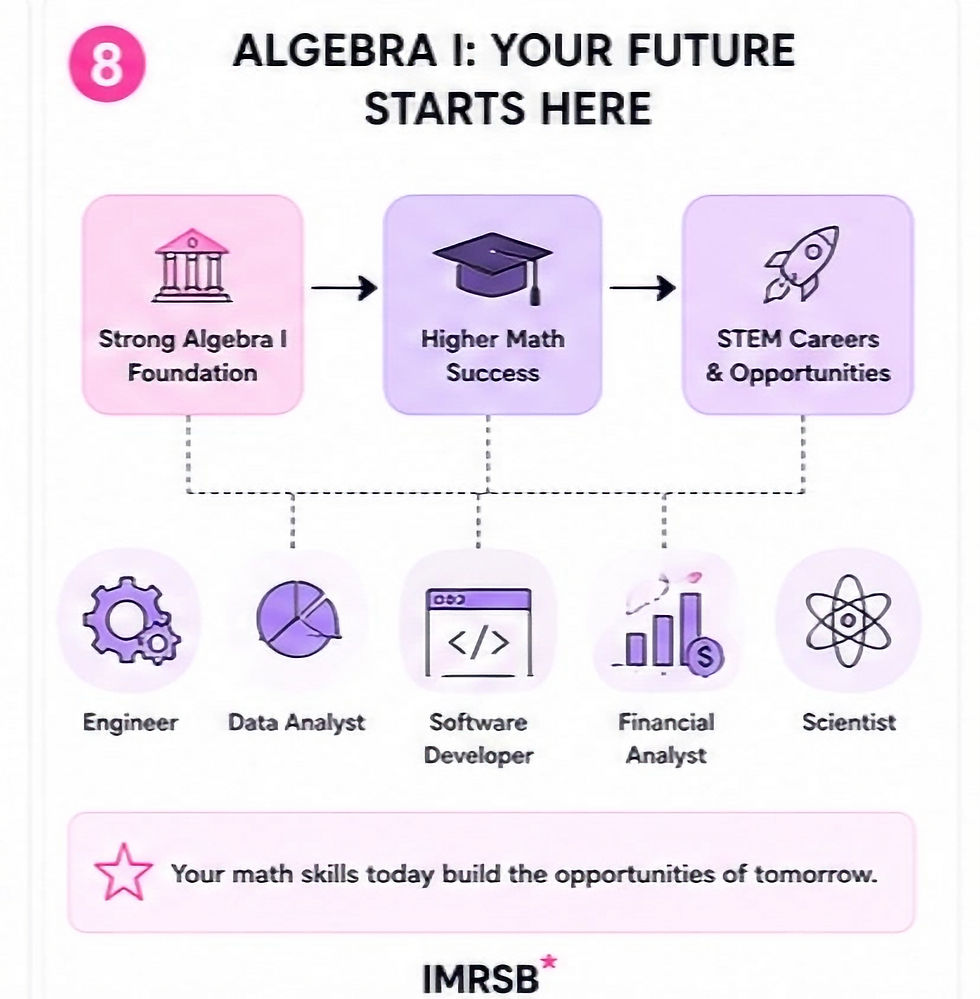
Once you've completed Algebra I, the next stage is to continue building your mathematical foundation.
A common learning path is:
Pre-Algebra → Algebra I → Geometry → Algebra II → Precalculus → Calculus → Advanced Mathematics
Each course introduces new ideas while reinforcing and expanding concepts from previous courses.
Ready to Improve Your Algebra I Score?
Book a free 30 minute evaluation with an IMRSB expert.
We'll identify your strengths, weaknesses, and create a personalized AP preparation plan.

Related IMRSB Guides
Continue your learning with these resources:
Mathematics
College Preparation
Advanced Placement
About IMRSB
At IMRSB, we believe mathematics should be understandable, approachable, and connected to real learning—not just memorization.
Every guide is designed around a consistent framework:
Understand the concept.
See the big picture.
Connect ideas.
Practice with purpose.
Learn from mistakes.
Build confidence over time.
Whether you're preparing for school, standardized tests, or future STEM studies, our goal is to help you develop a strong and lasting mathematical foundation.
Final Conclusion
Algebra I is much more than a single mathematics course—it is the beginning of mathematical thinking.
By learning how to represent relationships, solve problems logically, and interpret patterns, you gain skills that extend into higher mathematics and many real-world situations.
Approach each topic with curiosity, practice regularly, and don't be discouraged by challenges. Every concept you master in Algebra I becomes a building block for future success.
Your journey doesn't stop here.
After building a strong Algebra I foundation, continue exploring mathematics with IMRSB by moving to the Geometry Guide, where you'll learn how shapes, space, and logical reasoning come together to solve real-world problems.
Keep learning, stay consistent, and enjoy the process of discovering mathematics.
Comments