AP Precalculus Guide (2026): Complete Course, Exam, Units, Study Plan & Practice Questions

Updated: Jul 29
Complete AP Precalculus Guide (2026

In this guide
Complete AP Precalculus Guide (2026)
Everything You Need to Know About the AP Precalculus Course and Exam
Whether you're preparing for the AP Precalculus exam, deciding if the course is right for you, or building a strong foundation for AP Calculus, this guide explains everything you need to know—from course units and exam structure to study strategies, practice questions, and college credit.
Learning Objectives
After reading this guide, you'll be able to:
Understand what AP Precalculus is.
Know exactly what topics are covered.
Understand the AP exam format.
Build an effective study plan.
Decide whether AP Precalculus is right for you.
Prepare confidently for college-level mathematics.
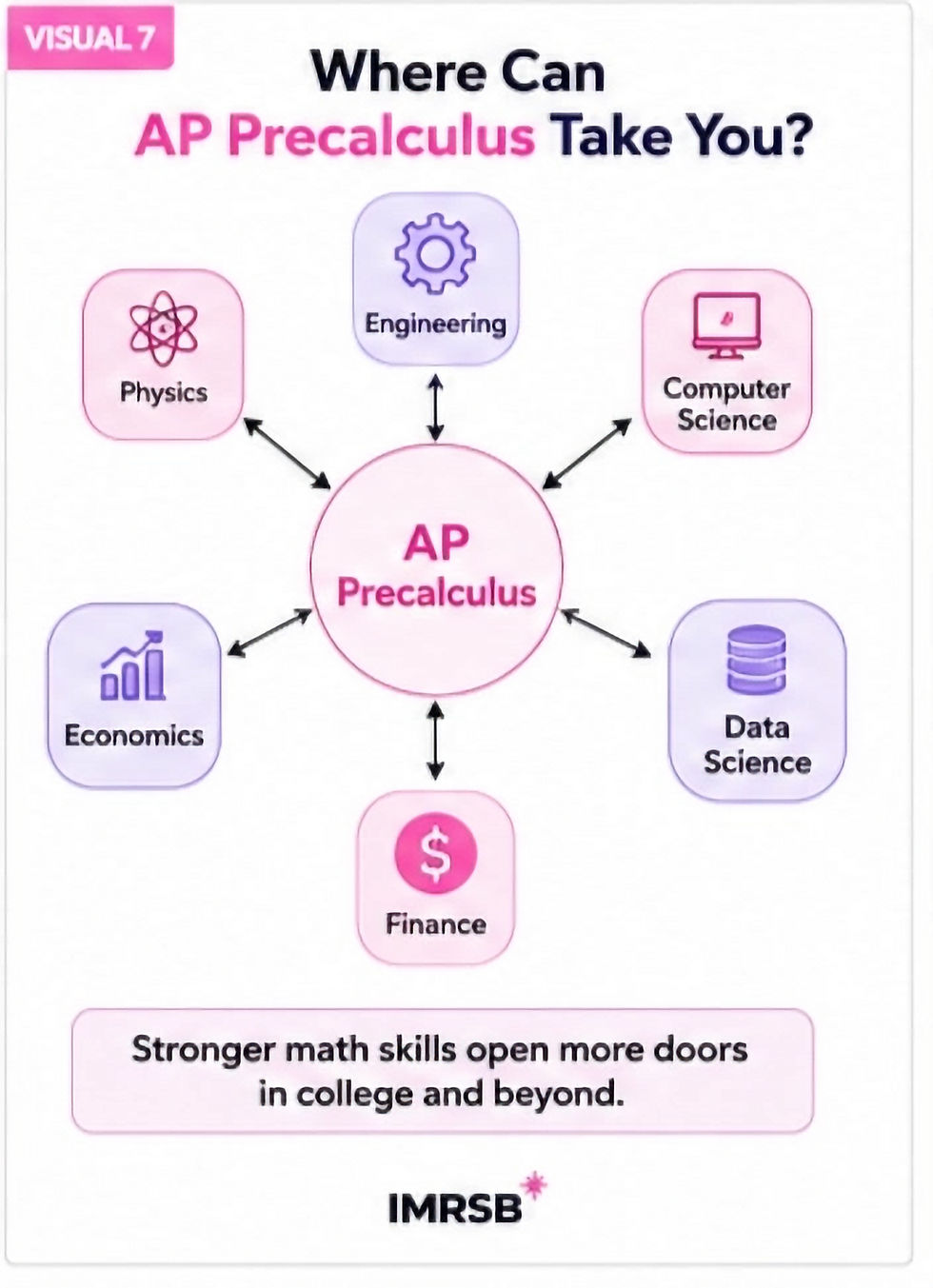
AP Precalculus is a college-level mathematics course designed by the College Board that prepares students for future coursework in calculus, statistics, computer science, economics, engineering, physics, and other STEM fields.
The course focuses on understanding functions, mathematical modeling, rates of change, and trigonometry. Rather than emphasizing memorization, AP Precalculus encourages students to analyze relationships, interpret graphs, and solve real-world problems.
It serves as a bridge between Algebra II and AP Calculus, helping students develop the mathematical reasoning skills needed for more advanced study.

Who Should Take AP Precalculus?
AP Precalculus is well suited for students who:
Enjoy mathematics and problem solving.
Have successfully completed Algebra II or an equivalent course.
Plan to study STEM, economics, business, data science, or related fields.
Want to strengthen their college applications with rigorous coursework.
Intend to continue to AP Calculus AB or AP Calculus BC.
Even students who do not plan to take calculus can benefit from the modeling and analytical skills developed in AP Precalculus.
Why Take AP Precalculus?
Students choose AP Precalculus for several reasons:
Build a Strong Mathematical Foundation
The course develops the algebraic, graphical, and analytical thinking required for higher-level mathematics.
Prepare for AP Calculus
Concepts such as functions, transformations, trigonometry, and rates of change appear throughout AP Calculus.
A solid understanding of these topics makes the transition much smoother.
Develop Real-World Problem Solving Skills
Students learn to model situations involving:
Population growth
Financial mathematics
Periodic motion
Exponential change
Optimization
Scientific data
Strengthen College Applications
Completing challenging mathematics courses demonstrates academic preparation and persistence.
Admissions decisions consider many factors, but rigorous coursework can be a positive signal of readiness for college-level study.
Quick Facts
Feature | Details |
Course Level | College-level |
Developed By | College Board |
Recommended Prerequisite | Algebra II |
Calculator | Graphing calculator required for some tasks |
Main Focus | Functions, Modeling, Trigonometry |
Final Exam | AP Precalculus Exam |
What Will You Learn?
Throughout the course, you'll study how different types of functions behave, how they can model real-world situations, and how graphs, equations, and tables represent the same mathematical relationships.
The course emphasizes multiple representations of mathematical ideas rather than solving problems in only one way.
The Four Big Ideas
The AP Precalculus course is organized around several interconnected mathematical themes.
1. Functions
You'll explore:
Function notation
Domain and range
Transformations
Inverses
Composition
Piecewise functions
Functions are the foundation of nearly every topic in the course.
2. Polynomial and Rational Functions
You'll investigate:
Factoring
Zeros
End behavior
Graphs
Asymptotes
Rational expressions
Understanding how these functions behave helps explain many real-world phenomena.
3. Exponential and Logarithmic Functions
Topics include:
Exponential growth
Exponential decay
Compound interest
Natural logarithms
Logarithmic properties
Solving exponential equations
These models appear in finance, biology, chemistry, economics, and data science.
4. Trigonometric Functions
Students learn:
Unit circle
Radian measure
Trigonometric graphs
Trigonometric identities
Periodic behavior
Modeling with sine and cosine
Trigonometry provides the mathematical language for describing waves, rotations, oscillations, and cycles.
AP Precalculus Course Units Explained
Understanding the structure of the course is one of the best ways to prepare effectively. Instead of thinking of AP Precalculus as a collection of unrelated topics, think of it as a progression: each unit builds on the ideas introduced in the previous one.

Unit 1 — Polynomial and Rational Functions
This unit explores functions that appear throughout algebra and higher mathematics. Students learn not only how to solve equations but also how to understand the behavior of graphs.
Topics Covered
Polynomial functions
Degree of a polynomial
Factoring techniques
Zeros and roots
Multiplicity
End behavior
Turning points
Rational functions
Vertical asymptotes
Horizontal asymptotes
Holes in graphs
Real-World Applications
Polynomial models are used in:
Business profit analysis
Engineering design
Population modeling
Computer graphics
Manufacturing optimization
Unit 2 — Exponential and Logarithmic Functions
Many real-world processes change at rates that are proportional to their current value. These situations are modeled using exponential functions.
Examples include:
Population growth
Radioactive decay
Compound interest
Disease spread
Investment growth
Topics Covered
Exponential growth
Exponential decay
Compound interest
Natural exponential functions
Logarithms
Properties of logarithms
Solving exponential equations
Solving logarithmic equations
Why This Matters
Exponential models appear throughout:
Finance
Biology
Economics
Environmental science
Data science
Understanding these models helps students analyze changing quantities over time.
Unit 3 — Trigonometric and Polar Functions
Trigonometry extends beyond right triangles. In AP Precalculus, students learn how trigonometric functions describe periodic behavior and rotational motion.
Topics Covered
Radian measure
Unit circle
Sine function
Cosine function
Tangent function
Graphs of trigonometric functions
Amplitude
Period
Phase shift
Polar coordinates
Modeling periodic phenomena
Unit 4 — Functions Involving Parameters, Vectors, and Matrices (where included by course emphasis)
This part of the course strengthens students' ability to analyze mathematical models and solve systems using different representations.
Depending on classroom emphasis, students may encounter introductory ideas involving vectors or matrices as tools for modeling relationships. (Always follow your teacher's syllabus and the official AP course framework.)
Skills Developed
Interpreting mathematical models
Comparing different representations
Analyzing parameters
Connecting equations, tables, and graphs
Communicating mathematical reasoning clearly
AP Precalculus Skills You'll Develop
Success in AP Precalculus is about more than learning formulas.
The course develops mathematical thinking.
By the end of the course, students should be able to:
Analyze Functions
Instead of simply plotting points, you'll explain why graphs behave the way they do.
Connect Multiple Representations
Every function can be represented as:
An equation
A graph
A table
A real-world situation
Strong students move comfortably between all four.
Build Mathematical Models
Real-world problems rarely provide perfect equations.
You'll learn how to create mathematical models from data and interpret what the results mean.
Use Technology Effectively
Graphing technology is part of modern mathematics.
You'll learn when calculators are helpful—and when algebraic reasoning is the better approach.
How AP Precalculus Differs from Algebra II
Many students ask whether AP Precalculus is simply "harder Algebra II."
The answer is no.
Algebra II | AP Precalculus |
Focuses on solving equations | Focuses on analyzing functions |
Procedural practice | Conceptual understanding |
Individual skills | Connecting multiple ideas |
Mostly algebraic manipulation | Algebra, graphs, modeling, interpretation |
Foundation course | College-level course |
The shift is from "How do I solve this?" to "What does this function tell me, and how can I use it?"
IMRSB Learning Tip
Don't memorize graphs or formulas in isolation. For every new function you study, ask yourself: What does its graph look like? How does changing a parameter affect it? What real-world situation could it model? Answering these questions will deepen your understanding and prepare you for both the AP exam and future calculus courses.

AP Precalculus Exam Structure
The AP Precalculus Exam is designed to measure your understanding of mathematical concepts, your ability to solve problems, and your skill in interpreting functions in different contexts.
Success requires more than memorizing formulas—you must apply mathematical reasoning in unfamiliar situations.
Exam Overview
Feature | Details |
Exam Duration | Approximately 3 hours |
Sections | Multiple Choice + Free Response |
Calculator | Required for specific parts |
Skills Tested | Functions, Modeling, Trigonometry, Mathematical Reasoning |
Note: Always verify the current exam format and policies on the official College Board website, as details may change over time.
Multiple-Choice Section
The multiple-choice section evaluates your ability to solve mathematical problems efficiently and accurately.
Question types may include:
Function analysis
Graph interpretation
Polynomial functions
Rational functions
Exponential functions
Logarithmic functions
Trigonometry
Mathematical modeling
Example
A graph of a function is shown.
Which statement is true?
A. The function has exactly two zeros.
B. The function is increasing over its entire domain.
C. The function has a vertical asymptote.
D. The function is periodic.
Instead of performing lengthy calculations, you'll often analyze graphs and mathematical relationships.
Free-Response Section
The free-response questions (FRQs) require students to communicate mathematical reasoning clearly.
Unlike multiple-choice questions, simply writing the final answer is not enough.
Students are expected to:
Show mathematical work.
Explain reasoning.
Interpret graphs.
Justify conclusions.
Model real-world situations.

Mathematical Practices
Throughout AP Precalculus, you'll develop habits used by mathematicians, scientists, and engineers.
These include:
1. Represent
Translate information between:
Equations
Graphs
Tables
Verbal descriptions
2. Analyze
Identify patterns and explain why functions behave as they do.
3. Justify
Support your conclusions using mathematical evidence.
4. Communicate
Explain mathematical thinking using clear notation, graphs, and written reasoning.
Calculator Policy
A graphing calculator is an important tool in AP Precalculus, but it is not a substitute for mathematical understanding.
You should be comfortable using it to:
Graph functions.
Find intersections.
Analyze maxima and minima.
Estimate solutions.
Explore transformations.
However, you should also know when to solve problems algebraically without relying on technology.
Skills Every AP Precalculus Student Should Master
By exam day, you should be comfortable with the following:
Function Analysis
Can you determine:
Domain
Range
Intercepts
Increasing intervals
Decreasing intervals
End behavior
Graph Interpretation
Given only a graph, can you identify:
Maximum values
Minimum values
Asymptotes
Transformations
Periodicity
Mathematical Modeling
Can you decide which type of function best models a situation?
For example:
Population growth → Exponential
Projectile motion → Quadratic
Ferris wheel → Trigonometric
Profit optimization → Polynomial
Algebraic Manipulation
Can you simplify expressions accurately?
Examples include:
Factoring
Expanding
Solving equations
Working with logarithms
Rational expressions
These foundational skills support nearly every topic in the course.
IMRSB Strategy
When evaluating functions:
Identify the input value.
Substitute carefully.
Follow the order of operations.
Include the correct units in your final answer.
Common Mistakes Students Make

Even strong students lose points because of avoidable errors.
Mistake 1
Treating functions like simple equations without considering their graphs.
Mistake 2
Ignoring the domain of a function.
Mistake 3
Using a calculator without interpreting the mathematical meaning of the result.
Mistake 4
Memorizing formulas without understanding when to apply them.
Mistake 5
Skipping written explanations on free-response questions.
Clear mathematical communication is an important part of the AP exam.
IMRSB Success Framework
Rather than studying one topic at a time in isolation, build connections.
For every function you learn, ask yourself:
What does its graph look like?
Where is it increasing or decreasing?
What happens as xxx becomes very large or very small?
What real-world situation could this function represent?
Students who consistently connect algebra, graphs, and applications often develop a deeper understanding and perform more confidently on assessments.
Excellent. Let's finish AP Precalculus. This is the last section before publication.
Frequently Asked Questions (FAQ)
1. What is AP Precalculus?
AP Precalculus is a college-level mathematics course developed by the College Board. It focuses on functions, mathematical modeling, trigonometry, and preparing students for future coursework in calculus and other STEM disciplines.
2. Is AP Precalculus harder than Algebra II?
Yes, but in a different way.
Algebra II focuses primarily on solving equations and learning algebraic procedures.
AP Precalculus emphasizes:
Conceptual understanding
Mathematical modeling
Function behavior
Graph analysis
Real-world applications
Multi-step reasoning
Instead of asking "Can you solve this equation?", AP Precalculus often asks "What does this function tell us?"
3. Do I need to take AP Precalculus before AP Calculus?
Not always.
Many schools allow students to move directly from Algebra II to AP Calculus AB.
However, AP Precalculus provides an excellent bridge and can help students feel much more confident when studying calculus.
4. Is AP Precalculus useful if I don't plan to study engineering?
Absolutely.
The course develops analytical and quantitative reasoning that is valuable in many fields, including:
Economics
Finance
Computer Science
Business
Architecture
Data Science
Social Sciences
5. Is there a lot of memorization?
No.
Success comes from understanding concepts rather than memorizing formulas.
You should know the key formulas, but more importantly, you should understand:
When to use them.
Why they work.
How to interpret the results.
6. How much should I study each week?
A good target is:
4–6 hours per week during the school year.
Increase your study time in the weeks leading up to the AP exam, especially by taking timed practice tests and reviewing mistakes.
Consistency is usually more effective than occasional marathon study sessions.
7. What calculator should I use?
Use the graphing calculator recommended by your teacher or school and become comfortable with its features before exam day.
Practice using it throughout the course rather than saving it for the final weeks.
8. What is the biggest mistake students make?
The most common mistake is treating AP Precalculus like a traditional algebra course.
Students who focus only on calculations often struggle with questions involving:
Graph interpretation
Function behavior
Modeling
Mathematical reasoning
Understanding why a function behaves a certain way is just as important as finding the correct numerical answer.
Key Takeaways
Before moving on to AP Calculus, remember these core ideas:
✔ Functions are the foundation of the course.
✔ Learn to move between equations, graphs, tables, and real-world contexts.
✔ Understand concepts before memorizing formulas.
✔ Practice explaining your mathematical reasoning.
✔ Review mistakes carefully after every practice session.
AP Precalculus Learning Roadmap

Follow this progression as you study:
Functions
↓
Polynomial & Rational Functions
↓
Exponential & Logarithmic Functions
↓
Trigonometric Functions
↓
Mathematical Modeling
↓
Mixed Practice
↓
Full-Length Practice Exams
↓
AP Exam Day
Continue Your AP Journey
Now that you've built a strong foundation in AP Precalculus, the next step is learning how calculus extends these ideas.
In the next guide, you'll discover:
What AP Calculus is.
The difference between AP Calculus AB and AP Calculus BC.
Which course is right for you.
How calculus is used in science, engineering, economics, and computer science.
How to prepare successfully.
➜ Next Lesson: Complete AP Calculus Guide
Related IMRSB Guides
Continue learning with these resources:
AP Series
SAT Series
Coming Soon
About IMRSB
At IMRSB, our goal is to help students develop deep mathematical understanding rather than short-term memorization.
Every guide is built around the same learning philosophy:
Understand the concept
See it visually
Practice with purpose
Review mistakes
Build confidence through consistency
Whether you're preparing for the SAT, AP courses, or college mathematics, IMRSB is designed to support your learning journey step by step.
Ready to Improve Your AP Precalculus Math Score?
Book a free 30 minute evaluation with an IMRSB expert.
We'll identify your strengths, weaknesses, and create a personalized SAT preparation plan.

Ready for AP Calculus?
If you've completed this guide, you're ready to begin the next stage.
This guide explains the AP Calculus pathway, compares AB and BC courses, and helps you choose the right option based on your goals.
Comments