How AP Calculus Helps College Admissions: What Students Need to Know

How AP Calculus Helps College Admissions: What It Really Signals to College
In this guide
Taking AP Calculus AB can look impressive on a high school transcript.
But here's the more important question:
Does AP Calculus actually help you get into college?
The answer is yes—but not in the simplistic way many students think.
AP Calculus does not function like a secret admissions bonus where:
"Take AP Calculus = automatic advantage."
Selective colleges don't admit students simply because they have calculus on their transcript.
What AP Calculus can do is provide evidence.
Evidence that you challenged yourself.
Evidence that you progressed through a demanding mathematics sequence.
Evidence that you're prepared for college-level quantitative work.
And, for students interested in STEM, economics, engineering, computer science, data science, mathematics or other quantitative fields, it can help tell a much more coherent academic story.
Harvard, for example, explicitly says that applicants' mathematics records are viewed holistically and that calculus is not required for admission. At the same time, Harvard identifies calculus and other advanced mathematics as examples of rigorous coursework and says students intending to study engineering, computer science, physics, mathematics or statistics may benefit from taking calculus in high school.
That distinction is the heart of this article:
AP Calculus is valuable because of what it demonstrates—not because the course title itself guarantees an admissions advantage.
What Colleges Actually See When They See AP Calculus
Imagine an admissions officer opens two transcripts.

Student A has:
Algebra I → Geometry → Algebra II → Precalculus
Student B has:
Algebra I → Geometry → Algebra II → Precalculus → AP Calculus AB
At first glance, Student B has taken a more advanced mathematics course.
But the admissions question isn't simply:
"Who took calculus?"
The more important questions are:
Was AP Calculus the most challenging reasonable course available to this student?
Did the student perform well?
Does the course fit the student's academic interests?
Does the overall transcript show increasing rigor?
Did the student continue challenging themselves in other subjects?
Does the student's academic record tell a coherent story?
This is why simply adding AP Calculus to a transcript isn't enough.
The context surrounding the course matters.
College Board's guidance similarly emphasizes that colleges generally want to see students taking the most rigorous coursework available to them, while admissions decisions consider much more than AP exam scores alone.
AP Calculus Is a Signal of Academic Rigor
One of the strongest benefits of AP Calculus is that it can demonstrate academic ambition.
AP courses are designed as college-level courses, and College Board describes AP Calculus AB as an introductory college-level course covering differential and integral calculus.
That matters because colleges aren't only asking:
"What grades did this student receive?"
They're also interested in:
"How challenging was the academic environment in which those grades were earned?"
An A in a highly demanding course and an A in a substantially easier course are not necessarily interpreted identically.
This doesn't mean students should intentionally overload themselves.
It means that rigor and performance have to be considered together.

AP Calculus Is Not a Requirement for Every Applicant
This is one of the most important points for students and parents to understand.
You do not need AP Calculus to get into an Ivy League school.
You don't need it to get into Harvard.
You don't need it to get into Princeton.
And you shouldn't take calculus simply because you believe every successful applicant must have it.
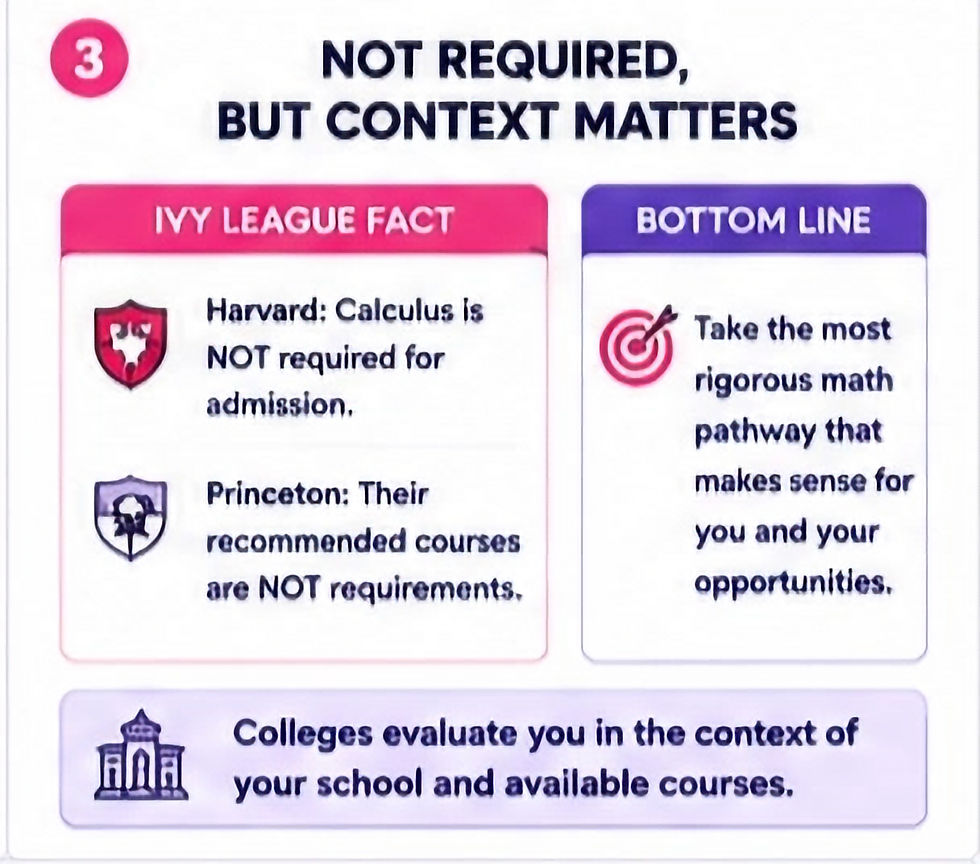
Harvard explicitly states that calculus is not an admission requirement and that students' mathematics preparation is evaluated holistically. Harvard also recognizes that high schools differ in their available courses.
Princeton similarly says its recommended course of study is not a list of admission requirements, while encouraging students to challenge themselves with rigorous courses such as honors, AP and dual enrollment when available.
This leads to a much better rule:
Take the most rigorous mathematics pathway that makes sense for your preparation, school opportunities and academic goals.
Not:
"Take calculus at all costs."
Why AP Calculus Matters More for Some Students Than Others
The admissions value of AP Calculus depends heavily on what you intend to study.
Consider two applicants.
Applicant A
Wants to study:
English Literature
Their transcript contains:
AP English Literature, AP History, AP Spanish, Advanced humanities coursesStrong writing portfolio
They take AP Calculus AB and earn a B.
The calculus course demonstrates rigor, but it may not be the central feature of their academic identity.
Applicant B
Wants to study:
Computer Science
Their transcript contains:
AP Calculus ABAP PhysicsComputer science courseworkMathematical competitionsProgramming projects
Now AP Calculus becomes part of a much larger pattern.
It helps answer:
"Does this student actually pursue quantitative subjects seriously?"
That's much more powerful.
AP Calculus Can Strengthen a STEM Story
For STEM applicants, the mathematics sequence can become one of the most important parts of the academic profile.
Suppose a student says:
"I want to study engineering."
Then the admissions reader sees:
Algebra IGeometryAlgebra IIPrecalculusAP Calculus ABAP PhysicsEngineering projectRobotics
That is a coherent academic narrative.
The transcript isn't simply showing that the student took difficult classes.
It is showing direction.
Princeton's admissions guidance emphasizes that applicants should challenge themselves with the rigorous courses available to them and that admissions officers look at the overall academic pattern rather than simply counting AP classes.
AP Calculus AB Can Show Academic Progression
One of the most overlooked aspects of a transcript is trajectory.
Admissions officers aren't looking at each course as an isolated event.

They're seeing a four-year academic story.
For example:
Grade 9
Algebra I
Grade 10
Geometry
Grade 11
Algebra II + Precalculus
Grade 12
AP Calculus AB
This can demonstrate progression.
But another student might have:
Grade 9
Geometry
Grade 10
Algebra II
Grade 11
AP Precalculus
Grade 12
AP Calculus AB
The specific sequence varies by school.
That's okay.
The important question is:
Did the student keep moving toward more advanced mathematics?
The Course Availability Question Is Extremely Important
Here's a mistake students make when comparing themselves with other applicants.
They see someone online saying:
"You need AP Calculus by junior year."
That's not universally true.
A student attending a school with:
AP Calculus BC
Multivariable Calculus
Linear Algebra
may have very different opportunities from a student whose school offers only:
AP Calculus AB
or even no AP calculus at all.
Colleges know this.
Harvard explicitly states that applicants don't all have the same opportunities and course offerings in their high schools.
Princeton similarly says students without access to all of its suggested courses are still given full consideration.
This is why context matters more than comparison.
AP Calculus AB vs. AP Calculus BC: Does BC Look Better?
This is another common misconception.
Students often ask:
"If AP Calculus BC is harder, do Ivy League schools automatically prefer it?"
Not necessarily.
AP Calculus BC covers all of the AP Calculus AB material and adds additional topics. College Board describes BC as a more extensive calculus course that builds on AB content.
If your school offers both and you're genuinely prepared for BC, BC can demonstrate additional mathematical depth.
But:
AP Calculus AB with excellent performance is not a weak academic choice simply because BC exists.
The right course is the highest level you can take successfully and meaningfully.
A Strong Grade in AP Calculus Matters
Here's where students sometimes misunderstand the purpose of rigor.
They think:
"If I take the hardest class possible, admissions officers will forgive any grade."
That's not how you should approach it.
Princeton's admissions dean has explained that the university looks for evidence that students have challenged themselves and can do well in those classes. Princeton explicitly rejects the idea that applicants need enormous numbers of AP courses with perfect grades.
So consider:
AP Calculus AB — A
versus
AP Calculus AB — D
The second applicant has technically taken the harder course.
But the first applicant has demonstrated both:
ambition + mastery.
That's a much stronger signal.
What If You Get a B in AP Calculus?
A B in AP Calculus does not automatically damage an application.
One grade should not be viewed in isolation.
Admissions offices look at the larger transcript, course rigor, academic trajectory and context.
A student with:
A, A, A, B, A
is very different from a student with:
C, D, B, C, D.
And a B in a highly demanding course may be interpreted differently from a B in a less rigorous course.
The broader question becomes:
"What does this student's academic record tell us?"
Not:
"Was every single grade an A?"
What If You Get a 3 on the AP Calculus Exam?
This is where you need to separate two things:
The course
and
the AP exam.
Colleges can see your coursework on the transcript.
AP exam scores may be self-reported or officially sent depending on the institution and application circumstances.
College Board states that colleges consider many factors beyond AP exam scores, including coursework strength and GPA in rigorous courses. It also advises students to check individual colleges' policies regarding whether official AP scores are useful in admission decisions.
So don't make this mistake:
"I got a 3, therefore AP Calculus was worthless."
The course itself may still have demonstrated that you challenged yourself.
What If You Get a 5?
A 5 is obviously a strong result.
It can provide additional evidence that you mastered the AP Calculus material.
But don't turn it into:
"5 = admission."
That's simply not how selective admissions works.
College Board itself notes that AP scores are only one component of a broader admissions evaluation.
A 5 can strengthen the academic story.
It does not replace:
Grades
Course rigor
Recommendations
Activities
Essays
Intellectual interests
Personal context
Academic trajectory
The Difference Between Taking AP Calculus and Mastering AP Calculus
This distinction is critical.
There is a major difference between:
"I took AP Calculus AB."
and:
"I took AP Calculus AB, mastered the material, performed strongly in the course, earned a strong AP score, and used calculus as a foundation for deeper quantitative work."
The second tells a much richer story.
That's why students should stop treating AP classes as badges.
Think of them as evidence of capability.
AP Calculus Can Support Your Intended Major
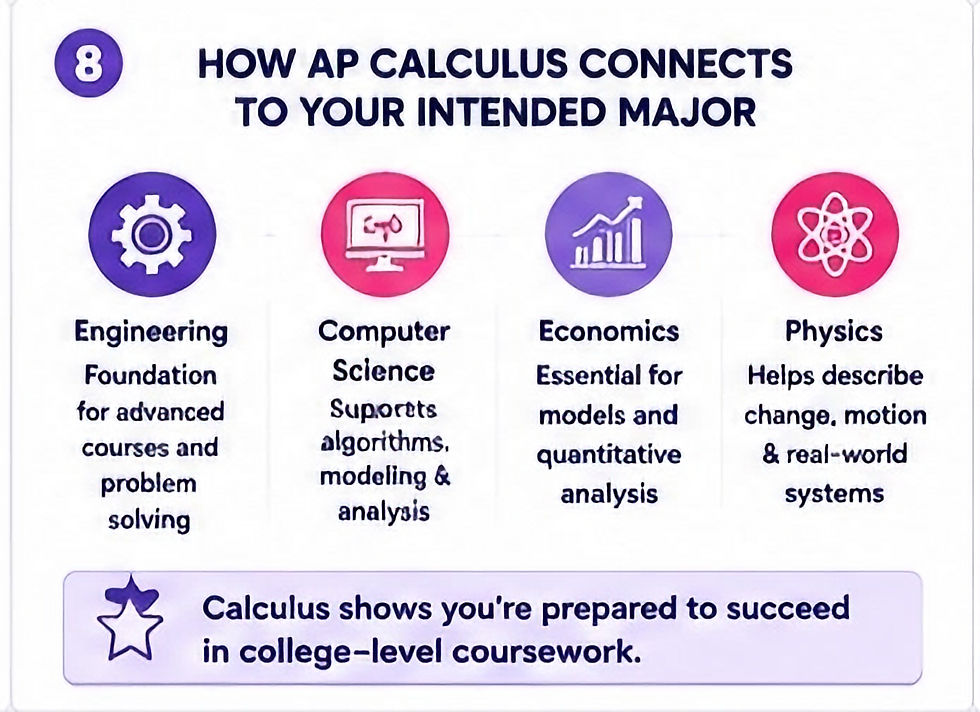
Let's look at how calculus can connect to different academic directions.
Engineering
Calculus is foundational.
An engineering applicant who takes AP Calculus and pairs it with physics, engineering projects or technical activities creates a natural academic progression.
Computer Science
Calculus isn't the entirety of computer science.
But advanced mathematics can demonstrate quantitative preparation.
Pairing calculus with:
Programming
Algorithms
Data structures
Mathematical modeling
Statistics
can create a much stronger profile than calculus alone.
Mathematics
Here, AP Calculus can be the beginning rather than the endpoint.
A mathematically focused applicant might continue into:
AP Calculus BC
Multivariable calculus
Linear algebra
Differential equations
Math competitions
Research
Independent mathematical study
The deeper the progression, the more meaningful the calculus course becomes.
Economics
Calculus can be especially relevant for students interested in quantitative economics.
An applicant might build:
AP Calculus
Statistics
Economics
Data analysis
Research
This creates an academically coherent pathway.
Physics
Calculus and physics naturally reinforce each other.
A student interested in physics who reaches calculus and then applies mathematical thinking to mechanics or other physical systems can demonstrate something more valuable than course collection:
transfer of knowledge.
AP Calculus Can Help With College Readiness
Admissions is only one side of the equation.
AP Calculus can also prepare students for what comes after admission.
College Board describes AP courses as opportunities to develop skills including time management, critical thinking, scholarly work and independent study.
That's important.
A student who learns how to manage a demanding calculus course is developing habits that can transfer to college.
And some colleges may grant credit or advanced placement based on AP scores, although policies vary significantly by institution and department.
Princeton, for example, says its AP policy can allow students to place into courses matching their preparation and, in some cases, skip introductory coursework.
AP Credit Is Not the Same as Admissions Value
Don't confuse these.
Admissions value asks:
"Does this strengthen my academic preparation and application?"
Credit value asks:
"Will this college give me credit for my AP score?"
Placement value asks:
"Will this score allow me to start at a more advanced course level?"
A college might:
Give credit
Give placement
Give both
Give neither
Apply different rules by major
Therefore, always check the specific college's current AP policy.
Why AP Calculus Can Be More Powerful Than Another Random AP
Imagine a student interested in engineering.
They have room for one more AP.
Option A:
AP Calculus AB
Option B:
An unrelated AP course selected solely because it is another AP.
The answer isn't automatically AP Calculus.
But if calculus directly advances the student's intended academic direction, it may create a stronger narrative.
The goal isn't:
"Maximum AP count."
The goal is:
"Maximum meaningful academic challenge."
Don't Build Your Schedule Around Ivy League Myths
There are many online claims like:
"Ivy League applicants need 12 APs."
"You need calculus by sophomore year."
"You need AP Calculus BC."
"You need five STEM APs."
"A 5 in calculus guarantees you'll stand out."
These statements are far too simplistic.
Princeton explicitly says applicants do not need enormous numbers of AP courses and instead looks for students who challenge themselves in the courses available to them and perform well.
Harvard similarly says there is no specific mathematics course required for admission.
The better question is:
"What is the strongest academic program I can realistically build at my school?"
AP Calculus Should Fit Into a Larger Academic Story
This is where strong applications become interesting.
Imagine a student interested in environmental engineering.
They take:
AP Calculus AB
AP Physics
Environmental Science
Computer Science
Then build a project modeling local water usage.
Suddenly calculus isn't just a transcript line.
It becomes part of a story:
Mathematics → science → modeling → application → impact
That's much more compelling.
What Admissions Officers May Infer From Strong Calculus Preparation
You should be careful here.

Admissions officers don't necessarily think:
"This student took AP Calculus, therefore they possess trait X."
Admissions is more nuanced.
But a strong mathematics progression can provide evidence of things such as:
Willingness to challenge oneself
Quantitative preparation
Academic persistence
Ability to work through complex material
Interest in a quantitative field
Preparation for advanced coursework
These aren't guaranteed conclusions.
They're possible signals within the broader application.
AP Calculus Can Strengthen the "Why STEM?" Question
Suppose your application says:
"I've always loved computer science."
But your transcript contains:
Algebra II
Standard Statistics
No advanced mathematics
No quantitative projects
No technical coursework
The reader may reasonably want more evidence.
Now compare:
AP Calculus AB
AP Physics
Computer Science
Mathematical modeling project
Programming competition
Research
The second profile provides more academic evidence supporting the stated interest.
That's the real value of rigorous coursework.
Your Course Selection Should Be Contextual
Before choosing AP Calculus, ask five questions.
1. Is it the appropriate next course?
Do you have the algebra, trigonometry and precalculus foundation?
2. Does your school offer it?
If yes, is it accessible to you based on your school's normal pathway?
3. Can you realistically perform well?
Don't choose it solely for prestige.
4. Does it connect to your academic interests?
Especially if you are pursuing STEM.
5. What comes next?
A strong course should ideally open doors rather than create an academic dead end.
AP Calculus AB Can Be a Bridge to AP Calculus BC
For students who want greater mathematical depth, AB can serve as a strong foundation for BC.
College Board notes that BC contains all eight AB units and extends beyond them with additional calculus topics.
That means a student might build:
AP Precalculus → AP Calculus AB → AP Calculus BC
or, where appropriate:
AP Precalculus → AP Calculus BC
depending on school structure and preparation.
The correct pathway depends on the student's readiness and school offerings.
Don't Rush Into Calculus Just for Admissions
This is perhaps the most important warning in the article.
Harvard explicitly encourages students to master foundational mathematics rather than rushing through advanced courses merely for the sake of taking them.
That's excellent advice.
If your algebra is weak, rushing into calculus can create a chain reaction:
Weak algebra↓Weak precalculus↓Struggling calculus↓Lower grade↓Stress↓Less time for other academic work
Sometimes the strongest admissions decision is actually:
Build the foundation first.
The "Most Advanced Course" Isn't Always the "Best Course"
This deserves repeating.
Suppose:
Student A: AP Calculus AB → C
Student B: Precalculus → A
If AP Calculus was genuinely appropriate for Student A and the student worked hard, the context matters.
But if Student A took calculus without the required foundation simply to impress colleges, the strategy may have backfired.
The best academic profile isn't necessarily the most aggressive one.
It's the one that demonstrates:
Challenge + mastery + progression + purpose.
How AP Calculus Fits Into an Ivy League Application
For highly selective universities, think of your academic profile as a structure.
Foundation
Strong core classes.
Rigor
Honors/AP/IB/dual enrollment where appropriate.
Performance
Strong grades.
Direction
Course choices connected to interests.
Depth
Advanced study beyond the minimum.
Evidence
Projects, competitions, research, intellectual work or meaningful application.
AP Calculus can contribute to several of these layers.
But it cannot create all of them by itself.
A Strong AP Calculus Profile Might Look Like This
Imagine a student applying for computer science.

Transcript
AP Calculus AB — A
AP Physics — A
AP Computer Science — A
Advanced English — A
Outside the Classroom
Programming project
Math competition
Independent coding
STEM summer program
Application Narrative
The student explains how mathematical modeling led them to explore computational approaches to real-world problems.
Now AP Calculus has context.
It isn't merely:
"I took AP Calculus."
It becomes:
"I developed mathematical tools and then used them."
That's a stronger story.
A Different Student Can Use Calculus Differently
Consider an economics applicant.
They might combine:
AP Calculus AB
AP Statistics
Economics
Research project
Data analysis
Here calculus supports a quantitative economics story.
The course doesn't have to be connected to an engineering project to have value.
What About a Humanities Applicant?
This is where the answer becomes more nuanced.
A humanities student doesn't need to force calculus into their profile.
But taking challenging mathematics can still demonstrate breadth and academic ambition.
If the student genuinely enjoys mathematics and performs well, AP Calculus can absolutely be worthwhile.
The key is not to pretend:
"I'm a STEM applicant"
when the rest of the application clearly says otherwise.
Authenticity matters.
Princeton explicitly advises applicants to tell their story and write in their own voice rather than trying to fit a generic admissions formula.
Does AP Calculus Help More Than SAT Math?
These are different pieces of evidence.
The SAT Math section measures standardized performance.
AP Calculus is a sustained academic course.
One shows:
performance on a standardized assessment.
The other can show:
performance over an extended period in advanced coursework.
For a STEM applicant, having both strong quantitative preparation and strong standardized math performance can create consistency.
But neither one substitutes for the other.
What About AP Calculus and SAT Scores Together?
Consider this profile:
SAT Math: 790
AP Calculus AB: A
AP Exam: 5
That's a very consistent quantitative signal.
Now imagine:
SAT Math: 790
AP Calculus AB: A
AP Exam: 3
Still not necessarily problematic.
The course grade, overall transcript and context matter.
This is why you shouldn't reduce an application to a single number.
How to Talk About AP Calculus in Your Application

Don't write:
"I took AP Calculus because Ivy League schools like calculus."
That's weak.
Instead, if true, explain:
What did calculus teach you?
What problem did it help you understand?
What did you do with the knowledge?
How did it influence what you want to study?
For example:
"Learning differential equations changed how I thought about systems that evolve over time."
That's much more intellectually interesting than:
"I took AP Calculus because it looked good on my transcript."
AP Calculus Can Create Opportunities Beyond Admissions
The benefits aren't limited to getting into college.
Calculus can prepare students for later coursework in:
Engineering
Physics
Computer science
Economics
Mathematics
Statistics
Data science
Biology
Chemistry
Finance
and many other fields.
College Board describes AP Calculus as relevant to further study across mathematics and other disciplines.
So the strongest reason to take calculus is not:
"Admissions officers will like it."
It is:
"This is the mathematics I need—or want—to learn next."
Admissions benefit can follow naturally.
How IMRSB Thinks About AP Calculus
At IMRSB, we don't believe AP Calculus should be treated as a checkbox.
A student shouldn't be preparing for calculus simply to say:
"I took AP Calculus."
The goal should be:
Understand the concept.
Solve the problem.
Explain the reasoning.
Apply the mathematics.
Build confidence.
Then use that foundation to move into more advanced work.
That's why our AP Calculus content connects preparation with both academic mastery and long-term academic planning.
You can continue with our related IMRSB resources:
And for students thinking beyond AP courses, our Ivy League admissions series can help
connect academic preparation with the broader application strategy.
A Practical AP Calculus + College Admissions Roadmap
Grade 9
Build strong algebra foundations.
Focus on:
Accuracy
Problem solving
Mathematical reasoning
Grade 10
Continue advancing through geometry/algebra/precalculus depending on your school's sequence.
Don't rush simply because another student is ahead.
Grade 11
If appropriately prepared:
AP Calculus AB
Now focus on:
Understanding + performance
not just completing the course.
Grade 12
Use your calculus foundation to pursue:
AP Calculus BC
or another advanced quantitative course where appropriate.
Continue developing depth in your intended academic area.
The Biggest Mistakes Students Make With AP Calculus and Admissions

Mistake 1: Taking calculus only for prestige
If you don't have the foundation, this can hurt more than help.
Mistake 2: Counting APs instead of developing mastery
Five meaningful advanced courses are not necessarily better than ten shallow ones.
Mistake 3: Ignoring school context
Your opportunities are not identical to another student's.
Mistake 4: Treating the AP exam score as everything
The course itself, grades and transcript context matter too.
Mistake 5: Forgetting the rest of the transcript
Calculus cannot compensate for weakness everywhere else.
Mistake 6: Assuming STEM applicants all need the exact same schedule
There is no universal Ivy League schedule.
Mistake 7: Letting admissions determine every academic decision
You are supposed to be preparing for college—not simply trying to impress an admissions office.
So, Does AP Calculus Help College Admissions?
Yes.
But the better answer is:
AP Calculus can help college admissions when it is part of a rigorous, successful and coherent academic pathway.
It can demonstrate:
Academic rigor
Mathematical preparation
Willingness to challenge yourself
Progression
STEM readiness
Quantitative ability
Preparation for college-level work
But it does not guarantee admission.
It does not replace excellent performance.
It does not replace meaningful extracurricular involvement.
It does not replace strong writing.
And it does not mean every student must take calculus.
Harvard explicitly says calculus is not required for admission, while Princeton encourages students to challenge themselves with the rigorous courses available to them.
The strongest strategy is therefore not:
"How can I take the hardest math course possible?"
It is:
"How can I build the strongest mathematics education that makes sense for me?"
That distinction can completely change the way you plan high school.

Final Conclusion
AP Calculus AB can be one of the most valuable courses on a student's transcript—but its value doesn't come from the words "AP Calculus" alone.
Its value comes from what the course represents.
A student who progresses into calculus, performs strongly, understands the mathematics and then applies that knowledge to STEM, economics, research, programming, modeling or other intellectual interests is demonstrating something much more meaningful than course completion.
They're demonstrating academic direction.
And that's what makes calculus powerful in college admissions.
Don't take AP Calculus because someone on the internet told you that Ivy League schools require it.
Take it because:
You're ready for it.
Your school offers it.
It challenges you.
It supports your goals.
And you're prepared to master it.
Then let the transcript tell the story.
Rigor + mastery + progression + purpose = a much stronger academic profile.

FAQ
Does AP Calculus AB look good for college admissions?
Yes. AP Calculus AB can demonstrate that you challenged yourself with college-level mathematics, particularly when it fits naturally into your academic pathway and you perform well.
Do Ivy League schools require AP Calculus?
No. Harvard explicitly states that calculus is not required for admission. Colleges evaluate students in the context of their school and available coursework.
Is AP Calculus AB good for STEM students?
Yes. For students interested in engineering, computer science, mathematics, physics, statistics, economics and related areas, calculus can provide valuable quantitative preparation. Harvard specifically notes that students pursuing several calculus-intensive fields may benefit from taking calculus in high school.
Is AP Calculus BC better than AB for college admissions?
BC covers all AB topics and adds additional material, so it can demonstrate greater mathematical depth when appropriately taken. But the best course depends on your preparation, school offerings and academic pathway.
Will a 5 on AP Calculus guarantee admission to an Ivy League school?
No. A 5 is strong evidence of AP-level mastery, but selective admissions considers the complete application.
Does a 3 on AP Calculus hurt college admissions?
Not automatically. Colleges consider many factors beyond AP exam scores, including course rigor and grades. Individual colleges also have their own policies regarding AP scores in admission.
Should I take AP Calculus if I'm not a STEM student?
You can, if you're genuinely interested and prepared. But you don't need calculus simply to manufacture an impressive-looking transcript.
Is AP Calculus more important than having a high GPA?
Neither should be considered in isolation. A strong application generally combines rigorous coursework with strong academic performance.
Does AP Calculus give college credit?
It can. Credit and placement policies vary by college and sometimes by department. Students should check the current policy for each college on their list. Princeton, for example, states that AP results can sometimes allow students to skip introductory coursework or receive advanced placement.
Related IMRSB Guides
College Admissions
SAT Preparation
Advanced Placement
School Math
About IMRSB
At IMRSB, we believe that college preparation is about more than achieving high scores.
It is about developing knowledge, curiosity, resilience, and confidence over time.
Our goal is to help students make informed decisions, strengthen their academic foundations, and prepare thoughtfully for the opportunities ahead.
Comments