Best AP Calculus AB Resources: Books, Websites, FRQs & Study Tools

Updated: Sep 9

In this guide
If you're preparing for AP Calculus AB, the biggest challenge isn't finding resources.
It is finding the right resources for the right job.
There are hundreds of videos, books, websites, practice-question banks, calculator tutorials and study guides available. Some are excellent. Some are outdated. Some are much harder than the actual AP exam. Others are useful for learning calculus but don't teach you how to communicate your reasoning in the AP format.
And that creates a common problem:
A student has five books, three websites, dozens of YouTube videos and hundreds of practice questions—and still doesn't know what to study on Monday.
This guide takes a different approach.
Instead of giving you a giant list of resources, we're going to organize the best AP Calculus AB resources by purpose:
Learning calculus from scratch
Understanding difficult concepts
Practicing AP-style questions
Preparing for Free-Response Questions
Improving calculator skills
Reviewing before the exam
Finding good textbooks
Choosing between prep books
Building a realistic study system
Deciding which resources you actually need
The goal isn't to collect resources.
The goal is to build a resource system that gets you from understanding → practice → AP-level performance.
Students targeting a 5 can also follow our How to Score a 5 on AP Calculus AB study strategy, and for BC How to Score a 5 on AP Calculus BC.
The Most Important AP Calculus AB Resource Is Free
Before buying a single book, go to the official College Board resources.
The AP Calculus AB Course and Exam Description (CED) should be your academic map.
College Board describes the CED as the core document for the course. It lays out the course content, skills and exam information.
This matters because commercial books are secondary resources.
The College Board defines what students are expected to know.
A prep company is trying to help you prepare for that target.
Those are not the same thing.
Why the CED matters
You can use it to answer:
What do I actually need to know?
Which skills belong to each unit?
What concepts are connected?
What does College Board expect me to be able to do?
What type of mathematical reasoning is being assessed?
If a prep book and the official College Board materials appear to disagree, College Board wins.

The Best Free AP Calculus AB Resources
A student can prepare extremely well without spending hundreds of dollars.
The strongest free resource stack includes:
College Board
AP Classroom
IMRSB Academy
Official released FRQs
Bluebook
And, depending on the student, selected instructional videos and additional practice platforms.
The key is using each resource for a different purpose.
College Board AP Calculus AB Resources
College Board should be your source of truth.
Its AP Calculus AB resources include the course information, exam information, Course and Exam Description and access to AP Classroom through your AP class.
If you have an AP teacher, AP Classroom becomes particularly valuable.
The official CED explains that teachers can use AP Classroom's Personal Progress Checks and Question Bank to create additional practice and assess specific skills.
That means AP Classroom isn't simply another question bank.
It can help identify which skill is actually causing the problem.
That distinction is extremely useful.
Official AP Calculus AB Free-Response Questions
If I had to choose one resource that students consistently underuse, it would be the official FRQs.
College Board provides released AP Calculus AB Free-Response Questions, scoring guidelines, sample student responses and scoring information.
And there is an important difference between:
doing an FRQ
and
studying an FRQ.
The second is much more powerful.
After completing a question, don't simply check whether your final answer is correct.
Ask:
Did I earn every available point?
Did I show the required setup?
Did I include units?
Did I justify my conclusion correctly?
Did I interpret the mathematics in context?
Did I make a calculator-dependent statement without explaining it?
This is how an FRQ becomes a learning tool instead of just another worksheet.
Use the 2026 FRQs Carefully
The 2026 AP Calculus AB exam materials are now available through College Board.
For example, the 2026 released FRQ includes problems involving rate interpretation, Riemann sums, accumulation and function comparison.
But don't make the mistake of memorizing the 2026 questions.
Use them to study patterns.
What kinds of reasoning are required?
How are functions represented?
How much work needs to be shown?
How are units handled?
How does College Board phrase justification?
That is much more valuable than memorizing individual question types.
Bluebook Is an Important Part of Your Preparation
The current AP Calculus AB exam is a hybrid digital exam.
Students view the multiple-choice questions in Bluebook, while the Free-Response Questions are answered in paper exam booklets.
College Board also provides AP exam preparation through Bluebook.
That means your preparation should not be entirely paper-based.
You need to become comfortable with:
Reading questions on screen
Navigating digital testing
Using the permitted calculator effectively
Switching between calculator and non-calculator reasoning
Managing time digitally
Then transitioning into handwritten FRQ responses
This is an overlooked part of modern AP preparation.

The Best AP Calculus AB Resources Are Not All Designed for the Same Student
This is probably the most important idea in this entire article.
Consider four students.
Student A: "I don't understand calculus."
Primary resource:
Textbook + IMRSB Academy + teacher/tutor explanation
Student B: "I understand calculus but make mistakes."
Primary resource:
Targeted practice + error log
Student C: "I know the content but can't score well on FRQs."
Primary resource:
Official FRQs + scoring guidelines + timed writing
Student D: "I'm already scoring 5-level results."
Primary resource:
Full-length timed exams + difficult mixed practice + precision work
Giving all four students the same book is inefficient.
Our AP Calculus AB Guide explains the units, exam structure and preparation strategy.
Similarly for AP Calculus BC Guide does the same for other.
Best AP Calculus AB Books
Books are still extremely useful.
But you don't need six of them.
A good AP Calculus AB resource library usually contains:
One learning/reference textbook
One AP-focused review book
Official College Board material
A dedicated FRQ practice system
That's enough for most students.
Princeton Review AP Calculus AB Premium Prep
The Princeton Review remains one of the most recognizable AP preparation options.
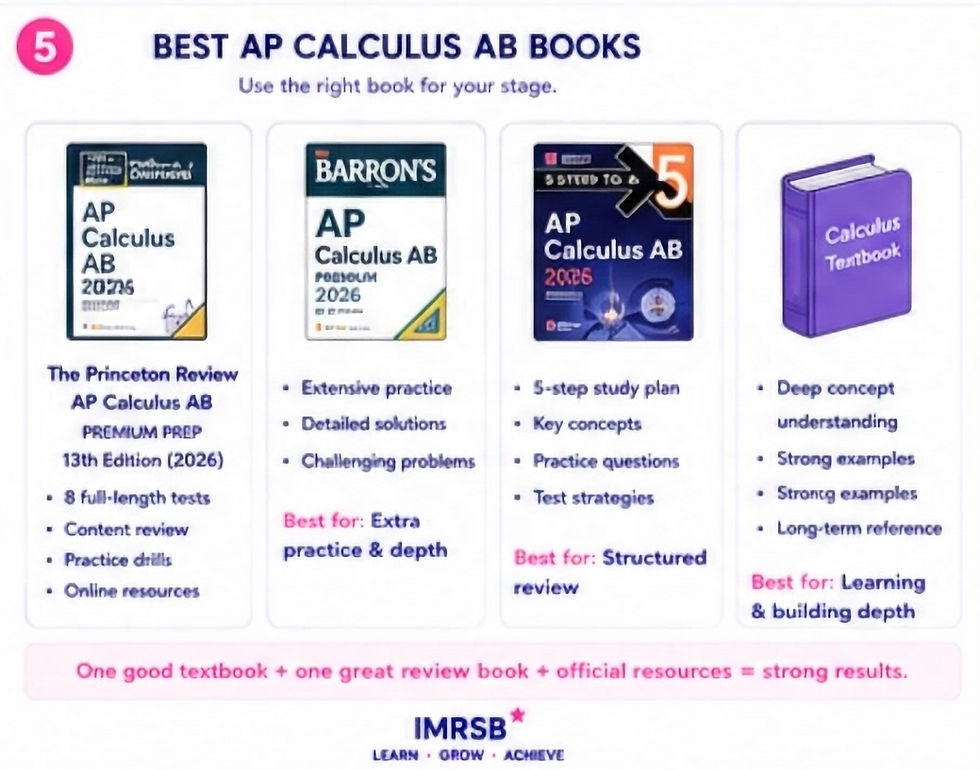
Its current AP Calculus AB Premium Prep, 13th Edition was released in 2026 and is specifically designed around the hybrid-digital AP Calculus AB exam. It includes content review, practice drills, eight full-length practice tests across print and online formats, answer explanations and digital study tools.
Princeton Review AP Calculus AB Premium Prep
Who should use it?
It is particularly useful for students who:
Already understand most of the course
Want structured review
Need lots of practice
Want full-length tests
Prefer a traditional prep-book format
Need a resource for the final months before the exam
What shouldn't you do?
Don't use a review book as your only teacher if you haven't learned calculus yet.
A review book is generally better at answering:
"How do I review this?"
than:
"How do I understand calculus for the first time?"
Barron's AP Calculus
Barron's AP Calculus is another well-known option.
Barron's AP Calculus Premium, 2026
Its appeal is straightforward:
More practice.
For students who already understand the material and want to challenge themselves, that can be useful.
But there's a strategic warning.
Don't automatically assume that harder = better.
A student who is struggling with Unit 6 does not necessarily need the hardest integration questions available.
They need to understand integration.
Then they need AP-level practice.
Then they need to become consistent.
Difficulty should increase after understanding, not instead of understanding.
5 Steps to a 5
5 Steps to a 5 has traditionally been popular with students who want a structured review system.
Its biggest advantage is not necessarily that it contains some magical calculus technique.
It is the organization.
Students who struggle with:
"What should I study today?"
can benefit from a resource that imposes a sequence.
But again, don't confuse organization with mastery.
A schedule tells you what to do.
It does not guarantee that you understand what you're doing.
Kaplan and Other Review Books
Kaplan and other AP preparation publishers can also be useful as secondary resources.
The important thing is not to buy every major brand.
Choose one.
Then actually use it.
A student who completes one strong review book carefully is generally better positioned than a student who owns:
Barron's
Princeton Review
Kaplan
5 Steps to a 5
three old textbooks
and has completed none of them.
A Real Calculus Textbook Is Different From an AP Prep Book
This distinction deserves its own section.
A textbook teaches mathematics.
An AP review book teaches you how to review and perform on a standardized assessment.
Those are different jobs.
A traditional calculus textbook may spend substantial time developing:
Definitions
Theorems
Derivations
Examples
Conceptual reasoning
Proof ideas
Mathematical connections
An AP prep book is more likely to emphasize:
AP terminology
Exam strategies
Practice questions
Common mistakes
FRQ approaches
Timing
Test structure
If you are self-studying AP Calculus AB from the beginning, don't expect a 600-page exam review guide to replace a full learning experience.
What About Stewart Calculus?
James Stewart's Calculus is an excellent college-level calculus reference.
It is also much larger in scope than what you need for AP Calculus AB.
That doesn't make it bad.
It makes it different.
Stewart can be particularly useful for a student who:
Loves mathematics
Wants deeper conceptual understanding
Is preparing for future college mathematics
Wants more challenging exercises
Plans to continue into higher mathematics
But you shouldn't spend weeks completing material that has little relevance to your AP target.
Use a comprehensive calculus textbook selectively.
What About Larson Calculus?
Larson's calculus texts can similarly provide a deeper mathematical foundation.
They are useful if your goal extends beyond:
"I need to pass AP Calculus AB."
If you're interested in engineering, mathematics, physics, economics or another quantitative field, a strong calculus textbook can become a long-term reference.
But for exam preparation, pair it with:
Official College Board questions.
Otherwise, you may become excellent at calculus while becoming less familiar with AP-style communication.
The Best Resource for AP Calculus AB FRQs
It's not a commercial book.
It's the official College Board FRQ archive.
College Board provides recent released questions, scoring guidelines and student samples.
Why?
Because the scoring system matters.
A third-party book can imitate an FRQ.
College Board actually writes and scores the AP exam.
That makes official questions uniquely valuable.
How to Use an FRQ Correctly
Don't do:
Question → Answer → Score → Next question
Instead:
Question → Attempt → Score → Diagnose → Rewrite → Reattempt
Suppose you lose a point because you failed to justify why a function has an absolute minimum.
Don't simply write:
"I lost 1 point."
Write:
"I need to identify the mathematical theorem or condition that supports the conclusion."
Now you've learned something transferable.
That mistake can disappear from dozens of future questions.
Build an AP Calculus AB Error Log
This is one of the most useful systems you can create.
Your error log should have columns such as:
Question | Topic | Error Type | Why I Made It | Correct Idea | Fix |
1 | Limits | Concept | Confused left/right limits | Evaluate each side separately | Practice graphical limits |
2 | Derivatives | Algebra | Sign error | Simplify before differentiating | Slow down |
3 | FRQ | Justification | Missing theorem | State condition + conclusion | Practice written justification |
4 | Integration | Setup | Wrong bounds | Identify x-interval first | Diagram before integrating |
This is much more useful than simply counting how many questions you got wrong.
Your Mistakes Usually Belong to One of Five Categories
Most AP Calculus AB mistakes can be classified as:
Concept Error
You don't understand the mathematics.
Procedure Error
You understand the idea but don't know the process.
Algebra Error
Your calculus is correct but your algebra breaks the solution.
Interpretation Error
You calculate correctly but misunderstand what the answer means.
Communication Error
You know the answer but don't provide enough reasoning to earn the point.
This classification is extremely useful because each error requires a different solution.
Calculator Resources Matter More Than Students Think
The calculator isn't a substitute for calculus.
It is a tool for executing certain parts of the mathematics efficiently.
You should know how to use your approved graphing calculator for tasks such as:
Graphing functions
Finding numerical zeros
Evaluating numerical derivatives
Evaluating numerical integrals
Exploring intersections
Checking reasonableness
Analyzing tables
Supporting calculator-active questions
But here's the important distinction:
Knowing which button to press is not the same as knowing why you are pressing it.
If you can obtain a decimal answer but cannot explain what that number represents, you haven't mastered the underlying AP skill.
Don't Let Your Calculator Become a Crutch
A dangerous habit is:
"I'll just graph it."
That can work for some calculator-active questions.
It can also hide conceptual weaknesses.
A strong AP Calculus student should be able to look at a graph and understand:
What is changing?
What does the slope represent?
Where are the critical points?
What does the area represent?
Why does the integral have this interpretation?
What does the derivative tell me?
The calculator should make your mathematics more efficient.
It should not replace your mathematical thinking.
The Best Resource for Learning FRQ Communication
Use:
Official scoring guidelines
plus
Official sample student responses
College Board's released materials include scoring information and sample responses.
This lets you see something a prep book cannot perfectly reproduce:
what actually earned points.
Study the difference between:
A mathematically correct answer
and
A mathematically correct AP-scoring response.
That difference can be worth multiple points across an exam.
AP Calculus AB Resources by Unit
Instead of randomly studying calculus, organize your resources around the course structure.

Unit 1: Limits and Continuity
Best resources:
College Board CED
Khan Academy
Class notes
Targeted textbook exercises
Official FRQs involving limits
Focus on:
Graphical limits
Numerical limits
Algebraic limits
Continuity
Intermediate Value Theorem
Don't move on simply because you can calculate a limit.
You should understand what a limit represents.
Unit 2: Differentiation — Definition and Basic Rules
Focus on:
Derivative meaning
Derivative from the limit definition
Basic derivative rules
Interpretation of derivatives
A common mistake is memorizing derivative formulas without understanding the derivative as a rate of change.
That becomes a problem later when the exam gives you a graph or contextual situation instead of a clean equation.
Unit 3: Differentiation — Composite, Implicit and Inverse Functions
This is where many students begin to feel that AP Calculus has become "hard."
Use:
Khan Academy
Your textbook
Teacher/tutor explanations
Targeted practice
Focus on:
Chain Rule
Implicit differentiation
Inverse functions
Derivative relationships
Don't simply memorize the chain rule.
Learn to recognize when the chain rule is present.
Unit 4: Contextual Applications of Differentiation
This is where calculus becomes applied mathematics.
You should become comfortable with:
Related rates
Motion
Rate interpretation
Units
Linearization
This unit is an excellent example of why conceptual understanding matters.
You aren't just differentiating.
You're explaining what the derivative means.
Unit 5: Analytical Applications of Differentiation
This unit is extremely important for building a complete understanding of functions.
Work on:
Critical points
Increasing/decreasing intervals
Relative extrema
Absolute extrema
Concavity
Inflection points
First derivative reasoning
Second derivative reasoning
Khan Academy's current Unit 5 provides extensive practice in these areas.
Unit 6: Integration and Accumulation of Change
This is one of the major conceptual transitions in the course.
Students need to understand:
Antiderivatives
Definite integrals
Accumulation
Riemann sums
Fundamental Theorem of Calculus
Don't treat integration as simply:
"Reverse differentiation."
That is only one part of the story.
Integration is also about accumulation.
That idea appears repeatedly in AP questions.
Unit 7: Differential Equations
Focus on:
Slope fields
Separable differential equations
Initial conditions
Euler's method
The key is connecting the symbolic mathematics to the visual representation.
Unit 8: Applications of Integration
This is where many students need substantial practice.
Focus on:
Area
Area between curves
Volumes
Cross sections
Accumulation
Motion
Khan Academy's AP Calculus AB course provides dedicated material for applications of integration, including area and volume problems.
What About YouTube?
YouTube can be incredibly useful.
It can also destroy your study schedule.
The problem isn't YouTube.
The problem is passive learning.
Watching:
"The 47 hardest AP Calculus problems"
for two hours isn't the same as solving 20 problems yourself.
Use videos when:
You don't understand a concept.
Then close the video.
Solve problems.
That is where learning happens.
The Best Way to Use Online Videos
Use the:
Watch → Pause → Predict → Solve → Check
method.
If the teacher starts solving a problem, pause the video.
Attempt it yourself.
Then compare.
This converts a passive video into an active lesson.
Best AP Calculus AB Resource Combination for Different Students
Student Type | Best Resource Mix |
Beginning student | Textbook + IMRSB + teacher/tutor |
Strong classroom student | CED + AP Classroom + review book |
Self-studier | Structured textbook + Khan Academy + official FRQs |
Struggling student | IMRSB + targeted instruction + basic practice |
3 → 4 student | Error log + targeted AP questions |
4 → 5 student | Official FRQs + timed practice + advanced review |
Last-minute student | CED + focused review book + official FRQs |
Future STEM student | Deep textbook + AP resources + challenging practice |
The Best Resource Stack for a Student Trying to Get a 5
If your goal is specifically a 5, I would not recommend buying ten resources.
I'd build this:
Core Resource
College Board CED
Learning Resource
IMRSB or a strong textbook
AP Practice
AP Classroom
FRQ Practice
Official College Board FRQs
Review Book
Princeton Review OR Barron's OR another single quality guide
Diagnostic Tool
Error log
Final Assessment
Timed full-length practice
That's enough.
The difference between a 4 and a 5 is often not another resource.
It is how intelligently the resources are used.

A 12-Week AP Calculus AB Resource Strategy
If you have approximately three months remaining, don't start by taking random full-length tests every weekend.
Build progressively.
Weeks 1–3: Repair
Identify weak units.
Use:
IMRSB Academy + textbook + class resources
Your goal is understanding.
Weeks 4–6: Build
Begin targeted AP-style questions.
Use:
AP Classroom + review book + error log
Your goal is consistency.
Weeks 7–9: Apply
Start serious FRQ work.
Use:
Official College Board FRQs
Your goal is mathematical communication.
Weeks 10–11: Simulate
Take timed sections and full-length practice.
Your goal is endurance and timing.
Week 12: Refine
Do not attempt to relearn the entire course.
Review:
Recurring mistakes
Weak concepts
FRQ communication
Calculator fluency
Timing
This is much more effective than panic-studying everything.
What Should You NOT Buy?
This is just as important.
Don't buy a resource simply because someone says:
"This book has 1,500 questions."
More questions do not automatically produce more learning.
You also don't need:
Five different review books.
Three calculators.
Every AP Calculus course on the internet.
A giant collection of old editions.
Practice questions with no answer explanations.
And be especially careful with very old AP prep books.
The exam evolves.
College Board's current exam information notes that changes are being introduced for the May 2027 exams, including changes to multiple-choice question counts and timing, while course content itself is not changing.
That makes current-format practice particularly important.
Don't Confuse a Difficult Resource With an Accurate Resource
This deserves emphasis.
Suppose a practice book gives you extremely difficult questions.
You score:
55%.
You panic.
You buy another book.
You start doing harder problems.
Your score becomes:
48%.
You conclude:
"I'm terrible at calculus."
Maybe you're not.
Maybe you're practicing at the wrong difficulty level.
The best preparation moves through:
Understand → Practice → Apply → Challenge → Simulate
not:
Understand → Immediately do the hardest questions available.
How Many AP Calculus AB Resources Do You Really Need?
For most students:
4–6 serious resources are enough.
A strong setup might be:
College Board CED
AP Classroom
Khan Academy
One review book
Official FRQs
Your school textbook/class resources
That's plenty.
If you have a tutor, that can replace some of the explanatory role played by a textbook or online course.
Where IMRSB Fits Into Your AP Calculus AB Preparation
This is where we take a different approach from a generic resource list.
IMRSB's AP Calculus AB preparation should sit between content understanding and exam execution.
In other words:
You don't simply need another collection of questions.
You need help identifying:
What don't you understand?
Why are you making the same mistake?
Which AP skill is missing?
How should you approach the problem?
Can you explain your reasoning?
Can you reproduce the skill without help?
That is where personalized instruction can become valuable.
Our earlier IMRSB resources on How to Score a 5 on AP Calculus AB can be used alongside this resource guide rather than replacing the resources themselves.
And if you are coming from AP Precalculus, our Best Resources for AP Precalculus guide provides the bridge into the calculus sequence.
The AP Calculus AB Resource Pyramid
Think of your resources as a pyramid.
Level 1 — Official Curriculum
College Board CED
This tells you what matters.
Level 2 — Understanding
Teacher + textbook + IMRSB Academy + tutoring
This teaches you the mathematics.
Level 3 — AP Practice
AP Classroom + review book
This converts understanding into AP-style performance.
Level 4 — Authentic Practice
Official FRQs + scoring guidelines
This teaches you how the actual exam rewards reasoning.
Level 5 — Simulation
Timed practice + Bluebook
This tests whether you can perform under exam conditions.
If Level 2 is weak, jumping directly to Level 5 is frustrating.
If Level 2 is strong but Level 4 is missing, you may understand calculus but lose points on
FRQs.
The levels work together.
My Recommended AP Calculus AB Resource List
If I were building an AP Calculus AB resource library from scratch today, I would prioritize:

1. College Board AP Calculus AB resources
Your official curriculum and exam reference.
2. College Board AP Classroom
For targeted course practice when available through your AP class.
3. Official AP FRQs
Your most authentic source of exam-style Free-Response practice.
4. IMRSB AP/College Calculus AB
One of the strongest free resources for concept learning and targeted practice.
5. Princeton Review AP Calculus AB Premium Prep
A strong all-around commercial review option with current-format practice and multiple full-length tests.
6. Barron's AP Calculus
Useful as a more intensive practice/reference option, particularly once your fundamentals are strong.
7. A full calculus textbook
For students who want deeper mathematical understanding or are preparing for college STEM coursework.
8. Your own error log
Free—and arguably one of the most valuable resources you can create.
The Most Underrated AP Calculus AB Resource Is Your Own Mistake History
Imagine you take six practice tests.
You repeatedly make mistakes on:
Units
Justification
Related rates
Area interpretation
Derivative graphs
Accumulation
The obvious response is:
"I need more practice."
But the better response is:
"I need targeted practice on these six weaknesses."
That's a completely different strategy.
Your mistakes tell you what to study next.
Frequently Asked Questions
What is the best AP Calculus AB resource?
There isn't one universal best resource. College Board should be your source of truth, Khan Academy is excellent for free concept instruction, official FRQs are essential for authentic exam practice, and one quality commercial review book can provide additional structured practice.
Is IMRSB enough for AP Calculus AB?
It can be an excellent learning resource, but most students should supplement it with official College Board questions and FRQs. Khan Academy currently provides a broad AP Calculus AB course mapped to AP standards.
What is the best AP Calculus AB prep book?
Princeton Review and Barron's are both useful options, but they serve slightly different purposes. The current Princeton Review 13th edition includes extensive practice and eight full-length tests across print and online formats.
Should I buy both Barron's and Princeton Review?
Usually, no. One good review book used thoroughly is generally more useful than owning multiple books and barely completing any of them.
Are old AP Calculus AB books still useful?
They can help with general calculus concepts, but old AP prep books may not reflect the current exam structure. For exam preparation, use current College Board materials and a current-format review resource.
Are official College Board FRQs free?
Yes. College Board provides released FRQs, scoring guidelines and other scoring information through AP Central.
Should I study from a calculus textbook or an AP review book?
If you are learning calculus for the first time, a textbook or structured instructional resource is usually better. If you already understand the course and need exam preparation, an AP review book is more appropriate.
How many practice tests should I take?
Quality matters more than quantity. Every full-length test should produce a detailed analysis of your mistakes. Five carefully analyzed tests can be more useful than ten tests that you simply score and forget.
What is the best resource for AP Calculus AB FRQs?
The official College Board FRQ archive is the first place to go because it includes authentic questions, scoring guidelines and sample responses.

Final Takeaway
The internet has created a strange problem for AP Calculus AB students.
There is too much information.
The solution isn't finding more.
It's finding the right resource for the right problem.
Use College Board to understand what the course and exam require.
Use IMRSB, your textbook, your teacher or a tutor when you don't understand the mathematics.
Use AP Classroom and a quality review book to develop AP-style fluency.
Use official FRQs and scoring guidelines to learn how your work is actually evaluated.
Use Bluebook and timed practice to become comfortable with the current exam environment.
And use an error log to turn your mistakes into your personal study plan.
The best AP Calculus AB student isn't necessarily the student with the biggest bookshelf.
It is the student who can look at a problem and say:
"I know what this is asking, I know why this method works, I can execute it accurately, and I can explain my reasoning."
That's the level of preparation that can turn calculus knowledge into a 5.
Related IMRSB Guides
College Admissions
SAT Preparation
Advanced Placement
School Math
About IMRSB
At IMRSB, mathematics is not about memorizing procedures and hoping the next question looks familiar. Our approach focuses on:
Understanding → Reasoning → Representation → Application → Confidence
For AP Calculus AB students, that means preparing not only for familiar calculus exercises, but also for the unfamiliar problems that separate procedural knowledge from genuine mathematical understanding.
Comments