How to Get a 5 on AP Precalculus: 12 Week Study Plan & Exam Strategy

Updated: Sep 7
The Complete 2026–27 Strategy Guide for Students Who Want a Top AP Score

In this guide
Want to get a 5 on AP Precalculus? The key is not simply studying more—it is knowing what to study, practicing the way the AP Exam asks questions, and learning from the mistakes you make along the way.
This guide is for students preparing for the AP Precalculus exam who want a clear strategy for mastering the three major content areas: Polynomial and Rational Functions, Exponential and Logarithmic Functions, and Trigonometric and Polar Functions.
You will learn how to build your foundation, connect equations with graphs and tables, improve multiple-choice and free-response performance, use your calculator effectively, track recurring mistakes, and follow a practical 12-week study plan.
Whether you are starting early or trying to strengthen your preparation before exam day, this guide will show you how to prepare deliberately for a 5.
How to Get a 5 on AP Precalculus
Getting a 5 on AP Precalculus is not about memorizing every formula in your notebook.
It is about being able to recognize mathematical structure, interpret functions, move between representations, model situations, use your calculator intelligently, and explain your reasoning under time pressure.
That distinction matters.
A student can understand the algebra in a chapter and still lose points on an AP Precalculus exam because the question asks for the same mathematics in a graph, table, verbal scenario, or unfamiliar model.
The strongest AP Precalculus preparation therefore has two goals:
Master the mathematics.
Learn how the AP exam asks you to use that mathematics.
This guide gives you a practical strategy for doing both.
Important 2026–27 update: College Board's AP Precalculus exam information was clarified for exams beginning in 2027. The number and timing of some question sections changed, so students preparing for the May 2027 exam should use the current College Board materials rather than older AP Precalculus study guides.
What Does It Take to Get a 5?
A 5 does not require perfection.
AP exams are scored on a 1–5 scale, and College Board describes a 5 as "Extremely well qualified." The exact score needed on the underlying exam components can vary because AP uses evidence-based score setting rather than a permanently fixed percentage cutoff.
That means you should not build your strategy around a simplistic idea such as:
"I need to get exactly 90%."
Instead, build a preparation system that makes you capable of earning points consistently across both multiple-choice and free-response questions.
Understand the AP Precalculus Exam First
Before studying, know what you are preparing for.
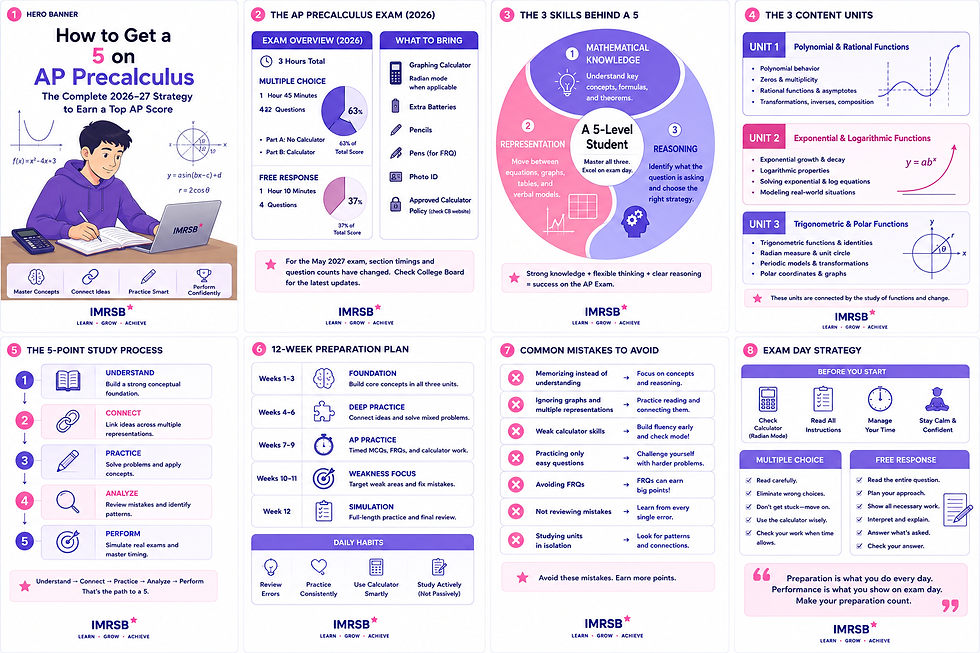
For the 2026 AP Precalculus exam, College Board listed a three-hour exam with multiple-choice and free-response sections. The 2026 version had:
42 multiple-choice questions
1 hour 45 minutes for multiple choice
Approximately 63% of the score from multiple choice
4 free-response questions
1 hour 10 minutes for free response
Approximately 37% of the score from free response

The multiple-choice section included both no-calculator and calculator portions. The calculator portion requires an appropriate graphing calculator, including radian mode when applicable.
For the May 2027 exam, College Board's fall-2026 clarifications changed the multiple-choice counts and timing: Part A became 29 questions in 65 minutes, Part B became 13 questions in 40 minutes, and the free-response parts were changed to 35 minutes each.
Students should therefore practice against the exam structure for their specific test year.
This leads to the first major rule:
Never prepare for AP Precalculus using an outdated exam structure.
Your mathematics may remain relevant, but your pacing strategy can become outdated.
Want a personalized AP Precalculus study plan?
If you understand some of the material but keep making the same mistakes, struggle with specific units, or need help preparing for AP-style questions and FRQs, personalized 1:1 tutoring can help you focus on the areas that matter most.
The Three Skills Behind a 5
A useful way to think about AP Precalculus is that you are developing three different abilities.

Skill 1: Mathematical Knowledge
You need to understand the actual mathematics.
Examples include: Algebra I, Alegbra II
Functions
Polynomial functions
Rational functions
Exponential functions
Logarithmic functions
Trigonometric functions
Polar functions
Modeling
Skill 2: Representation
You need to move between different ways of describing the same mathematical idea.
A function might appear as:
An equation
A graph
A table
A verbal description
A real-world situation
The exam can ask you to connect these representations.
Skill 3: Reasoning
You must determine:
What is the question actually asking me to do?
This is where strong students sometimes lose points.
They know the mathematics but apply the wrong mathematical idea to the situation.
A 5-level student learns to slow down enough to identify the structure before calculating.
AP Precalculus Self-Study vs. Tutoring vs. Group Preparation
There is more than one effective way to prepare for AP Precalculus. The best option depends on how independently you learn and where you are currently struggling.
Preparation Method | Best For | Main Advantage | Possible Limitation |
Self-Study | Independent students with strong foundations | Flexible schedule and pace | Harder to identify your own weaknesses |
Students needing targeted support | Personalized instruction and feedback | Requires a greater time and financial commitment | |
Group Preparation | Students who benefit from structured learning | Shared practice and classroom structure | Less individual attention |
Self-study can work very well when a student has a strong foundation, follows a consistent schedule, and carefully reviews mistakes.
1:1 tutoring can be particularly useful when a student has recurring errors, struggles with specific units, needs FRQ feedback, or has reached a score plateau.
The goal is not to choose the most intensive preparation method. It is to choose the method that addresses your actual learning needs.
Master the Three AP Precalculus Units
AP Precalculus is organized around three major content areas:
Polynomial and Rational Functions
Exponential and Logarithmic Functions
Trigonometric and Polar Functions
But there is a deeper connection among them.

They are all ways of understanding functions and change.
That means you should not study each unit as an isolated chapter.
Look for the connections.
Unit 1: Polynomial and Rational Functions
This is where your algebraic foundation becomes extremely important.
You should be comfortable with:
Linear functions
Quadratic functions
Polynomial behavior
Zeros
Factors
Multiplicity
End behavior
Rational functions
Asymptotes
Transformations
Inverses
Composition
Function notation
Don't Just Memorize Graph Shapes
Suppose you see a polynomial graph.
A strong student doesn't simply think:
"That looks cubic."
Instead, ask:
Where are the zeros?
What are their multiplicities?
Does the graph cross or touch the axis?
What is happening at the ends?
What does the leading term imply?
Can the graph be represented algebraically?
What information can be inferred without solving everything?
This is the difference between recognition and reasoning.
Rational Functions: Think About Structure
Rational-function questions can become much easier when you separate:
Numerator
What determines the zeros?
Denominator
What restrictions and asymptotic behavior occur?
Simplification
Does cancellation create a removable discontinuity?
End behavior
What happens as x becomes very large or very negative?
Instead of treating rational functions as a collection of rules, think about what each component tells you about the graph.
Transformations Are High-Value Skills
Be comfortable interpreting changes such as:
Horizontal shifts
Vertical shifts
Reflections
Vertical scaling
Horizontal scaling
But don't memorize them mechanically.
Practice looking at a graph and explaining:
"What changed from the parent function?"
Then reverse the process:
"What equation could produce this graph?"
That two-way thinking is much stronger preparation.
Unit 2: Exponential and Logarithmic Functions
This unit becomes much easier when you understand that exponential and logarithmic functions are closely connected.
A logarithm is fundamentally an inverse relationship.
You should understand:
Exponential growth
Exponential decay
Compound growth
Logarithmic scales
Inverse functions
Properties of logarithms
Solving exponential equations
Solving logarithmic equations
Modeling
Focus on Meaning, Not Symbol Manipulation
Consider a growth model.
Don't immediately ask:
"Which formula do I use?"
Ask:
"What quantity is changing, what causes it to change, and what does the parameter represent?"
That mindset is particularly useful for modeling questions.
Exponential Models: Know What the Parameters Mean
If you see a model of the form:
f(x)=abx
you should immediately recognize:
a relates to the initial value.
b controls multiplicative change.
b>1 represents growth.
0<b<1 represents decay.
But don't stop there.
If the problem gives you a real-world scenario, be able to explain what those parameters mean in that scenario.
Logarithms: Understand Their Inverse Relationship
Many students memorize logarithm properties but struggle when the question is presented graphically or verbally.
You should be able to recognize the relationship between:
An exponential function
Its inverse
Their graphs
Their domains
Their ranges
A strong conceptual foundation makes unfamiliar questions much less intimidating.
Unit 3: Trigonometric and Polar Functions
This is often where preparation becomes more demanding because students must combine:
Algebra
Geometry
Trigonometry
Graph interpretation
Periodic behavior
Modeling
Master the Unit Circle
If your unit-circle knowledge is weak, fix it early.
Know:
Common angles
Radian measure
Sine
Cosine
Tangent
Signs in each quadrant
But don't simply memorize a chart.
Understand the unit-circle interpretation.
That makes unfamiliar trigonometric questions easier.
Radians Are Essential
A common source of avoidable errors is mixing degrees and radians.
Your graphing calculator must be in the correct mode for the problem.
College Board specifically notes that the graphing calculator portion of the AP Precalculus exam uses radian mode where applicable.
Make checking calculator mode part of your routine.
Understand Trigonometric Transformations
For a sinusoidal function, be able to interpret:
Amplitude
Midline
Period
Phase shift
Maximum
Minimum
But again, don't rely only on memorized formulas.
If a problem describes daylight, temperature, tides, or another periodic phenomenon, ask:
What does each parameter represent in the real situation?
Polar Functions: Don't Treat Them as a Separate World
Polar questions can initially look unfamiliar.
The key is to understand the relationship between:
Angle
Signed radius
Position
Symmetry
Distance from the origin
Graph behavior
The 2026–27 AP Precalculus clarifications also include more precise guidance around how changes in angle and signed radial displacement relate to distance from the origin.
That is a reminder that interpretation matters, not just plotting.
The Secret: Learn Across Representations
One of the strongest AP Precalculus habits you can develop is this:
Never study a topic in only one representation.
For every important function, practice asking:
Algebraically
What does the equation tell me?
Graphically
What does the graph tell me?
Numerically
What does the table tell me?
Verbally
What does the situation mean?
Then connect all four.
Why This Matters on the AP Exam
College Board describes AP Precalculus questions as using graphical, numerical, analytical, and verbal representations, including modeling and real-world contexts.
So a student who studies only equations is preparing for only part of the exam.
The Calculator Is a Tool—Not a Substitute for Mathematics
One of the biggest mistakes students make is either:
Mistake A
Trying to do everything manually.
or:
Mistake B
Trying to make the calculator do everything.
Neither approach is ideal.
What You Should Know Without a Calculator
You should be able to reason through:
Basic algebra
Function behavior
Transformations
Exact trigonometric values
Basic logarithmic relationships
Graph interpretation
Mathematical relationships
What You Should Be Comfortable Doing With a Graphing Calculator
Depending on the question, your calculator can help with:
Graphing
Tables
Numerical comparisons
Finding intersections
Exploring function behavior
Evaluating expressions
Numerical approximations
The goal is not:
"Use the calculator as much as possible."
The goal is:
"Use the calculator where it provides useful evidence or saves time."
Build Calculator Fluency Before Exam Month
Don't wait until April to learn your calculator.
Practice using it during the year.
You should be able to quickly:
Enter a function.
Adjust the viewing window.
Create a useful table.
Locate an intersection.
Read a graph.
Check whether an answer is reasonable.
Recognize when a calculator result is misleading.
A calculator is powerful only when the person using it understands the output.
Free-Response Questions: Where Strong Students Can Separate Themselves
The free-response section deserves special attention.
The 2026 AP Precalculus free-response instructions explicitly state that students should show their work and that responses are evaluated for correctness and completeness, including supporting work when requested.
That means your FRQ strategy should not be:
Calculate → write answer → move on.
Instead:
Interpret → set up → calculate → explain → check.
Never Throw Away Earnable FRQ Points
Suppose a question has several parts.
You make a mistake in Part A.
That does not mean you should mentally abandon the entire question.
Continue.
Later parts may test different skills.
A strong FRQ mindset is:
"Every part is a new opportunity to earn points."
Write Enough Work to Make Your Reasoning Visible
Don't create unnecessary pages of algebra.
But don't write only:
"Answer = 14.7"
when the problem requires supporting work.
Your response should communicate:
What you calculated.
What mathematical relationship you used.
What the result means when interpretation is required.
FRQ Practice Should Be Deliberate
Don't simply complete FRQs.
After completing one, compare your response with the official scoring materials.
College Board provides recent AP Precalculus free-response questions and scoring information, including 2026 materials and prior released exams.
Ask:
Where did I earn the point?
Where did I lose the point?
Did I misunderstand the mathematics?
Did I fail to communicate?
Did I make an arithmetic error?
Did I answer a different question from the one asked?
This post-practice analysis is where much of the learning happens.
The 5-Level Error Log
Create one page—or one digital document—with five categories.
1. Concept Error
I didn't understand the mathematics.
Action: relearn the concept.
2. Representation Error
I understood the concept but couldn't interpret the graph/table/equation.
Action: practice switching representations.
3. Process Error
I knew what to do but made an algebraic or computational mistake.
Action: slow down and check intermediate steps.
4. Strategy Error
I chose an inefficient or inappropriate method.
Action: compare multiple solution approaches.
5. Communication Error
I knew the answer but didn't provide sufficient reasoning.
Action: practice writing complete FRQ responses.
This Is More Valuable Than Simply Counting Questions
A student who completes:
500 questions without reviewing mistakes
may learn less than a student who completes:
250 questions and deeply analyzes every recurring error.
The objective is not to maximize the number of problems completed.
It is to maximize the number of mistakes you stop making.
How to Study for a 5
Use four phases.
Phase 1 — Build the Foundation
Goal: Understand the mathematics.
Work through:
Functions
Polynomial functions
Rational functions
Exponential functions
Logarithmic functions
Trigonometric functions
Polar functions
Do not rush this phase.
If the foundation is weak, advanced practice becomes frustrating.
Phase 2 — Connect Representations
Goal: Become flexible.
Take a single function and practice:
Equation → Graph → Table → Verbal interpretation
Then reverse it.
Graph → Equation
Table → Model
Scenario → Function
This is one of the highest-value habits you can develop.
Phase 3 — AP-Style Practice
Goal: Learn the language of the exam.
Begin working with:
AP-style multiple choice
Timed questions
FRQs
Modeling problems
Graph-based questions
Calculator-active questions
Use official College Board material whenever possible. College Board's AP Central currently provides the three most recent years of released AP Precalculus FRQs, including scoring information where available.
Phase 4 — Exam Simulation
Goal: Perform under pressure.
Practice complete sections under realistic timing.
Do not pause every five minutes.
Do not check answers halfway through.
Do not give yourself unlimited time.
You are training both:
knowledge + execution.
A 12-Week AP Precalculus 5 Plan
If you have approximately three months, use this structure.

Weeks 1–3: Foundation
Week 1
Polynomial and rational functions
Week 2
Exponential and logarithmic functions
Week 3
Trigonometric and polar functions
Weeks 4–6: Deep Practice
Week 4
Functions and transformations
Week 5
Modeling and representation
Week 6
Mixed-unit practice
At this stage, stop thinking:
"I'm studying Unit 1."
Start thinking:
"Which mathematical structure is this question testing?"
Weeks 7–9: AP Practice
Complete:
Timed multiple-choice sets
FRQs
Calculator practice
Mixed-topic problems
Maintain your error log.
Weeks 10–11: Weakness Elimination
Now identify your three biggest weaknesses.
For example:
Weakness 1: Rational functions
Weakness 2: Trigonometric modeling
Weakness 3: FRQ explanations
Spend disproportionate time fixing those areas.
Don't keep studying topics you already know simply because they feel comfortable.
Week 12: Simulation and Refinement
Complete realistic practice exams.
Then review.
Do not spend the entire final week learning completely new material.
Your final week should be about:
Accuracy
Confidence
Timing
Calculator fluency
Error reduction
The 7-Day Final Review
Day 7
Full practice exam.
Day 6
Analyze every mistake.
Day 5
Review weakest content area.
Day 4
FRQ practice.
Day 3
Mixed multiple-choice practice.
Day 2
Calculator + formulas + concepts.
Day 1
Light review.
Sleep.
Do not attempt a twelve-hour mathematical marathon.
What NOT to Do the Night Before
Don't:
Learn an entire unit.
Complete hundreds of random questions.
Stay awake until 3 a.m.
Panic over one difficult topic.
Change your entire strategy.
Your brain needs to perform.
Give it a chance.
Exam-Day Strategy
Before You Start
Make sure you understand:
Calculator requirements.
Calculator mode.
Timing.
Section structure.
How responses are recorded.
For the 2026 exam, AP Precalculus was delivered as a hybrid digital exam through Bluebook, with multiple-choice questions viewed in Bluebook and free-response answers written in paper booklets.
Always follow the instructions for your specific exam administration.
Multiple Choice Strategy
Don't spend too long fighting one question.
If a question is consuming excessive time:
Identify what it is asking.
Eliminate clearly impossible choices.
Make the best decision you can.
Move forward.
One difficult question should not destroy your timing for several easier questions.
Read the Representation Before Calculating
If a question gives you a graph, table, or model, don't immediately reach for the calculator.
First ask:
What information has the question already given me?
Sometimes the fastest solution is interpretation rather than computation.
FRQ Strategy
For each part:
Step 1
Read carefully.
Step 2
Identify the mathematical task.
Step 3
Write the setup.
Step 4
Calculate.
Step 5
Interpret if required.
Step 6
Check whether your answer actually addresses the question.
The Biggest Mistakes Students Make

1. Memorizing Instead of Understanding
AP Precalculus rewards flexible thinking.
2. Ignoring Graphs
Graphs contain information.
Learn to read them quickly.
3. Weak Calculator Skills
A calculator cannot fix poor mathematical judgment.
4. Practicing Only Easy Questions
Easy questions build confidence.
Difficult questions build adaptability.
You need both.
5. Avoiding FRQs
You cannot prepare effectively for the free-response section by doing only multiple choice.
6. Not Reviewing Mistakes
This is perhaps the most expensive mistake.
Your errors are giving you a personalized study guide.
Use it.
7. Studying Units in Isolation
The AP exam can combine ideas.
Learn to recognize connections.
How Many Practice Tests Should You Take?
Quality matters more than a magic number.
A useful progression is:
Early
Untimed diagnostic work.
Middle
Timed individual sections.
Later
Full-length simulations.
Final weeks
Several realistic simulations with detailed review.
The important part is what happens after each test.
A practice exam without analysis is incomplete.
How to Know You're Ready for a 5
You are moving toward 5-level readiness when:
You can explain concepts without notes.
You can interpret graphs quickly.
You can move between representations.
You know when to use your calculator.
You can solve unfamiliar problems.
Your mistakes are becoming less repetitive.
You can complete FRQs under realistic conditions.
You can explain your reasoning clearly.
Your practice performance is becoming consistent.
That last point matters.
One exceptional practice score is less meaningful than repeated strong performance.
Should You Get an AP Precalculus Tutor?
Not every student needs one.
Independent students who can diagnose their own mistakes and maintain a consistent schedule may do very well through self-study.
A tutor can become particularly useful when:
You understand the basics but cannot break through a score plateau.
You repeatedly make the same errors.
You struggle to interpret graphs or models.
You need help organizing a study plan.
You want targeted FRQ feedback.
You need accountability.
You are preparing for an ambitious score goal.
The value of tutoring is not simply having someone give you more questions.
It is having someone help you determine which questions you should be solving and why.
The IMRSB 5-Point Strategy
At IMRSB, we recommend thinking about AP Precalculus preparation as five stages:

1. Understand
Build conceptual foundations.
↓
2. Connect
Move between equations, graphs, tables, and words.
↓
3. Practice
Work through progressively challenging problems.
↓
4. Analyze
Study mistakes rather than merely counting them.
↓
5. Perform
Practice under realistic AP conditions.
Understand → Connect → Practice → Analyze → Perform
That is a much stronger system than:
Read → Memorize → Test
Frequently Asked Questions
Is AP Precalculus difficult?
It can be challenging because it combines substantial algebra, functions, trigonometry, modeling, and multiple representations.
Students with strong algebra and function foundations often have an easier time.
Can I get a 5 without a tutor?
Yes.
A tutor is not required.
The key is having:
Strong resources
A realistic schedule
Consistent practice
Effective error analysis
Official AP-style practice
How early should I start studying?
Ideally, preparation should begin during the course rather than immediately before the exam.
A student who consistently reviews concepts throughout the year generally has a significant advantage over someone attempting to relearn the entire course in the final weeks.
Is the calculator important?
Yes—but calculator skill should complement mathematical understanding.
The AP Precalculus exam includes calculator-active portions, and College Board specifies graphing-calculator use for certain sections.
Should I memorize formulas?
Know important relationships, but don't rely exclusively on memorization.
Ask yourself:
What does this formula mean?
Understanding makes it easier to reconstruct or apply relationships in unfamiliar situations.
How important are FRQs?
Very.
For the 2026 exam, free response represented approximately 37% of the score. The exam format for later administrations has been updated, so students should check the current year's College Board specifications.
AP Precalculus 5-Point Checklist
Before exam day, ask:

☐ Do I understand all three major content areas?
☐ Can I interpret equations, graphs, tables, and verbal models?
☐ Can I work confidently without a calculator?
☐ Can I use my graphing calculator efficiently?
☐ Am I comfortable in radian mode?
☐ Have I practiced official AP-style questions?
☐ Have I completed released FRQs?
☐ Have I studied scoring guidelines?
☐ Do I maintain an error log?
☐ Have I practiced under timed conditions?
☐ Can I explain my mathematical reasoning?
☐ Have I completed realistic full-exam simulations?
If you can honestly check most of these boxes, you're no longer simply studying AP Precalculus.
You're preparing to perform on AP Precalculus.
Preparing for a 5 on AP Precalculus?
Don't wait until the final weeks to discover what you don't know. Start with a diagnostic assessment. Identify your strongest and weakest areas.
Build a targeted study plan.
Practice deliberately.
Review every important mistake.
And turn preparation into measurable progress. IMRSB — Mathematics, SAT, Mentorship.
Final Verdict
How do you get a 5 on AP Precalculus?
You don't get there by studying harder in a random direction.
You get there by studying deliberately.
Master the mathematics.
Understand functions.
Connect representations.
Practice modeling.
Become comfortable with your calculator.
Learn how AP questions are constructed.
Practice free response.
Track your mistakes.
Fix recurring weaknesses.
Then simulate the exam.
Most importantly, stop measuring your preparation by:
"How many hours did I study?"
Start measuring it by:
"What can I do today that I couldn't do confidently last month?"
That is real progress.
And when your preparation becomes consistent, flexible, and evidence-based, a 5 stops being an abstract goal and becomes a realistic outcome of the work you've put in.
Related IMRSB Guides
College Admissions
SAT Preparation
Advanced Placement
School Math
About IMRSB
IMRSB's mathematics approach is built around more than completing problems.
We focus on helping students understand mathematical ideas, recognize patterns, communicate reasoning, and develop the confidence to approach unfamiliar problems.
For AP Precalculus students, that means building the foundation not only for the AP exam, but also for the mathematics that follows.
Comments