How to Score a 5 on AP Calculus AB: Complete 2026–27 Study Guide

Updated: Sep 9
The Complete 2026–27 Strategy Guide for Students Who Want to Master AP Calculus AB

In this guide
The Strategy Most Students Need Before They Start Studying Harder
AP Calculus AB is not simply a test of whether you can differentiate and integrate.
A student can memorize derivative rules, know several integration techniques, and still struggle to score a 5.
Why?
Because AP Calculus AB asks you to connect calculus concepts, interpret representations, justify conclusions, model real situations, communicate mathematically, and make decisions about which method is appropriate.
College Board specifically identifies determining mathematical procedures, connecting representations, justifying reasoning, and communicating with correct notation and conventions as core skills in AP Calculus AB.
So if your goal is a 5, your preparation needs to go beyond:
"Can I solve this problem?"
You need to reach:
"Can I recognize what this problem is asking, choose the right calculus idea, solve it accurately, explain what my answer means, and do it under exam conditions?"
That is the real AP Calculus AB skill set. You can refer to Complete AP Calculus Guide for overview.
What Does a 5 Actually Mean?
AP scores range from 1 to 5.
A 5 represents the highest AP performance category, but there is not a permanently fixed percentage such as "90% = 5."
College Board combines the multiple-choice and free-response performance into a composite score and uses statistical score-setting procedures to translate that performance into the 1–5 AP scale.
So don't build your entire study strategy around trying to hit an imaginary fixed percentage.
Instead, build the ability to earn points consistently.
Know the AP Calculus AB Exam
Before you begin preparing, understand the battlefield.
For the current AP Calculus AB exam structure published by College Board, the exam lasts 3 hours 10 minutes.
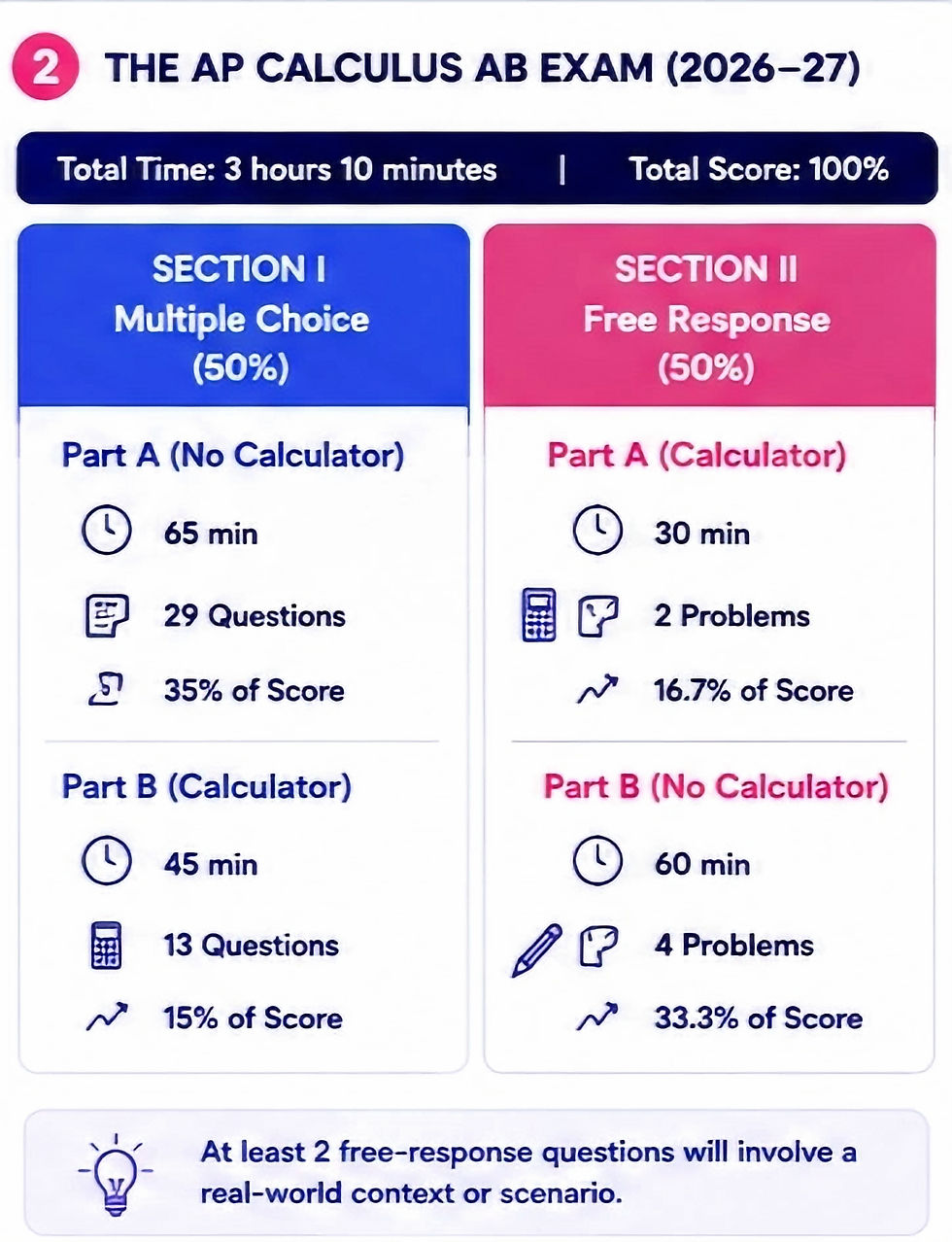
Section I — Multiple Choice
42 questions
1 hour 40 minutes
50% of the score
Part A
29 questions
65 minutes
No graphing calculator
35% of the total score
Part B
13 questions
45 minutes
Graphing calculator required for some questions
15% of the total score
Section II — Free Response
6 questions
1 hour 30 minutes
50% of the score
Part A
2 problems
30 minutes
Graphing calculator required
16.7% of the total score
Part B
4 problems
60 minutes
No graphing calculator
33.3% of the total score
College Board also notes that the exam uses different function types and representations, including analytical, graphical, tabular, and verbal representations. At least two free-response questions incorporate a real-world context or scenario.
This immediately tells us something important:
Half of your score comes from free response.
So preparing exclusively with multiple-choice questions is a major strategic mistake. You can also check out our detailed guide on Online Math Tutoring for AP Calculus
AP Calculus AB Is Also a Communication Exam
This surprises some students.
You are not simply being tested on whether your final number is correct.
You may need to:
Define a quantity.
Interpret a derivative.
Explain a conclusion.
Justify an answer.
Use mathematical notation correctly.
Connect a numerical result to a real-world situation.
College Board explicitly emphasizes communication and justification as course skills.
So your preparation needs to include writing mathematics, not just doing mathematics.
The 8 Units You Need to Master

AP Calculus AB is organized into eight major units.
Unit | Main Focus | Approx. Exam Weight |
1 | Limits and Continuity | 10–15% |
2 | Differentiation: Definition and Fundamental Properties | 10–15% |
3 | Composite, Implicit, and Inverse Functions | 5–10% |
4 | Contextual Applications of Differentiation | 10–15% |
5 | Analytical Applications of Differentiation | 15–20% |
6 | Integration and Accumulation of Change | 15–20% |
7 | Differential Equations | 5–10% |
8 | Applications of Integration | 10–15% |
These are the current College Board weight ranges for AP Calculus AB.
Notice something.
Units 5 and 6 carry some of the highest individual weighting.
That doesn't mean you should ignore the other units.
It means that your preparation should be strategic rather than evenly distributed simply because there are eight units.
The Big Idea Behind AP Calculus AB
If you remember one conceptual framework from this entire guide, make it this:
Limits → Derivatives → Integrals
Limits help define instantaneous behavior.
Derivatives describe rates of change.
Integrals describe accumulation.

And the Fundamental Theorem of Calculus connects differentiation and integration.
That is the intellectual structure underneath much of the course.
Unit 1: Limits and Continuity
Don't Treat Limits as a Calculator Exercise
A limit is about what a function approaches.
You should be comfortable finding limits from:
Graphs
Tables
Algebraic expressions
Numerical evidence
Verbal descriptions
But the deeper skill is recognizing why the limit behaves the way it does.
Continuity Matters
Know the conditions for continuity at a point.
But don't merely memorize them.
When looking at a graph, ask:
Can I travel through the function at this point without lifting my mathematical pencil?
Then investigate:
Is the function defined?
Does the limit exist?
Does the function value match the limit?
Intermediate Value Theorem
You should understand the theorem conceptually.
If a function is continuous over an interval and takes values on both sides of a target value, the function must take that target value somewhere in between.
AP questions can ask you to justify the existence of a solution rather than calculate the exact solution.
That means memorizing the theorem's name is not enough.
You must know:
The conditions.
The conclusion.
How to apply it to a particular situation.
Extreme Value Theorem
Similarly, understand the relationship between continuity and extrema on a closed interval.
College Board's 2026 clarification specifically updated the Extreme Value Theorem language to emphasize that a continuous function on a closed interval has at least one minimum and at least one maximum on that interval.
Unit 2: Differentiation
This is where calculus begins to feel like calculus.
You need to understand:
Derivative at a point
Derivative as a function
Instantaneous rate of change
Tangent lines
Differentiability
Power rule
Product rule
Quotient rule
Basic derivatives
But don't let derivative rules become a memorization contest.
Derivative Meaning Is More Important Than Derivative Speed
Suppose:
f′(3)=7
Don't automatically think:
"The answer is 7."
Think:
"At x=3, the instantaneous rate of change of f with respect to x is 7."
If x and f(x) represent real-world quantities, you also need to attach units.
That interpretation can be the difference between an incomplete response and a complete one.
Unit 3: Chain Rule, Implicit Differentiation, and Inverses
This unit builds on differentiation.
You need to be comfortable recognizing when a function is composite.
Instead of seeing:
sin(x2)
as one intimidating expression, see:
outside function: sine
inside function: x2
That makes the Chain Rule much more intuitive.
Implicit Differentiation
Don't memorize a sequence of mysterious algebraic steps.
Understand that both x and y depend on the same underlying variable.
When differentiating a term involving y, the derivative introduces:
dxdy
The important skill is recognizing when implicit differentiation is appropriate.
Inverse Functions
You should understand the relationship between a function and its inverse.
That includes:
Graphical relationships
Derivative relationships
Inverse-function notation
Interpretation
Don't treat inverse differentiation as an isolated formula.
Connect it back to the idea of reversing a function.
Unit 4: Contextual Applications of Differentiation
This is where calculus becomes a language for describing real situations.
You may encounter:
Motion
Related rates
Rates of change
Linear approximation
Local behavior
Real-world models
Motion Problems: Build the Translation Skill
A common mistake is trying to calculate immediately.
Instead, identify:
Position
What is the location?
Velocity
How quickly is position changing?
Acceleration
How quickly is velocity changing?
Then connect:
Position → Velocity → Acceleration
Related Rates
Related rates problems often feel difficult because the mathematics isn't necessarily advanced.
The difficulty is translation.
You need to convert a verbal situation into a mathematical relationship.
A reliable sequence is:
1. Identify the quantities.
2. Write the relationship between them.
3. Differentiate with respect to time.
4. Substitute known values.
5. Solve for the requested rate.
Don't substitute everything before differentiating unless the structure of the problem specifically permits it.
Linearization
Understand the idea:
Near a point, a differentiable function can often be approximated by its tangent line.
Don't only memorize the formula.
Ask:
Why should the tangent line be a reasonable approximation nearby?
That conceptual understanding makes unfamiliar problems easier.
Unit 5: Analytical Applications of Differentiation
This is one of the highest-weighted units.
It deserves serious attention.
Increasing and Decreasing
Know how the sign of f′(x) relates to the behavior of f(x).
But learn to explain it:
f′(x)>0
The function is increasing.
f′(x)<0
The function is decreasing.
The key is learning to move between:
Derivative → sign → behavior of original function
Critical Points
A critical point occurs where the derivative is zero or does not exist, provided the point is in the domain of the function.
But don't automatically call every critical point a maximum or minimum.
You must analyze the behavior around it.
First Derivative Test
Learn to use the sign of the derivative on either side of a critical point.
For example:
positive → negative
means the original function changes from increasing to decreasing.
That indicates a local maximum.
Second Derivative Test
Understand what the second derivative tells you about concavity and how that can help classify certain critical points.
Again:
Don't memorize.
Interpret.
Mean Value Theorem
Know:
Conditions
Conclusion
How to apply it
How to justify it
A classic AP-style mistake is stating the theorem without verifying its conditions.
The strongest response does both.
Optimization
Optimization questions often appear complicated because they are wrapped in a story.
Strip the problem down.
Ask:
What quantity am I trying to maximize or minimize?
Then:
Define variables.
Establish the constraint.
Build the objective function.
Differentiate.
Find candidates.
Check the relevant domain.
Interpret the answer.
Unit 6: Integration and Accumulation of Change
This is the other major high-weight unit.
Integration should not feel like a completely separate subject from derivatives.
It is connected to them.
Understand Accumulation
If a rate tells you how quickly something is changing, an integral can tell you how much change accumulated.
This idea appears everywhere in AP Calculus.
For example:
Rate → Accumulated Change
That relationship is more important than memorizing dozens of isolated formulas.
Riemann Sums
Understand the idea behind:
Left sums
Right sums
Midpoint sums
Trapezoidal sums
The fundamental idea is approximation through smaller pieces.
The AP exam may test interpretation rather than simply asking you to calculate a sum.
Definite Integrals
A definite integral can represent:
Accumulated change
Net change
Area under a curve
Signed area
The phrase net change is especially important.
If a rate becomes negative, the integral reflects that negative contribution.
Fundamental Theorem of Calculus
This is one of the central ideas of the course.
You should understand both directions:
Differentiation of an accumulation function
and
Evaluation of a definite integral using an antiderivative
Don't memorize the theorem as a disconnected formula.
Understand the relationship:
Differentiation and integration are deeply connected operations.
Unit 7: Differential Equations
This unit may feel unusual at first.
The key concept is:
A differential equation describes a relationship involving a function and its derivative.
You should understand:
Differential equations
Slope fields
Solution curves
Initial conditions
Separation of variables
Exponential growth and decay
Slope Fields
Don't just plot random little line segments.
Interpret them.
A slope field gives you information about:
How a solution curve should behave at different locations.
You should be able to reason about whether a solution:
Increases
Decreases
Levels off
Moves toward a particular behavior
Unit 8: Applications of Integration
This unit turns integration into applications.
You need to understand:
Average value
Accumulation
Particle motion
Area between curves
Volumes
Cross sections
Disk method
Washer method
Area Between Curves
Don't memorize "top minus bottom" without understanding why.
Sketch the region.
Identify:
Which function is on top.
Which function is on bottom.
Where they intersect.
What interval you are integrating over.
If the functions switch positions, your setup may need to change.
Volumes
This is another area where diagrams are extremely valuable.
Before writing an integral, ask:
What does one cross-section look like?
Then determine:
Shape
Radius
Width
Area
Bounds
The integral is the accumulation of those cross-sectional areas.
To find the best resources for AB and BC, please refer to our Best AP Calculus AB Resources
and Best AP Calculus BC Resources guide.
The Most Important AP Calculus Habit

Draw the situation.
A quick sketch can reveal:
Bounds
Intersections
Increasing/decreasing behavior
Maximum/minimum
Area
Volume
Motion direction
Sign changes
Don't underestimate visual reasoning.
Learn to Translate Between Four Representations
For AP Calculus AB, you should constantly practice moving between:
Equation
What does the formula tell me?
Graph
What does the shape tell me?
Table
What does the numerical pattern tell me?
Words
What does the situation mean?
College Board explicitly states that AP Calculus AB questions use analytical, graphical, tabular, and verbal representations.
A 5-level student can move between these representations without feeling like the problem has suddenly become a completely different subject.
Calculator Strategy
The graphing calculator is important.
College Board currently permits graphing calculators for AP Calculus AB, with calculator use required for Part B of the multiple-choice section and Part A of the free-response section.
The built-in Desmos graphing calculator is also available through Bluebook.
But:
Don't become calculator-dependent.
You should be able to reason about the mathematics before using the calculator.
Our AP Calculus AB Guide explains the units, exam structure and preparation strategy.
Similarly for AP Calculus BC Guide does the same for other.
Learn These Calculator Skills
Practice:
Graphing functions
Finding intersections
Evaluating expressions
Numerical derivatives
Numerical integrals
Tables
Appropriate windows
Solving equations numerically
Checking whether an answer is reasonable
Calculator Skill #1: Know When to Use It
Ask:
Does this question actually require numerical technology?
Sometimes the graph or algebra gives the answer immediately.
Calculator Skill #2: Know What the Output Means
If the calculator returns:
x=3.847
you still need to know:
What does x represent?
Are the units appropriate?
Is the answer in the requested interval?
Is the value mathematically reasonable?
A calculator produces numbers.
You produce mathematics.
Free Response: The 50% Opportunity
Half of the AP Calculus AB score comes from free response under the current exam structure.
That means FRQ preparation should begin early.
Not two weeks before the exam.

How to Approach an FRQ
Use this sequence:
Read
Understand the scenario.
↓
Identify
What mathematical idea is being tested?
↓
Set Up
Write the appropriate relationship.
↓
Calculate
Perform the mathematics.
↓
Interpret
Explain what the result means.
↓
Check
Does the answer make sense?
FRQ Mistake: Giving Only a Number
Suppose the question asks:
Interpret the meaning of f′(4) in context.
Writing:
7.2
is not an interpretation.
You need to communicate what 7.2 means in the context of the problem.
This is where students can lose points despite doing the underlying calculation correctly.
FRQ Mistake: Forgetting Units
If a derivative represents:
miles per hour
say so.
If an integral represents:
gallons
say so.
Units are part of mathematical communication.
FRQ Mistake: Not Justifying
If the question asks you to justify a conclusion, a calculation alone may not be sufficient.
Use the mathematical relationship that supports your conclusion.
FRQ Mistake: Giving Up After One Error
This is a major psychological trap.
Suppose you make an error in Part A.
Do not assume the entire problem is lost.
Read Part B independently.
Continue working.
The exam rewards points, not emotional reactions to previous mistakes.
The AP Calculus AB Error Log
Create five categories.
1. Concept Error
"I didn't understand the idea."
Fix:
Review the concept and explain it in your own words.
2. Algebra Error
"I knew the calculus but made an algebra mistake."
Fix:
Practice algebra separately.
3. Interpretation Error
"I calculated correctly but misunderstood what the answer meant."
Fix:
Practice units and contextual explanations.
4. Strategy Error
"I chose the wrong method."
Fix:
Learn to identify problem types before calculating.
5. Communication Error
"I knew the answer but didn't explain it properly."
Fix:
Practice FRQ responses against official scoring guidelines.
Why Your Error Log Is More Important Than Your Question Count
Imagine two students.
Student A
Completes 1,000 problems.
Repeatedly makes the same five mistakes.
Never reviews them.
Student B
Completes 500 problems.
Identifies recurring errors.
Fixes them systematically.
Student B may be much better prepared.
The objective is not:
More questions.
It is:
Fewer repeated mistakes.
The 5-Phase AP Calculus AB Study System
Phase 1 — Understand
Learn the concepts.
Phase 2 — Connect
Link equations, graphs, tables, and words.
Phase 3 — Practice
Solve AP-style questions.
Phase 4 — Analyze
Study every meaningful mistake.
Phase 5 — Perform
Practice under actual time pressure.
This is the difference between studying calculus and preparing for AP Calculus AB.
A 16-Week AP Calculus AB Study Plan

Weeks 1–4: Build the Foundation
Week 1
Limits and continuity
Week 2
Derivative definition and basic rules
Week 3
Chain rule, implicit differentiation, inverse functions
Week 4
Mixed differentiation review
Weeks 5–7: Applications of Derivatives
Week 5
Rates and motion
Week 6
Related rates and linearization
Week 7
MVT, extrema, increasing/decreasing, optimization
Weeks 8–10: Integration
Week 8
Antiderivatives and definite integrals
Week 9
Riemann sums and accumulation
Week 10
Fundamental Theorem of Calculus
Weeks 11–12: Applications
Week 11
Differential equations
Week 12
Area, volume, average value, particle motion
Weeks 13–14: Mixed AP Practice
Now stop studying only by unit.
Mix:
Limits
Derivatives
Integrals
Applications
Graphs
Tables
Modeling
This forces your brain to identify the method rather than being told the method by the chapter title.
Week 15: Full Exam Practice
Complete realistic practice exams.
Use official released material where possible.
College Board provides released AP Calculus AB free-response questions and scoring information through AP Central.
Week 16: Weakness Elimination
Don't try to relearn everything.
Identify your weakest three areas.
For example:
1. Related rates
2. Area between curves
3. FRQ interpretation
Spend your final preparation time fixing those.
How to Study Each Day
A strong study session might look like:
10 minutes
Review previous errors.
20 minutes
Learn or review a concept.
30 minutes
Solve targeted problems.
20 minutes
Complete AP-style questions.
10 minutes
Analyze mistakes.
This is often more productive than spending two hours simply doing random questions.
How to Prepare for the No-Calculator Section
This section deserves deliberate preparation.
Practice:
Algebraic manipulation
Exact values
Derivative rules
Integral relationships
Graph interpretation
Sign analysis
Limits
Conceptual reasoning
The goal is to become comfortable thinking without technological assistance.
How to Prepare for the Calculator Section
Practice:
Numerical solutions
Graphs
Intersections
Numerical derivatives
Numerical integrals
Tables
Modeling
But always connect the calculator result back to the mathematical question.
How to Prepare for FRQs
At least once per week during serious preparation:
Select an official or AP-style FRQ.
Set a timer.
Complete it without assistance.
Compare your work with the scoring information.
Identify every lost point.
Categorize the mistake.
Redo the question.
That final step matters.
Redo it.
Don't just read the solution.
How to Know Whether You're Improving
Don't look only at your raw score.
Track:
Accuracy
How many questions did you get correct?
Timing
How long did they take?
Error Type
Why did you miss them?
Consistency
Can you repeat the performance?
Transfer
Can you solve a similar problem presented differently?
That final category is particularly important.
What a 5-Level Student Can Do
A 5-level student can usually:
Recognize the underlying calculus concept.
Interpret graphs efficiently.
Use tables intelligently.
Set up contextual problems.
Differentiate accurately.
Integrate accurately.
Explain derivatives in context.
Explain integrals in context.
Justify conclusions.
Use the calculator strategically.
Communicate clearly on FRQs.
Recover quickly from difficult questions.
The goal is to develop this entire skill set.
The Biggest Mistakes AP Calculus AB Students Make

Mistake #1: Memorizing Formulas Without Understanding
You may remember a formula and still not know when to use it.
Mistake #2: Ignoring Algebra
Calculus cannot rescue weak algebra.
Mistake #3: Practicing Only Multiple Choice
You are leaving half the current exam score largely untrained.
Mistake #4: Avoiding Hard Questions
Hard questions teach you how to adapt.
Mistake #5: Never Practicing Under Time Pressure
Knowing calculus and performing calculus under a clock are different skills.
Mistake #6: Not Reviewing Mistakes
Your mistakes tell you what to study next.
Mistake #7: Forgetting Context
A number isn't always the final answer.
Explain what it means.
Mistake #8: Using the Calculator as a Crutch
Technology should support reasoning—not replace it.
Do You Need an AP Calculus AB Tutor?
Not necessarily.
A disciplined student with strong foundations can prepare independently.
However, targeted tutoring can be particularly valuable when a student:
Has recurring conceptual gaps.
Struggles with algebra.
Cannot translate word problems.
Gets stuck on FRQs.
Needs accountability.
Has a high score target.
Keeps plateauing despite extensive practice.
The best tutoring isn't simply:
"Here are 30 more questions."
It is:
"Let's figure out exactly why you're missing these questions and build a plan to eliminate that pattern."
The IMRSB AP Calculus AB Framework
At IMRSB, we can think about AP Calculus preparation as:
Understand
Build the concept.
↓
Visualize
Connect the equation, graph, table, and situation.
↓
Apply
Use calculus in unfamiliar contexts.
↓
Communicate
Explain and justify the mathematics.
↓
Perform
Execute accurately under AP conditions.
Understand → Visualize → Apply → Communicate → Perform
That is the path toward a 5.
Frequently Asked Questions
Is AP Calculus AB hard?
It can be challenging because it combines algebra, functions, limits, differentiation, integration, modeling, and mathematical reasoning.
Students with strong algebra, trigonometry, and function foundations generally have a much better starting point.
College Board recommends prior study of algebra, geometry, trigonometry, analytic geometry, and elementary functions.
Can I get a 5 without a tutor?
Yes.
A tutor is not required.
What matters is the quality of your preparation, your consistency, and whether you actively analyze and correct your mistakes.
How long should I study for AP Calculus AB?
There is no universal number of hours.
A student taking the course seriously throughout the year should be reviewing continuously rather than attempting to learn the entire course shortly before May.
Should I memorize all the derivative formulas?
Know the essential derivatives and rules, but understand the underlying structure.
You should be able to recognize when the Chain Rule, Product Rule, Quotient Rule, or implicit differentiation is appropriate.
How important are FRQs?
Extremely important.
Under the current AP Calculus AB exam structure, free response represents 50% of the total score.
Is the calculator required?
A graphing calculator is required for designated portions of the AP Calculus AB exam. College Board also provides a built-in Desmos graphing calculator through Bluebook.
What is the hardest AP Calculus AB unit?
There is no universal answer.
Many students find contextual differentiation, analytical applications, integration, or applications of integration challenging because these topics require students to combine multiple skills.
Your personal hardest unit is the one where your error pattern is strongest.
Can I get a 5 if I struggle with algebra?
Yes—but you should address the algebra immediately.
Weak algebra can make calculus problems appear much harder than they actually are.
The 5-on-AP-Calculus AB Checklist
Before exam day, you should be able to say:
☐ I understand limits conceptually.
☐ I understand continuity.
☐ I can interpret derivatives.
☐ I can differentiate common functions.
☐ I can use the Chain Rule.
☐ I can perform implicit differentiation.
☐ I understand inverse-function derivatives.
☐ I can solve related-rate problems.
☐ I understand motion problems.
☐ I can analyze increasing/decreasing behavior.
☐ I can identify and classify extrema.
☐ I can apply the Mean Value Theorem.
☐ I can solve optimization problems.
☐ I understand accumulation.
☐ I can use Riemann sums.
☐ I understand the Fundamental Theorem of Calculus.
☐ I can work with differential equations and slope fields.
☐ I can solve area problems.
☐ I can solve volume problems.
☐ I can calculate average value.
☐ I can use my graphing calculator efficiently.
☐ I can work without a calculator.
☐ I can write complete FRQ explanations.
☐ I understand how to justify conclusions.
☐ I have practiced official AP material.
☐ I maintain an error log.
☐ I have completed timed practice.
☐ I can perform consistently under exam conditions.
Final Verdict
How do you score a 5 on AP Calculus AB?
You don't get there by memorizing more formulas than everyone else.
You get there by becoming more mathematically flexible.
Understand the concepts.
Strengthen the algebra.
Learn to interpret graphs and tables.
Connect derivatives to rates of change.
Connect integrals to accumulation.
Practice contextual problems.
Learn to justify your reasoning.
Become fluent with your calculator.
Practice FRQs.
Analyze every meaningful mistake.
Then practice performing under realistic time pressure.
Most importantly, don't ask:
"How many problems have I completed?"
Ask:
"What mistakes am I no longer making?"
That is a much better measure of preparation.
A 5 is not produced by one heroic week of studying.
It is built through hundreds of small improvements:
one concept understood,one misconception corrected,one difficult FRQ explained,one recurring error eliminated,one better decision made under pressure.
That is how preparation becomes performance.
And that is how you give yourself the best possible chance of earning a 5 on AP Calculus AB.
Preparing for a 5 on AP Calculus AB?
Don't wait until the final weeks to discover your weaknesses.
Start with a diagnostic.
Identify your gaps.
Build a targeted plan.
Practice deliberately.
Analyze your mistakes.
Strengthen your mathematical reasoning.
And turn preparation into measurable progress.

Related IMRSB Guides
College Admissions
SAT Preparation
Advanced Placement
School Math
About IMRSB
At IMRSB, mathematics is not about memorizing procedures and hoping the next question looks familiar. Our approach focuses on understanding, reasoning, representation, application, and confidence. For AP Calculus AB students, that means preparing not only to recognize familiar calculus problems, but also to approach unfamiliar ones with a clear mathematical strategy.
Comments