Online Math Tutoring for AP Calculus | Personalized 1:1 AP Calculus Help

Updated: Sep 9
Online Math Tutoring for AP Calculus

In this guide
AP Calculus is where mathematics stops feeling like a collection of formulas and starts demanding reasoning.
A student may know the derivative rules and still struggle with an AP Calculus question.
They may know how to integrate and still lose points on an FRQ.
They may understand what a graph shows but not know how to explain it mathematically.
And sometimes the problem isn't calculus at all—it is algebra, trigonometry, notation,
interpretation, or simply knowing which mathematical idea the question is testing.
That is where personalized online math tutoring can make a meaningful difference.
At IMRSB, our approach to online math tutoring for AP Calculus is built around a simple idea:
Don't give every student more problems. Give each student the right problem, the right explanation, and the right feedback at the right time.
AP Calculus AB and BC are introductory college-level calculus courses. College Board describes the courses as requiring students to work with calculus through graphical, numerical, analytical, and verbal representations while also justifying conclusions and communicating mathematically.
That combination is exactly why personalized instruction can be so valuable. Our AP Calculus AB Guide explains the units, exam structure and preparation strategy.
Similarly for AP Calculus BC Guide does the same for other.
What Makes AP Calculus Different From Ordinary High School Math?
In many mathematics classes, a student can succeed by learning a procedure.

See the problem.
Identify the formula.
Substitute.
Calculate.
AP Calculus is different.
A question might give you a graph instead of an equation.
Or a table instead of a graph.
Or a verbal description instead of either.
It may ask you to interpret a derivative rather than calculate one.
It may ask you to justify why a function is increasing.
It may give you a calculator and still require mathematical reasoning.
College Board specifically emphasizes four major skills: determining expressions and values, connecting representations, justifying reasoning, and communicating with correct notation and mathematical conventions.
That means a student can be mathematically capable and still need help learning how AP Calculus wants that mathematics communicated.
Online AP Calculus Tutoring Is Not the Same as Homework Help
This distinction matters.
Homework help usually begins with:
“What problem are you stuck on?”
AP Calculus tutoring should begin with:
“Why are you getting stuck?”
Those are very different questions.
Suppose a student misses a related-rates question.
The visible problem is one incorrect answer.
But the underlying problem might be:
difficulty translating words into equations
misunderstanding what is changing
differentiating with respect to time incorrectly
weak algebra
incorrect units
failure to use the initial condition
inability to interpret the final answer
If a tutor simply demonstrates the solution, the student may understand that one problem.
If the tutor identifies the underlying weakness, the student can improve across an entire category of questions.
That is the difference between answer assistance and mathematical instruction.
Students targeting a 5 can also follow our How to Score a 5 on AP Calculus AB study strategy, and for BC How to Score a 5 on AP Calculus BC.
What Online AP Calculus Tutoring For?
Online AP Calculus tutoring can help students at very different levels.

Students who are struggling
These students often don't need harder questions.
They need the foundation repaired.
A student who struggles with derivatives because algebraic functions are unfamiliar will continue struggling regardless of how many derivative worksheets they complete.
The first step is diagnosis.
Students earning Bs who want an A
This is one of the most important groups.
These students often understand most of the material but have inconsistent performance.
They might:
make algebra mistakes
forget conditions
misread graphs
lose FRQ justification points
struggle with unfamiliar questions
make calculator errors
run out of time
For these students, tutoring can focus less on teaching an entire unit and more on turning partial understanding into reliable performance.
Strong students targeting a 5
A strong student doesn't necessarily need more teaching.
They may need:
Harder application
Mixed-topic practice
FRQ analysis
Timing
Error reduction
BC-specific depth
At this level, tutoring becomes less about:
“Here's how to do this problem.”
and more about:
“Why did you choose this method, and is there a faster or more defensible way to approach it?”
Students taking AP Calculus BC
BC contains the AB material and extends it into additional calculus topics.
College Board currently organizes AP Calculus BC into 10 units, including limits, differentiation, integration, differential equations, applications of integration, parametric/polar/vector-valued functions, and infinite sequences and series.
That additional breadth makes strategic tutoring particularly useful.
The BC student isn't simply studying “more calculus.”
They are learning to move between a broader set of mathematical ideas.
AP Calculus AB vs. AP Calculus BC Tutoring
The two courses overlap substantially.
To find the best resources for AB and BC, please refer to our Best AP Calculus AB Resources
and Best AP Calculus BC Resources guide.
BC includes all eight AB units and adds further content, including additional integration techniques, Euler's method and logistic models, arc length, parametric equations, polar coordinates, vector-valued functions, and infinite sequences and series.
So the tutoring strategy should not be identical.
For AB, a tutoring plan may concentrate heavily on:
limits
derivatives
applications of derivatives
integration
differential equations
applications of integration
For BC, those remain important, but tutoring must also deliberately protect time for:
advanced integration
parametric equations
polar calculus
vector-valued functions
sequences and series
Taylor and Maclaurin series
BC-specific applications
A student can be excellent at derivatives and still be underprepared for BC.
The First Step: Diagnose the Student
Before building a tutoring plan, we want to know what is actually happening.
Imagine two students both score 62% on a calculus practice set.
They should not automatically receive the same tutoring plan.

Student A may have:
90% conceptual understanding
weak algebra accuracy
several careless mistakes
poor time management
Student B may have:
weak understanding of derivatives
difficulty interpreting graphs
confusion about applications
relatively few careless mistakes
Giving both students the same worksheet is inefficient.
Their scores are similar.
Their problems aren't.
The IMRSB AP Calculus Diagnostic Approach
A useful diagnostic looks beyond the final score.
We want to examine:
Concept
Does the student understand the mathematical idea?
Process
Can the student choose an appropriate method?
Execution
Can the student carry out the mathematics accurately?
Representation
Can the student move between equations, graphs, tables and words?
Communication
Can the student explain and justify the result?
Timing
Can the student do all of this under AP conditions?
This produces a much more useful question than:
“What grade are you getting?”
The better question is:
“Where exactly is the grade being lost?”
Why Online Tutoring Can Work Especially Well for Calculus
Online instruction is particularly well suited to calculus because so much of calculus is visual and representational.
A tutor can work directly with:
graphs
functions
tables
derivatives
accumulation functions
motion diagrams
numerical approximations
calculator screens
digital whiteboards
written FRQ responses
A student can share their work immediately.
The tutor can annotate the exact point where the reasoning changed direction.
That is very different from simply watching a recorded lecture.
One Student, One Mathematical Path
A major weakness of generic AP preparation is that it assumes every student has the same problem.
They don't.

One student might need:
Limits → Continuity → Derivatives
Another might need:
Derivative applications → Optimization → Related rates
Another:
Integration → Accumulation → Differential equations
Another:
Series → Convergence → Taylor polynomials
The tutoring plan should follow the student's actual mathematical development.
The Four-Layer AP Calculus Tutoring Model
At IMRSB, a strong AP Calculus session should not be simply:
Explain → Student copies → Next question
A more effective structure is:
Understand → Apply → Explain → Transfer
Understand
Build the underlying mathematical idea.
Apply
Use it on a problem.
Explain
Have the student explain why the method works.
Transfer
Give the student a different-looking problem requiring the same idea.
That last step is critical.
A student hasn't truly mastered a concept just because they can reproduce the example they were shown.
Example: Teaching the Derivative
A weak tutoring session might say:
“The derivative of xn is nxn−1.”
Then provide 20 exercises.
A stronger session asks:
What does the derivative represent?
How is it connected to slope?
What does f′(a) tell us?
How does the graph of f′ relate to f?
What does a positive derivative mean?
What does a negative derivative mean?
What happens when f′(x)=0?
How can a derivative be interpreted in a real-world situation?
Now the student isn't simply memorizing a rule.
They're building a calculus concept.
Why Multiple Representations Matter
This is one of the biggest differences between ordinary tutoring and AP-focused tutoring.

Suppose a question presents:
f′(x)
A student should be able to think algebraically.
But AP Calculus may instead provide a graph.
Or a table.
Or a verbal description.
College Board explicitly emphasizes connecting representations, and its exam questions can use analytical, graphical, tabular, and verbal representations.
So tutoring should deliberately move between:
Equation
↔ Graph
↔ Table
↔ Words
A student who can only solve an equation is not yet fully AP-ready.
Calculus Is Full of “Translation Problems”
Consider a simple statement:
“The population is increasing at a rate of 400 people per year.”
A student must translate that statement into mathematical meaning.
Then perhaps determine:
what quantity is changing
what the derivative represents
what the units are
whether the value is positive or negative
what the result means in context
This is why AP Calculus tutoring should include language-to-mathematics translation.
You can also check out our detailed guide on AP Calculus Math
FRQs Require a Different Kind of Preparation
Free-response questions are not simply longer multiple-choice questions.
They require students to communicate.
The current AP Calculus BC exam allocates 50% of the score to free response, with six
questions over 90 minutes. The exam includes calculator and non-calculator portions.
That means students need practice writing mathematical answers.
Not just calculating them.
What a Tutor Should Look for in an FRQ
A tutor should examine:
Did the student answer the question asked?
Is the setup correct?
Is the mathematical notation appropriate?
Is the reasoning justified?
Are units included when needed?
Is the calculator result interpreted?
Did the student explain rather than simply state?
Did the student make an unsupported assumption?
This turns an FRQ into a diagnostic tool.
Why “I Got the Right Answer” Isn't Always Enough
Suppose a student writes:
x=4.7
and the numerical value is correct.
That does not automatically mean the response communicates the required reasoning.
AP Calculus rewards mathematical processes and communication, not merely the existence of a final number.
A tutor should therefore ask:
“How would you defend that answer if the calculator disappeared?”
That question builds mathematical independence.
Calculator Skills Are Part of Calculus Strategy
A graphing calculator isn't a substitute for understanding.
But it is an important tool.
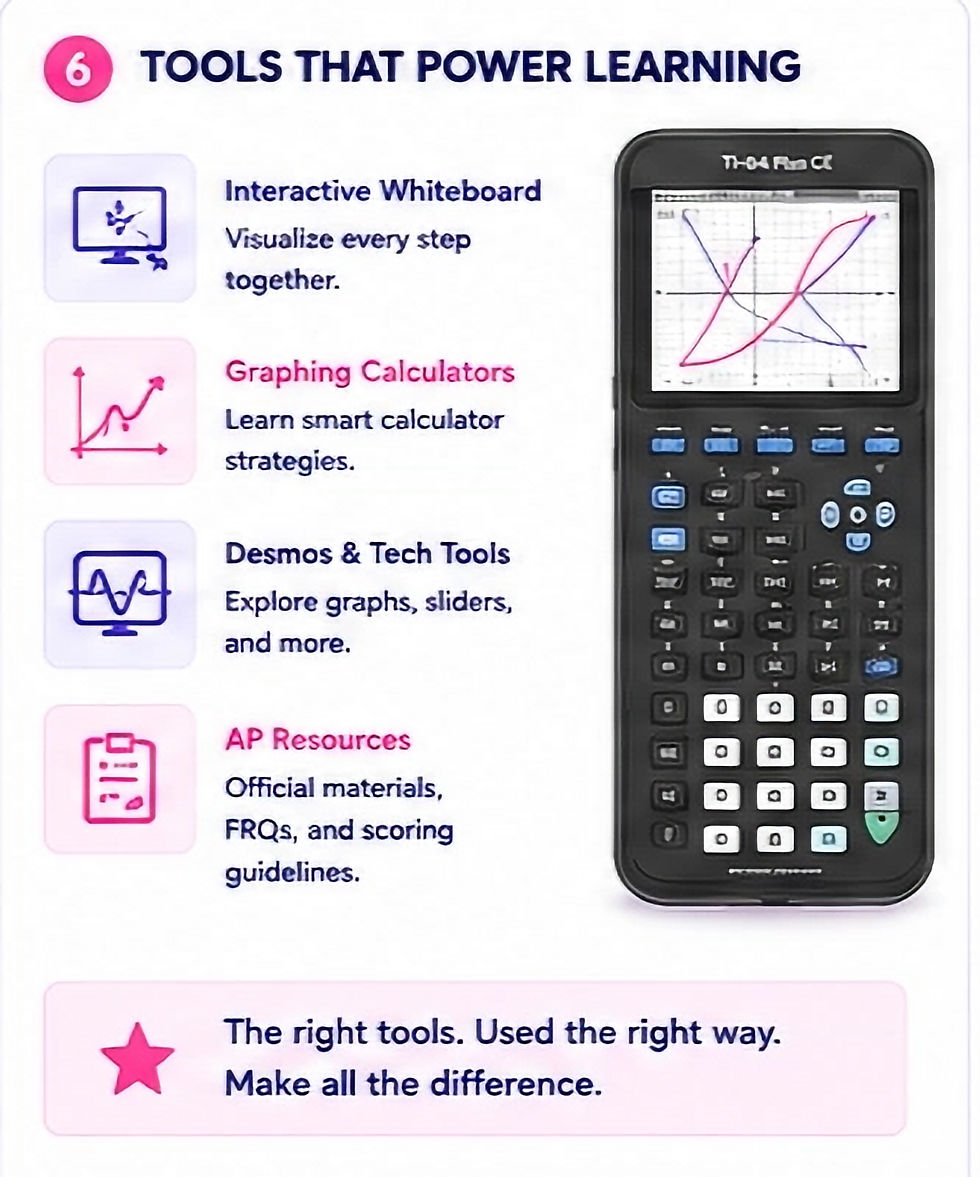
College Board permits calculators for the AP Calculus exam and specifies calculator requirements and permitted models.
Students should know how to use their calculator efficiently for tasks such as:
graphing
numerical roots
intersections
numerical derivatives
numerical integrals
table analysis
checking results
But they should also know when calculator output must be interpreted or justified.
The Goal Isn't “Use the Calculator More”
It is:
Use the calculator when it is mathematically appropriate.
A strong student doesn't reach for the calculator automatically.
They ask:
Can I solve this exactly?
Would a graph help?
Is a numerical approximation required?
Does the calculator confirm something I already understand?
What does this number mean in context?
That is much more sophisticated calculator fluency.
The Algebra Problem Hiding Inside AP Calculus
This is one of the most common reasons students struggle.
They say:
“I don't understand calculus.”
But the actual issue may be:
factoring
fractions
exponents
logarithms
trigonometric identities
function composition
equation manipulation
solving for variables
Calculus builds on these skills.
College Board recommends prerequisites involving algebra, geometry, trigonometry, analytic geometry, elementary functions, transformations, compositions and inverses.
That means an effective tutor sometimes has to temporarily step backward to move the student forward.
Trigonometry Can Become a Hidden AP Calculus Barrier
This becomes especially important in BC.
Students encounter:
sine
cosine
tangent
inverse trig functions
radians
identities
parametric equations
polar coordinates
If trigonometry is weak, the student may believe the calculus is difficult when the real issue is the underlying function knowledge.
A good tutoring plan identifies that early.
BC Students Need Special Attention to Series
Infinite sequences and series are among the areas that distinguish BC from AB.
College Board lists Unit 10, Infinite Sequences and Series, at 15–20% of the multiple-choice exam weighting. Unit 9, involving parametric equations, polar coordinates and vector-valued functions, is listed at 10–15%.
These aren't topics students should leave until the final weeks.
They require repeated exposure.
A tutoring plan should build them into the schedule early enough for students to practice:
recognition
selection of method
calculation
interpretation
and justification.
Taylor and Maclaurin Series Should Not Become Pure Memorization
Students often memorize a list of expansions.
That can help.
But it isn't enough.
A student should understand:
Why a Taylor polynomial works.
How derivatives determine coefficients.
What a Maclaurin series represents.
How approximation works.
What convergence means.
How the series represents a function.
Then memorized patterns become useful rather than fragile.
Parametric and Polar Calculus Need Visualization
These topics are particularly suited to online tutoring.
A tutor can display the curve and connect:
parameter → position → velocity → derivative → graph
or:
angle → radius → polar point → curve
Students can see how the mathematics changes the graph.
That makes the subject much less abstract.
The Error Log: Turning Mistakes Into Data
Every AP Calculus student should have an error log.

But it shouldn't simply say:
“I got #7 wrong.”
Instead:
Question | Error Type | Why It Happened | Fix |
Derivative | Algebra | Simplified incorrectly | Slow down algebra |
Related Rates | Setup | Didn't identify changing quantities | Define variables first |
FRQ | Communication | No justification | Write reasoning explicitly |
Series | Concept | Chose wrong test | Identify series structure first |
Calculator | Input | Entered wrong interval | Check bounds |
After several weeks, patterns emerge.
That's when tutoring becomes much more efficient.
Your Mistakes Become Your Curriculum
This is one of the strongest ideas behind personalized tutoring.
A student's mistakes tell us what to teach next.
If 40% of errors involve algebra, we work on algebra.
If 40% involve interpretation, we practice interpretation.
If the student knows everything but loses points because of timing, the plan changes again.
The student doesn't need a generic “Week 7 worksheet.”
They need their next mathematical obstacle removed.
A Typical Online AP Calculus Tutoring Session
A productive session might look like this:
5 minutes — Review
What happened since the last session?
10 minutes — Diagnose
Look at one or two recent mistakes.
15 minutes — Concept
Clarify the underlying idea.
20 minutes — Guided practice
Solve carefully together.
15 minutes — Independent transfer
Student solves a new problem independently.
10 minutes — AP-style application
Use a graph, table, FRQ or unfamiliar context.
5 minutes — Reflection
What was difficult?
What changed?
What should be practiced next?
This structure prevents tutoring from becoming a two-hour homework rescue session.
What Happens Between Tutoring Sessions Matters
Tutoring works best when the student has a clear independent practice plan.
A student might leave a session with:
3 problems to master
1 FRQ to attempt
1 concept to explain in their own words
1 mistake to revisit
10 minutes of mixed review
The objective isn't maximum homework.
It is targeted reinforcement.
How Often Should a Student Have AP Calculus Tutoring?
There isn't one correct answer.
It depends on the student.
Once a week
Useful for:
maintaining accountability
identifying gaps
reviewing difficult topics
supplementing a strong class
Twice a week
Useful for:
students struggling significantly
accelerated preparation
students targeting major score improvement
intensive FRQ preparation
More frequently
May be appropriate temporarily before:
major exams
AP practice tests
difficult units
final AP preparation
The goal should be to develop independence—not permanent dependence.
Online Tutoring During the School Year
The ideal approach is not to wait until March or April.
During the school year, tutoring should run alongside the class.
For example:
Class introduces derivatives
→ Tutor identifies weaknesses
→ Student practices
→ Tutor checks understanding
→ Student applies derivatives to AP-style problems
That creates a continuous feedback loop.
Online Tutoring Before the School Year
Summer tutoring can be useful for students who want to enter AP Calculus prepared.
Rather than teaching the entire AP course early, a smart summer plan might strengthen:
Algebra
Functions
Trigonometry
Exponential/logarithmic functions
Function transformations
Composition
Graph interpretation
These are the tools students will repeatedly use once calculus begins.
Online Tutoring for Students Already Behind
Being behind doesn't mean the student needs to start from page one.
First identify the minimum missing foundation.
Suppose a student struggles with optimization.
Perhaps they don't need to relearn all of calculus.
They may need:
function understanding
→ derivative interpretation
→ critical points
→ first derivative reasoning
→ optimization setup
That's a targeted intervention.
Online Tutoring for Students Who Are Already Getting 5-Level Practice Scores
Tutoring still has a role—but it changes.
At that level, the focus might become:
Speed
Precision
Unfamiliar contexts
FRQ communication
Error elimination
Advanced mixed practice
Exam strategy
The tutor becomes more of a performance coach than a lecturer.
AP Calculus Tutoring Should Include Unfamiliar Problems
A student can become very good at recognizing the pattern:
“This is the related-rates type.”
But the AP exam doesn't promise to announce the topic.
A stronger student needs to see problems where the method isn't obvious.
The question becomes:
“What mathematical structure do you see?”
rather than:
“Which chapter is this from?”
That is much closer to authentic problem solving.
Why Mixed Practice Matters
Studying one topic at a time creates a false sense of mastery.
If every question in a worksheet involves derivatives, the student already knows what tool to reach for.
A mixed set removes that clue.
Now the student must decide:
Derivative?
Integral?
FTC?
Differential equation?
Series?
Graph interpretation?
Numerical method?
That decision-making skill is essential.
Preparing for the Current AP Exam Format
For students taking the May 2027 AP Calculus AB/BC exam, College Board has announced changes to the multiple-choice question count and timing. The course content itself has not changed.
The current published BC format is:
Multiple Choice: 42 questions, 100 minutes
Free Response: 6 questions, 90 minutes
The multiple-choice section has a calculator-free portion and a calculator-required portion; the free-response section also divides calculator and non-calculator work.
The exam is hybrid digital: students view multiple-choice and free-response questions through Bluebook while handwriting their free-response answers in paper booklets.
That means preparation should include more than traditional worksheets.
Students should become comfortable with the actual testing environment.
Why AP Calculus Tutoring Should Include Exam Simulation
Near the end of the course, tutoring should gradually shift.
Early tutoring:
Understand.
Middle tutoring:
Apply.
Later tutoring:
Perform.
That means timed practice.
Mixed questions.
FRQs.
Calculator decisions.
Digital interface familiarity.
Error analysis.
The student needs to demonstrate that they can reproduce their knowledge under pressure.
What Makes IMRSB Different?
At IMRSB, we don't believe that online tutoring should feel like a video call version of a classroom.
The advantage of personalized online instruction is the ability to make the lesson specific to the student.
Instead of:
“Today everyone is doing integration.”
the question becomes:
“What does this student need to understand about integration today?”
That difference matters.
Personalized 1:1 Mathematics Instruction
Our model focuses on individualized instruction rather than putting every student through the same sequence.
A student may need more time with fundamentals.
Another may need advanced AP questions.
Another may need confidence.
Another may need challenge.
Another may simply need someone to identify why their answers keep losing points.
The mathematics is the same.
The pathway doesn't have to be.
What Students Should Expect From an IMRSB AP Calculus Session
A strong session should leave the student knowing:
What I understand now
What I was doing incorrectly
Why the correction works
What I need to practice
How I will recognize this type of problem next time
That's much more useful than leaving with 25 completed questions.
What Parents Should Look For in an AP Calculus Tutor
If you're a parent choosing an online calculus tutor, don't only ask:
“How much calculus do you know?”
Ask:
Can you diagnose why my child is struggling?
Do you teach concepts or only procedures?
Do you use graphs, tables and verbal explanations?
Do you teach FRQ communication?
Do you analyze mistakes?
Do you understand the current AP exam structure?
Will my child become more independent?
That last question may be the most important.
The purpose of tutoring should be to make the student less dependent on tutoring over time.

Questions to Ask Before Hiring an Online AP Calculus Tutor
Before starting, ask:
Does the tutor teach AP Calculus AB, BC, or both?
This matters if your student is taking BC.
Does the tutor use official AP-style questions?
Authentic College Board questions can be particularly useful for learning the actual assessment style.
Does the tutor review FRQ scoring?
A student should understand how mathematical communication affects performance.
Does the tutor diagnose mistakes?
If every session is just another worksheet, you're missing the value of personalization.
Does the tutor track progress?
Improvement should be measurable.
Does the tutor adapt the plan?
If a student masters derivatives early, the plan should move forward.
Online AP Calculus Tutoring vs. AP Calculus Class
These aren't replacements for one another.
A classroom provides:
Curriculum
Teacher instruction
Peer interaction
Structured coursework
Tutoring provides:
Individual attention
Targeted diagnosis
Flexible pacing
Personalized practice
Immediate feedback
The strongest approach for many students can be:
School course + independent practice + targeted tutoring
rather than expecting one resource to do everything.
Online AP Calculus Tutoring vs. an AP Prep Course
An AP prep course is designed for a group.
That can be useful.
But group instruction naturally has limits.
If 20 students are in a session, the teacher cannot spend the same amount of time diagnosing every student's individual error pattern.
A 1:1 tutor can.
That's the fundamental difference.
A prep course asks:
“What does this group need to learn?”
Personalized tutoring asks:
“What does this particular student need next?”
Online AP Calculus Tutoring vs. AI Tools
AI can be useful for:
generating additional practice
explaining a definition
checking an algebra step
offering another explanation
brainstorming examples
But a student should be careful about using AI as an unquestioned authority.
AP Calculus requires reasoning, notation, interpretation and justification.
A generated solution may look convincing while failing to teach the student why the method works.
The better approach is:
Use technology as a tool.
Use human instruction for diagnosis and judgment.
Make the student do the mathematics.
The IMRSB Study Loop
A strong tutoring relationship can follow this cycle:
Learn
Understand the concept.
↓
Practice
Solve targeted problems.
↓
Analyze
Find the exact mistake.
↓
Correct
Repair the misunderstanding.
↓
Transfer
Solve a new problem.
↓
Perform
Apply the skill under AP conditions.
↓
Repeat
The cycle continues.
This is how tutoring becomes a system rather than a collection of lessons.
A Sample 12-Week AP Calculus Tutoring Plan

Weeks 1–2: Diagnostic + Foundation
Identify gaps in:
algebra
functions
trigonometry
limits
notation
Create the student's initial error profile.
Weeks 3–4: Differentiation
Focus on:
derivative meaning
derivative rules
chain rule
implicit differentiation
related rates
local linearity
interpretation
Weeks 5–6: Applications of Differentiation
Work on:
extrema
MVT
EVT
optimization
motion
graph analysis
contextual reasoning
Weeks 7–8: Integration
Focus on:
accumulation
Riemann sums
FTC
substitution
numerical integration
applications
Weeks 9–10: Advanced AP / BC Topics
For BC students:
differential equations
parametric equations
polar functions
vector-valued functions
series
Taylor/Maclaurin
The exact sequence should depend on the student's school calendar.
Weeks 11–12: Exam Performance
Focus on:
mixed practice
timed MCQs
FRQs
scoring analysis
calculator strategy
error reduction
exam simulation
A Better Weekly AP Calculus Routine
Students don't need to spend every evening doing calculus.
A sustainable weekly routine could look like:
Classwork
Learn the current material.
Targeted practice
Complete a focused problem set.
Error review
Revisit mistakes.
Tutoring
Work on the highest-priority weakness.
Mixed practice
Prevent older topics from disappearing.
FRQ practice
Build communication skills.
That combination is much more effective than last-minute cramming.
How We Measure Progress
A student's progress should not be measured only by test scores.
Look for changes such as:
Fewer repeated mistakes
Better setup
Faster recognition
More complete explanations
Better calculator decisions
Improved graph interpretation
Greater independence
Improved timed performance
A student who moves from:
“I have no idea what to do.”
to:
“I know this is an accumulation problem, and here's why.”
has made significant progress—even before the next test score arrives.
The Goal Is Mathematical Independence
Ultimately, the best tutor should work toward making themselves less necessary.
The student should eventually be able to look at a new problem and think:
“I haven't seen this exact question before, but I recognize the mathematical structure.”
That is real AP Calculus preparation.
Not memorizing 100 question types.
Not copying solutions.
Not watching endless videos.
Understanding mathematics well enough to adapt.

Frequently Asked Questions
Is online tutoring good for AP Calculus?
Yes, particularly when tutoring is personalized around the student's specific weaknesses. AP Calculus requires conceptual understanding, multiple representations, justification and mathematical communication, so individualized feedback can address issues that generic practice may miss.
Should I get an AP Calculus AB or BC tutor?
Choose a tutor who understands the specific course your student is taking. BC contains the AB curriculum plus additional material, including parametric, polar, vector-valued functions and sequences and series.
Can tutoring help me get a 5?
Tutoring cannot guarantee a particular AP score. However, personalized instruction can help identify weaknesses, strengthen concepts, improve FRQ communication and build timed-practice skills—all important components of AP preparation.
How early should I start AP Calculus tutoring?
Earlier is generally better when the goal is long-term improvement. Starting before major gaps accumulate allows tutoring to reinforce classroom learning instead of becoming emergency remediation immediately before the AP exam.
Is one tutoring session per week enough?
For some students, yes. A strong student may benefit from weekly diagnosis and targeted practice, while a student with significant gaps may need more frequent support temporarily.
Can online tutoring help with AP Calculus FRQs?
Absolutely. FRQs are especially suited to individualized feedback because a tutor can examine the student's setup, reasoning, notation, interpretation and justification—not just the final answer.
Does online tutoring replace AP Classroom?
No. AP Classroom and official College Board materials remain valuable because they align directly with the AP course and assessment. Tutoring can help the student understand and use those resources more effectively.
Does AP Calculus tutoring include calculator practice?
It should. Students need to understand both the mathematics and appropriate calculator use. College Board permits graphing calculators on the AP Calculus exam and specifies where calculator use is required or prohibited.
What if my calculus problem is actually algebra?
That happens frequently. A good tutor should be able to identify prerequisite weaknesses and repair them rather than repeatedly giving the student more calculus problems.
Can tutoring help a student who already has an A?
Yes. For strong students, tutoring can shift toward advanced applications, mixed-topic questions, FRQ precision, timing, error reduction and preparation for a 5.
Final Thoughts: AP Calculus Is Not Supposed to Be Memorized
AP Calculus becomes much more manageable when students stop seeing it as hundreds of disconnected formulas.
A derivative is connected to rate of change.
An integral is connected to accumulation.
A graph communicates behavior.
A table contains evidence.
A differential equation describes change.
A series approximates behavior through an infinite process.
And an FRQ asks the student to communicate what all of that means.
That is why effective tutoring goes beyond homework help.
At IMRSB, our goal is to help students build the mathematical thinking that allows them to approach unfamiliar AP Calculus problems with confidence.
Learn the idea.
Understand the representation.
Practice the method.
Explain the reasoning.
Analyze the mistake.
Apply it under pressure.
And eventually:
Solve it independently.
For students and families looking for online math tutoring for AP Calculus, that is the standard we believe tutoring should aim for.
Related IMRSB Guides
College Admissions
SAT Preparation
Advanced Placement
School Math
About IMRSB
At IMRSB, mathematics is not about memorizing procedures and hoping the next question looks familiar. Our approach focuses on:
Understanding → Reasoning → Representation → Application → Confidence
For Math students, that means preparing not only for familiar calculus exercises, but also for the unfamiliar problems that separate procedural knowledge from genuine mathematical understanding.
Comments