Best Online Math Tutor for Middle School Students: A Parent's Complete Guide

Updated: Sep 10
Best Online Math Tutor for Middle School Students: How to Choose the Right 1:1 Math Support

In this guide
Best Online Math Tutor for Middle School Students
Middle school mathematics is often where a student's relationship with math begins to change.
In elementary school, many students can succeed by learning procedures, practicing basic operations, and following familiar patterns.
Then Grades 6–8 arrive.
Suddenly, math asks students to think differently.
Fractions become algebraic expressions.
Ratios become proportional reasoning.
Variables appear everywhere.
Negative numbers become unavoidable.
Equations require multiple steps.
Geometry becomes more abstract.
Graphs begin telling mathematical stories.
Probability and statistics require interpretation rather than calculation alone.
And eventually, students encounter pre-algebra and algebra, where the way they think about mathematics can matter as much as the answer they produce.
That is why choosing the best online math tutor for middle school students should not simply mean finding someone who can explain tonight's homework.
The better question is:
Can this tutor understand how the student thinks, identify what is actually holding them back, and build the mathematical foundation they will need next year?
That is the difference between homework help and mathematical development.
Current tutoring comparisons commonly distinguish between services based on 1:1 attention, curriculum alignment, personalization, tutor consistency, and whether the student receives structured instruction rather than simply completing practice problems.
This guide explains how parents can evaluate those differences before choosing an online math tutor. Our best guide Best Online Math Tutor for High School Students did the same for High School Student
Why Middle School Math Is Such an Important Stage
Middle school is not simply "elementary math, but harder."
It is a transition period.

Students begin moving from:
Arithmetic → Mathematical reasoning
Rules → Relationships
Numbers → Variables
Answers → Explanations
Individual skills → Connected systems
A student may be able to calculate correctly and still have a weak mathematical foundation.
For example, a student may know how to solve:
3x + 5 = 20
but struggle to explain why subtracting 5 from both sides preserves equality.
That distinction becomes increasingly important as mathematics becomes more advanced.
The Hidden Problem: A Student Can Be "Doing Fine" and Still Have a Math Gap
One of the most important things parents should understand is that a math problem does not always appear as a bad report card.
A student can earn:
A B
A B+
even an A
while developing a weakness underneath the surface.
Perhaps the student memorizes procedures.
Perhaps homework is completed with help.
Perhaps tests contain familiar question types.
Perhaps the teacher moves quickly because most of the class understands.
The problem may not become visible until the student reaches a course where those missing foundations are suddenly required.
This is why middle school tutoring should not focus exclusively on:
"How can we raise this week's grade?"
It should also ask:
"What mathematical understanding needs to become stronger before the next stage?"
What Does the Best Online Math Tutor Actually Do?
The best tutor is not necessarily the person who knows the most advanced mathematics.
A middle school student doesn't need someone to demonstrate calculus.
They need someone who can make a difficult idea understandable at exactly the student's
current level of thinking.
A strong tutor should be able to:
Diagnose misconceptions.
Explain concepts in multiple ways.
Ask questions instead of constantly giving answers.
Adjust the pace.
Connect today's lesson to previous knowledge.
Identify prerequisite gaps.
Give appropriately difficult practice.
Track progress.
Build mathematical confidence.
Prepare the student for what comes next.
Research on human tutoring interactions with middle school mathematics has found that targeted human tutor interactions can increase engagement, with concrete, stepwise scaffolding and organized work particularly useful.
That is an important distinction.
Personalization is not simply changing the worksheet.
It is changing the instruction.
What Should a Middle School Math Tutor Teach?
The exact curriculum varies by school, state, and course sequence.
But a strong middle school mathematics program commonly develops several major areas.

Number Sense
Students need confidence with:
Integers
Fractions
Decimals
Rational numbers
Percentages
Ratios
Proportions
Estimation
Operations with signed numbers
These topics can look elementary.
They are not.
Weak number sense can make later algebra unnecessarily difficult.
Expressions and Equations
Students gradually move toward:
Variables
Expressions
Combining like terms
Distributive reasoning
One-step equations
Multi-step equations
Inequalities
Proportional relationships
The goal shouldn't be memorizing isolated rules.
Students should understand what an expression or equation represents.
Pre-Algebra Thinking
Pre-algebra is a bridge.
It connects arithmetic reasoning to formal algebra.
A good tutor should help students become comfortable with:
Variables
Patterns
Functions
Coordinate planes
Rates
Proportional relationships
Algebraic expressions
Equations
Inequalities
The objective is not simply:
"Finish pre-algebra."
It is:
"Become ready for Algebra I."
Geometry
Middle school geometry may include:
Angles
Triangles
Quadrilaterals
Circles
Area
Surface area
Volume
Coordinate geometry
Transformations
Scale drawings
But geometry is also an opportunity to develop reasoning.
Students should increasingly learn to explain why a relationship is true.
Statistics and Probability
Students may encounter:
Mean
Median
Mode
Range
Data displays
Probability
Samples
Distributions
Variability
Interpreting data
Again, the goal is not merely calculating.
Students need to interpret what the numbers mean.
The Most Important Difference: Teaching vs. Explaining
A student asks:
"How do I solve this?"
A weak tutoring experience may immediately demonstrate the steps.
A stronger tutor might ask:
"What have you tried?"
Then:
"Where did you become unsure?"
Then:
"What does this number represent?"
Then:
"What would happen if we changed this value?"
The student is participating in the reasoning.
That matters.
A tutor should not become a human answer key.
The 1:1 Advantage in Middle School Math
One of the strongest reasons parents choose online tutoring is the opportunity for individualized attention.
In a classroom, a teacher has to make decisions for many students simultaneously.
In a 1:1 lesson, the tutor can observe one student's thinking.

That changes the interaction.
For example:
Student A
Understands the concept but makes arithmetic mistakes.
Student B
Calculates accurately but does not understand the concept.
Student C
Understands examples but cannot transfer the idea to unfamiliar problems.
Student D
Understands the mathematics but lacks confidence and stops when a problem looks unfamiliar.
All four students may receive the same grade.
But they need different tutoring.
Our guide on Online Math Tutoring for Algebra, Online Math Tutoring for Geometry and Online Math Tutoring for Algebra II tells parents exaclty how to choose and decide better.
The "Where Did the Thinking Break?" Method
A useful tutoring approach is to identify the precise point where reasoning breaks.
Suppose a student gets:
7 − 12 = 5
The answer is incorrect.
But why?
Possibilities include:
They do not understand negative numbers.
They reverse the operation.
They visualize subtraction incorrectly.
They have memorized a rule without understanding it.
They make sign errors under pressure.
Simply saying:
"The answer is -5"
doesn't solve the underlying problem.
The tutor needs to discover the misconception.
This is one of the strongest reasons personalized instruction can be valuable.
What Parents Should Look for in an Online Math Tutor
Instead of asking only:
"Is this tutor good at math?"
ask these questions.
1. Can the tutor diagnose?
Can they determine why the student is struggling?
2. Can the tutor explain the same idea differently?
A strong tutor shouldn't rely on one explanation.
They may use:
Visual models
Number lines
Diagrams
Examples
Real-world contexts
Algebraic reasoning
Verbal explanations
3. Does the tutor ask questions?
A student should be doing mathematical thinking during the lesson.
4. Does the tutor adjust difficulty?
If everything is easy, the student may not be developing.
If everything is difficult, confidence can collapse.
The tutor needs to find the productive middle.
5. Does the tutor know what comes next?
A good middle school tutor shouldn't teach every topic as an isolated island.
They should understand the progression toward:
Pre-Algebra → Algebra I → Geometry → Algebra II
and, for advanced students, potentially:
Pre-Algebra → Algebra I → Geometry → Algebra II → Precalculus
A Great Tutor Does Not Always Move Faster

This is one of the most misunderstood ideas in math tutoring.
Parents sometimes say:
"My child needs to get ahead."
But acceleration without understanding can create fragile knowledge.
Suppose a student is struggling with fractions.
Moving them quickly into algebra may feel like progress.
But algebra is full of fractions.
The better strategy may be:
Repair the fraction reasoning → strengthen proportional thinking → develop algebraic fluency → accelerate once the foundation is secure.
True acceleration is not simply moving faster.
True acceleration is reducing wasted repetition because the student understands the structure.
The Difference Between Catch-Up, Grade Improvement, and Acceleration
Parents should identify which of these three goals they actually have.
Goal 1 — Catch Up
The student has specific gaps.
The priority is repairing prerequisites.
Goal 2 — Improve Current Performance
The student understands much of the material but needs:
Better problem-solving
More practice
Better organization
Test preparation
Confidence
Goal 3 — Accelerate
The student is performing strongly and wants deeper or faster progression.
This requires a different tutoring philosophy.
A tutor who is excellent at remediation may not be the best tutor for an advanced student.
What Makes Online Math Tutoring Different From Homework Help?
Homework help answers:
"How do I solve this problem?"
Tutoring asks:
"Why are you having difficulty with this type of problem?"
Homework help is reactive.
Tutoring can be strategic.
For example, if a student repeatedly struggles with equations, the tutor might discover that the actual weakness is:
negative numbers → fractions → distributive property → equation solving
The tutor can then work backward.
That is far more valuable than completing ten more equations.
The "Math Dependency Chain"
Mathematics is cumulative.
A useful way to visualize learning is:
Number Sense
↓
Fractions & Ratios
↓
Expressions
↓
Equations
↓
Functions
↓
Algebra
↓
Advanced Mathematics
When one lower-level concept is weak, the difficulty can appear much later.
That is why a middle school tutor should constantly ask:
"What prerequisite is underneath this mistake?"
Why Confidence Matters More in Middle School Than Parents Sometimes Realize
Math anxiety can change how a student approaches a problem.
A student who thinks:
"I'm bad at math."
may stop attempting a problem as soon as it looks unfamiliar.
The tutor's job isn't to offer empty encouragement.
It is to create repeated experiences where the student can see:
"I didn't know this before. Now I understand it."
That creates evidence-based confidence.
Not:
"You're naturally good at math."
But:
"You figured out something that was previously difficult."
That is a much healthier form of confidence.
The Best Tutor Builds Independence
A tutoring relationship should not create dependence.
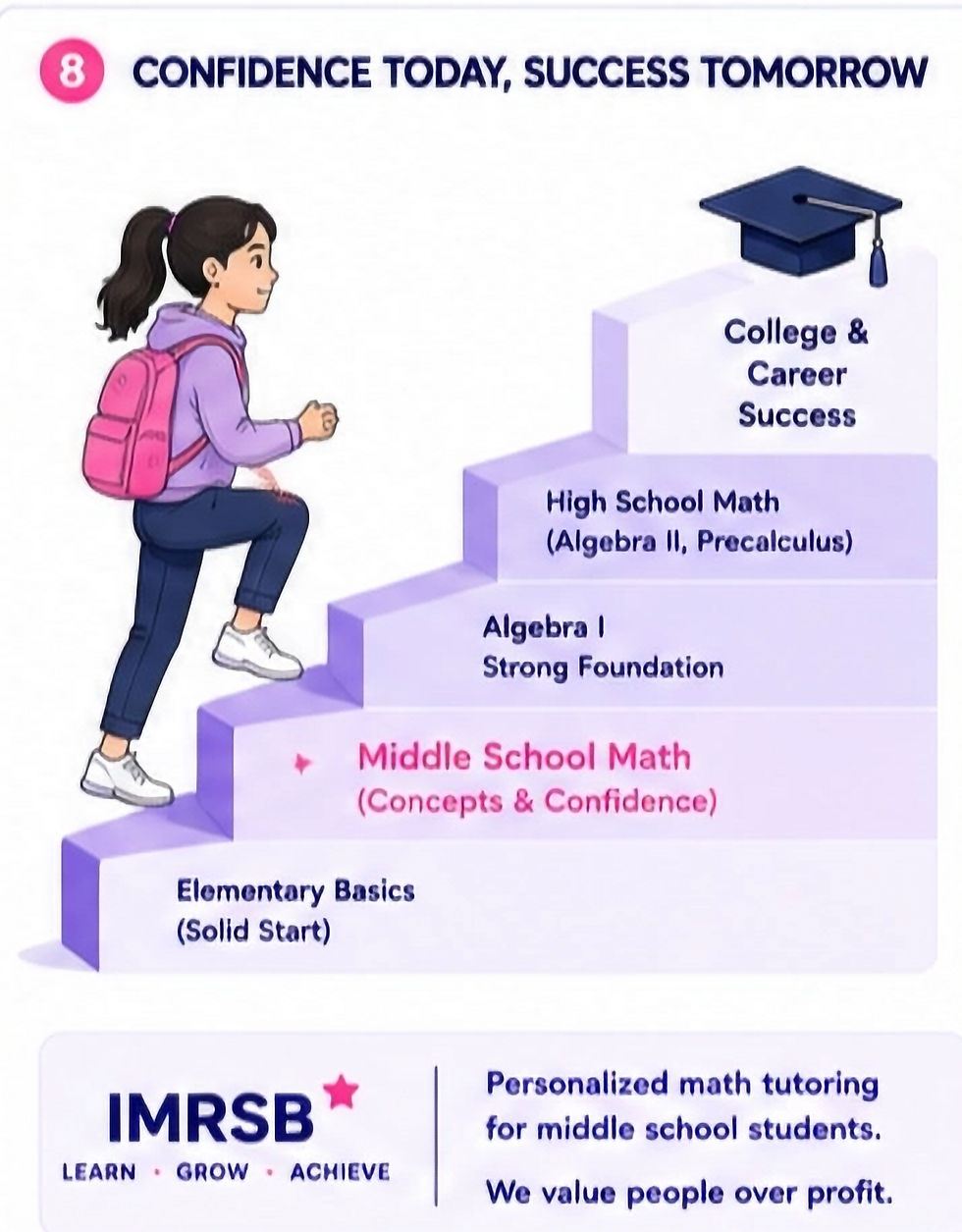
If a student needs the tutor beside them for every homework problem, something is wrong.
A strong tutor gradually transfers responsibility.
Early Stage
Tutor demonstrates.
Next Stage
Tutor and student solve together.
Next Stage
Student explains the approach.
Next Stage
Student solves independently.
Final Stage
Student can recognize the strategy without help.
That progression is the real goal.
The tutor should eventually become less necessary.
That is success.
Why "Show Me the Answer" Can Be a Dangerous Habit
Technology has made answers incredibly easy to obtain.
A student can photograph a problem and receive a solution almost instantly.
But receiving an answer is not the same as developing mathematical ability.
Current research and commentary around AI tutoring increasingly emphasize the distinction between systems that simply provide answers and systems designed to guide students through reasoning and feedback.
The same principle applies to human tutoring.
A tutor should resist becoming:
"The person who makes the problem disappear."
Instead:
"The person who teaches the student how to make the problem manageable."
How Online 1:1 Math Tutoring Can Work Particularly Well
Online tutoring is not automatically better than in-person tutoring.
The quality of the instructional interaction matters.
But online 1:1 tutoring can offer several practical advantages:
Flexible scheduling
No travel
Digital whiteboards
Screen sharing
Immediate access to visual resources
Easy sharing of practice materials
Potential access to tutors outside the local area
Consistent tutoring from home
The digital environment can also make it easier to save work and revisit previous lessons.
But technology should serve the teaching.
It shouldn't become the teaching.
What a Strong Online Math Lesson Should Look Like
A useful 1:1 lesson can follow a structure such as:
1. Quick Diagnostic
What does the student remember?
2. Target Concept
What is today's mathematical idea?
3. Guided Reasoning
The tutor asks questions and works through examples.
4. Student Practice
The student takes control.
5. Challenge Problem
Can the student transfer the concept?
6. Reflection
What was difficult?
What strategy worked?
7. Next Step
What should happen before the next lesson?
This is much more purposeful than simply filling an hour with worksheets.
The 60-Minute Lesson Should Not Feel Like 60 Minutes of Homework
A strong session might include:
10 minutes: Review and diagnosis
15 minutes: Concept development
15 minutes: Guided practice
10 minutes: Independent application
5 minutes: Challenge problem
5 minutes: Reflection and next steps
The exact timing should change according to the student.
The important idea is that instruction, practice, and diagnosis should interact continuously.
How Often Should a Middle School Student Have a Math Tutor?
There is no universal schedule.
It depends on the student's needs.
Occasional Support
Useful when the student is generally strong but needs help with particular topics.
Weekly Tutoring
Often appropriate for consistent skill development and accountability.
Two or More Sessions Per Week
May make sense when a student has significant gaps, needs intensive preparation, or is pursuing accelerated coursework.
The goal should not be:
"More tutoring is always better."
The goal is:
"Enough consistent support to create measurable progress without creating dependency."
What About Advanced Middle School Students?
Not every middle school student needs remediation.
Some students are ready for significantly more advanced mathematics.
For these students, the tutor should avoid simply giving them harder versions of grade-level worksheets.
Instead, consider:
Pre-algebra
Algebra I
Geometry
Competition mathematics
Mathematical reasoning
Problem-solving
Enrichment
Proof
Modeling
The objective is to increase depth, not merely difficulty.
A student who finishes 100 easy problems has not necessarily advanced as much as a student who spends an hour understanding one difficult problem deeply.
How to Choose the Best Online Math Tutor for a Grade 6 Student
Grade 6 can be a particularly important transition.

Look for a tutor who can help with:
Fractions
Ratios
Decimals
Percentages
Integers
Expressions
Equations
Coordinate reasoning
Geometry
Word problems
But don't evaluate the student only by grade-level standards.
Ask:
Is this student ready for the reasoning demands of Grade 7?
That is often more useful.
How to Choose the Best Online Math Tutor for a Grade 7 Student
Grade 7 is often where proportional and algebraic reasoning become increasingly important.
Look for support with:
Proportional relationships
Percent
Rational numbers
Expressions
Equations
Inequalities
Geometry
Probability
Statistics
Multi-step reasoning
A strong tutor should also begin preparing the student for more formal algebraic thinking.
How to Choose the Best Online Math Tutor for a Grade 8 Student
Grade 8 is a major transition point.
The key question becomes:
"Is this student ready for Algebra I?"
Depending on the school's pathway, students may encounter:
Linear equations
Functions
Systems
Exponents
Geometry
Transformations
Data analysis
Algebraic modeling
A tutor should therefore think beyond Grade 8.
They should understand the destination.
The Best Tutor Asks About the Student's Next Course
This is a surprisingly useful question for parents.
Don't just tell a tutor:
"My child is in Grade 8."
Tell them:
"My child is in Grade 8 and will take Algebra I next year."
That changes the planning.
Now the tutor can distinguish between:
What the student needs to pass today
and
What the student needs to succeed next year.
How Parents Can Evaluate a Tutor After the First Few Sessions
Don't judge only by whether your child says:
"I like the tutor."
That matters.
But ask more specific questions.
Ask your child:
"What did you understand today that you didn't understand before?"
"What was the hardest part?"
"Did the tutor let you try problems yourself?"
"Could you explain the idea without the tutor?"
"What are you working on next?"
These questions reveal much more than:
"Was the tutor nice?"
Ask the Tutor for Evidence of Progress
A good tutoring relationship should eventually produce evidence.
That might include:
Diagnostic results
Topic mastery
Error patterns
Practice performance
Assessment results
Confidence changes
Course performance
Independent problem-solving ability
Don't demand that every tutoring session produce a higher test score.
Look for learning trends.
A Simple Progress Dashboard for Parents
You can track four categories.
Area | Question |
Understanding | Can the student explain the concept? |
Accuracy | Can the student solve problems correctly? |
Transfer | Can the student handle unfamiliar problems? |
Independence | Can the student solve without assistance? |
The fourth category is especially important.
A student who gets 90% with constant prompting may be less ready than a student who gets 85% independently and is improving rapidly.
Red Flags When Choosing an Online Math Tutor
Be cautious if a tutor:
Red Flag 1
Does most of the talking.
Red Flag 2
Immediately gives answers.
Red Flag 3
Uses the same lesson for every student.
Red Flag 4
Cannot explain how they diagnose gaps.
Red Flag 5
Focuses only on homework completion.
Red Flag 6
Promises dramatic score improvements without understanding the student.
Red Flag 7
Cannot explain what the student should learn next.
Red Flag 8
Treats every mistake as a careless mistake.
Red Flag 9
Never asks the student to explain their reasoning.
Red Flag 10
Creates dependence rather than independence.
What Makes a Great Middle School Math Tutor Different?
A great tutor notices details.
They notice that a student:
Understands multiplication but struggles with fractions.
Knows formulas but cannot choose the right one.
Can solve examples but freezes on word problems.
Makes mistakes only when negative numbers appear.
Understands the concept verbally but struggles to represent it algebraically.
Works slowly because they are checking everything repeatedly.
Works quickly because they are skipping reasoning.
Those details allow the tutor to personalize instruction.
The "Error Is Information" Principle
A mistake should not simply be marked:
❌ Wrong.
It should be investigated.
For example:
Student error:2(x + 3) = 2x + 3
The important question isn't simply:
"What is the correct answer?"
The important question is:
"What did the student believe the 2 was doing?"
Maybe they understand multiplication but not distribution.
Now the mistake becomes useful information.
This mindset can transform tutoring.
Online Math Tutoring Should Build Mathematical Language Too
A student needs more than computational fluency.
They should gradually learn to use mathematical language such as:
Therefore
Because
Equivalent
Rate
Relationship
Variable
Constant
Proportional
Linear
Estimate
Represent
Justify
Why?
Because advanced mathematics requires students to communicate reasoning.
A tutor who constantly asks:
"How do you know?"
is teaching a skill that will remain valuable long after middle school.
Best Online Math Tutor for Middle School Students: What Parents Should Actually Compare
Instead of comparing tutoring companies solely by price, compare these dimensions.
Factor | What to Look For |
Personalization | Lessons adapt to the student |
Tutor consistency | Student develops an ongoing relationship |
Diagnosis | Tutor identifies underlying gaps |
Curriculum | Instruction connects to school coursework |
Depth | Student learns concepts, not just procedures |
Practice | Student solves independently |
Feedback | Errors are analyzed |
Progress tracking | Parents can see development |
Flexibility | Pace changes when needed |
Future preparation | Tutor understands the next course |
Confidence | Student becomes more willing to attempt problems |
Independence | Student gradually needs less help |
A current 2026 comparison of middle-school tutoring programs similarly highlights tutor consistency, curriculum alignment, personalization, and the distinction between live tutoring and self-paced practice as important factors.
Online Tutor vs. Math Learning App
Learning apps can be useful.
They can provide:
Practice
Immediate feedback
Review
Skill repetition
Progress tracking
But they cannot automatically replace personalized human instruction.
An app may tell a student:
"Try again."
A tutor can ask:
"What changed between these two problems?"
An app can recognize an incorrect answer.
A tutor can investigate the reasoning behind it.
This does not mean technology is bad.
It means different tools solve different problems.
A strong learning system can combine:
Human instruction + independent practice + targeted feedback.
Can AI Be Used Alongside a Math Tutor?
Yes—with care.
AI-based tutoring research is exploring personalized feedback, adaptive practice, and conversational guidance. Some studies report promising learning effects, while researchers also emphasize the importance of instructional design and the limitations of systems that simply provide answers.
For a middle school student, the principle should be:
Use technology to strengthen thinking—not bypass it.
A student should not become dependent on asking an AI for every solution.
Instead, technology can be used for:
Extra practice
Alternative explanations
Review
Visualization
Generating practice questions
Checking understanding
Human tutoring can then focus on the more difficult questions:
Why?
How do you know?
What would happen if...?
Can you solve it another way?
The IMRSB Approach to Middle School Math Tutoring
At IMRSB, the goal should not be to create students who can simply finish worksheets faster.
The bigger goal is:
Build mathematical thinkers before mathematical courses become harder.
That means looking at the student as a developing mathematician rather than as a collection of grades.
A strong 1:1 learning experience should connect:
Current Level
↓
Learning Gaps
↓
Conceptual Understanding
↓
Guided Practice
↓
Independent Problem Solving
↓
Confidence
↓
Future Readiness
This approach is especially valuable during Grades 6–8 because the student is moving toward increasingly formal algebraic thinking.
Why 1:1 Online Math Tutoring Can Be Especially Valuable for Middle School
The biggest advantage isn't that the tutor is online.
The biggest advantage is that the student can have a learning environment built around their own mathematical thinking.

One student may need more visual explanations.
Another may need more practice.
Another may need challenge.
Another may need foundational repair.
Another may need confidence.
Another may simply need someone to slow down and ask:
"Tell me what you're thinking."
That sentence can reveal more than ten completed worksheets.
Frequently Asked Questions
What is the best online math tutor for middle school students?
The best tutor is one who matches the student's academic level, learning needs, goals, and personality while providing individualized instruction rather than simply homework answers.
Look for strong diagnostic ability, conceptual teaching, guided practice, progress monitoring, and a plan for future coursework.
Is 1:1 online math tutoring worth it for middle school students?
It can be particularly useful when a student has persistent gaps, needs individualized instruction, wants accelerated learning, or benefits from consistent one-on-one attention.
The value depends heavily on the quality and personalization of the instruction.
Should a Grade 6 student have a math tutor?
Not necessarily.
Tutoring should be based on the student's needs rather than simply their grade.
A Grade 6 student who is thriving may not need regular tutoring. A student who has foundational gaps may benefit significantly from targeted support.
What should a Grade 7 math tutor focus on?
Common priorities include proportional reasoning, rational numbers, expressions, equations, geometry, statistics, probability, and increasingly sophisticated problem-solving.
The exact focus should be determined by the student's curriculum and diagnostic needs.
What should a Grade 8 math tutor focus on?
A Grade 8 tutor should consider both current coursework and the student's next mathematical course.
For many students, Algebra I readiness becomes an important goal.
Is an online math tutor better than a math app?
They serve different purposes.
Apps can provide practice and immediate feedback. A human tutor can diagnose misconceptions, ask questions, adjust explanations, and respond to the student's reasoning.
For students who need individualized support, those human capabilities can be especially valuable.
How often should my child meet with an online math tutor?
There is no universal answer.
Weekly sessions can provide consistent support, while more frequent sessions may be appropriate for intensive remediation or acceleration.
The schedule should reflect the student's goals.
Should a math tutor help with homework?
Yes, but homework should be a learning opportunity, not the entire purpose of tutoring.
The tutor should use homework mistakes to identify concepts that need deeper attention.
How do I know if my child's math tutor is working?
Look beyond grades.
Ask whether the student:
Explains concepts more clearly.
Makes fewer recurring mistakes.
Handles unfamiliar problems better.
Works more independently.
Shows greater confidence.
Needs fewer prompts.
Performs more consistently.
Those are meaningful signs of progress.
Ready to Build a Stronger Math Foundation?
For students in Grades 6–8, the goal isn't simply to survive the next math test.
It is to build the foundation for everything that comes afterward:
Pre-Algebra → Algebra I → Geometry → Algebra II → Precalculus → Advanced Mathematics
At IMRSB, 1:1 online mathematics can be positioned around the individual student—where they are now, where they need to go next, and what kind of mathematical thinker they are becoming.
Final Conclusion — Finding the Best Online Math Tutor for Middle School Students
Finding the best online math tutor for middle school students isn't really about finding the person with the longest résumé.
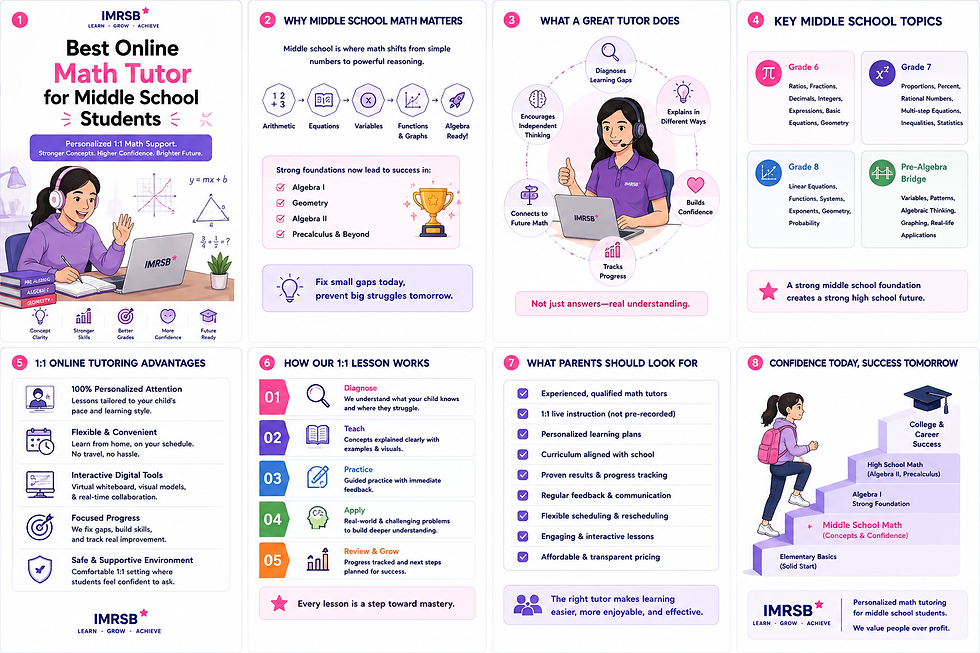
It is about finding the person who can look at a student's work and say:
"I understand where the difficulty is coming from."
Then:
"Here's how we're going to fix it."
And eventually:
"Now show me how you would solve it without me."
That progression matters.
Middle school is the period when mathematics begins moving decisively toward algebraic and abstract reasoning. Current tutoring research and market comparisons increasingly point toward the importance of individualized instruction, targeted scaffolding, curriculum alignment, and human interaction rather than simply supplying more problems.
The right tutor should therefore do more than improve a worksheet score.
They should help the student develop:
Understanding.
Problem-solving.
Confidence.
Independence.
Mathematical curiosity.
And ultimately:
The ability to face a difficult problem without immediately believing, "I can't do this."
That is the real return on good math tutoring.
Related IMRSB Guides
College Admissions
SAT Preparation
Advanced Placement
School Math
About IMRSB
At IMRSB, mathematics is not about memorizing procedures and hoping the next question looks familiar. Our approach focuses on:
Understanding → Reasoning → Representation → Application → Confidence
For AP Pre-Calculus students, that means preparing not only for familiar calculus exercises, but also for the unfamiliar problems that separate procedural knowledge from genuine mathematical understanding.
Comments