Online Math Tutoring for SAT Math: Personalized Preparation for a Higher Score

Ready to make SAT Math preparation personalized?
IMRSB provides personalized online SAT Math tutoring based on a student's current performance, mathematical strengths, learning gaps, target, and timeline.

In this guide
The SAT Math section is not simply a test of whether a student remembers enough formulas.
It is a test of whether the student can recognize mathematical structure, choose an efficient approach, interpret information, work accurately under time pressure, and apply familiar concepts in unfamiliar forms.
That distinction matters.
A student may understand Algebra II and still lose points because they misread a question, choose an inefficient method, spend too long on one problem, miss a calculator opportunity, or make the same type of error repeatedly.
Another student may know the mathematics but have uneven preparation across the SAT's different content domains.
That is where online math tutoring for SAT Math can be fundamentally different from simply completing another SAT question bank.
Personalized tutoring can identify why a student is losing points and then build a preparation plan around those specific weaknesses.
For students targeting a higher SAT score, the objective should not be to do the largest possible number of questions.
It should be to make every practice session reveal something useful.
What Makes SAT Math Different From School Mathematics?
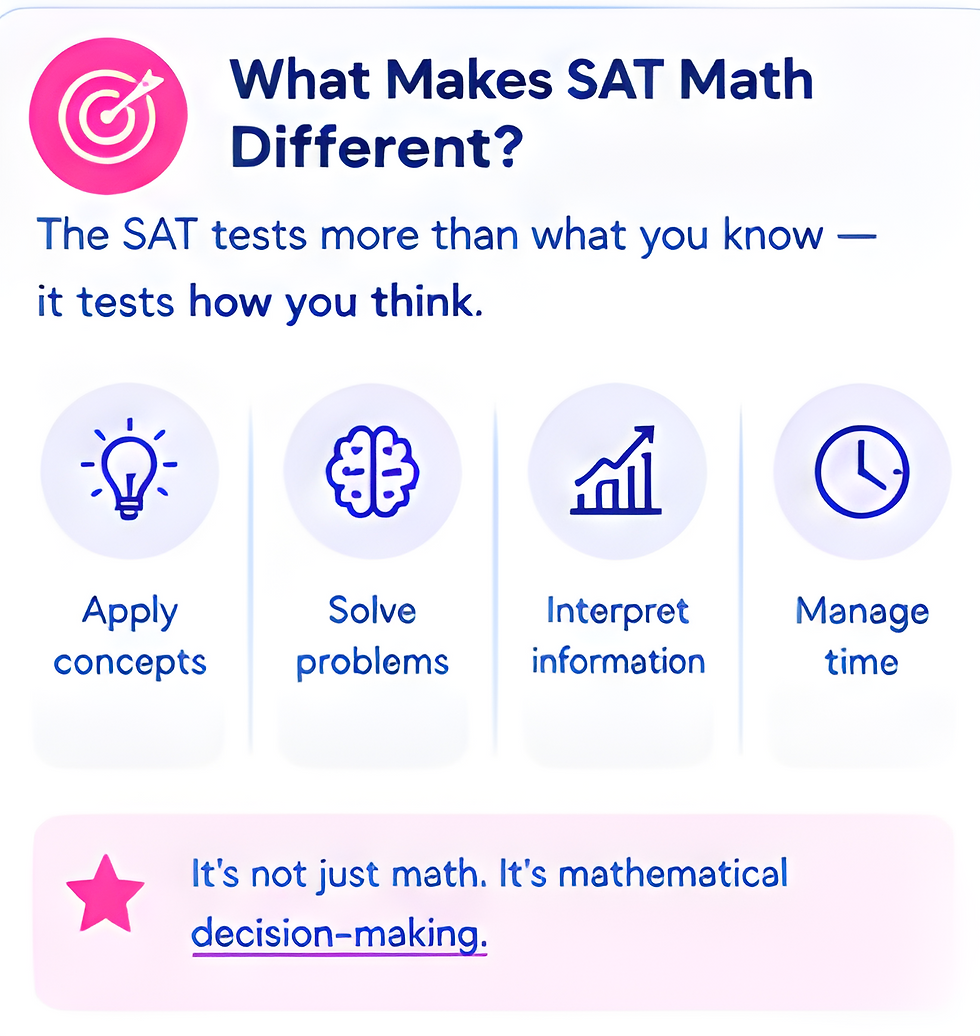
School mathematics and SAT Math overlap substantially, but they are not identical experiences.
A classroom may ask:
“Can you solve this quadratic equation?”
The SAT may ask the student to recognize a quadratic relationship inside a word problem, table, graph, or unfamiliar algebraic representation.
A classroom may provide several exercises using the same method.
The SAT frequently requires students to decide which method is appropriate.
A student therefore needs two kinds of preparation:
Mathematical knowledge
and
mathematical decision-making.
College Board describes SAT Math as measuring students' fluency with, understanding of, and ability to apply essential mathematics. The current Math section covers Algebra, Advanced Math, Problem-Solving and Data Analysis, and Geometry and Trigonometry.
That is why personalized SAT Math tutoring should go beyond formula review.
The Current Digital SAT Math Section
The current SAT Math section consists of 44 questions across two 35-minute modules, for a total of 70 minutes. The questions include both multiple-choice and student-produced-response formats.
That means a student has roughly 1 minute and 35 seconds per question on average.
But the average is deceptive.
Some questions can be solved very quickly.
Others require substantially more reading, modeling, algebraic manipulation, or interpretation.
So effective preparation should teach students to manage different problem types differently.
The SAT is also adaptive. The second Math module's difficulty is influenced by performance on the first module.
That makes preparation different from preparing for a fixed paper test.
Students need to become comfortable with the digital testing environment and with
questions that vary in difficulty and presentation.
The Four SAT Math Content Domains
The current SAT Math framework organizes questions into four major areas.

Algebra
This includes:
Linear equations
Linear functions
Systems of equations
Linear inequalities
Relationships between different representations of linear models
College Board's specifications place Algebra at approximately 35% of SAT Math.
This is not an area students should treat as elementary simply because the mathematics is familiar.
The SAT may test whether students can recognize the underlying linear relationship when it is presented through equations, tables, graphs, or real-world situations.
Advanced Math
Advanced Math includes:
Quadratic equations
Polynomial expressions
Rational equations
Radical equations
Exponential relationships
Nonlinear functions
Equivalent expressions
Systems involving nonlinear relationships
College Board specifically describes Advanced Math as important preparation for further study, including STEM fields.
This area is often where students discover that memorizing procedures is not enough.
They need to recognize structure.
Problem-Solving and Data Analysis
This domain includes:
Ratios
Rates
Percentages
Proportional relationships
Units
Data distributions
Measures of center and spread
Scatterplots
Probability
Conditional probability
Statistical claims
This domain is particularly important because the question may look less like a traditional mathematics exercise and more like a real-world interpretation problem.
Geometry and Trigonometry
Students may encounter:
Area
Volume
Lines
Angles
Triangles
Right-triangle trigonometry
Circles
Students sometimes underestimate this category because it represents a smaller share of the overall Math section than Algebra.
But a relatively small topic gap can still cost valuable points.
The Hidden Skill Behind a Higher SAT Math Score
One of the most important skills is not actually a formula.
It is problem classification.
When a student sees a question, they should increasingly be able to think:
What kind of problem is this?
Is it:
Linear?
Quadratic?
Exponential?
Proportional?
Geometric?
Statistical?
A system?
A function interpretation problem?
A calculator-friendly problem?
A problem where estimation is faster than exact calculation?
This ability saves time.
It also reduces cognitive load.
Instead of beginning from scratch, the student recognizes a mathematical structure and selects an appropriate tool.
That is one of the areas where one-to-one tutoring can be particularly valuable.
Why Some Students Know the Math but Still Miss SAT Questions
This is one of the most important SAT tutoring issues.
A student can understand the underlying mathematics and still lose points.

For example:
Misreading the question
The student solves for xx, but the question actually asks for 2x+52x+5.
Using the wrong quantity
The student calculates the radius when the problem asks for diameter.
Missing a unit conversion
The algebra is correct but the units are inconsistent.
Solving too much
The student performs a long calculation when the answer could have been obtained through a simpler relationship.
Using the calculator inefficiently
The student spends time entering calculations that could have been handled mentally.
Failing to check an answer
A negative length or impossible percentage should immediately trigger suspicion.
Choosing a familiar method instead of the fastest method
This is particularly common among students who have strong classroom mathematics but limited test-specific training.
The problem is not necessarily mathematical knowledge.
It is mathematical execution under constraints.
Personalized SAT Math Tutoring Starts With Diagnosis

A strong tutoring program should not begin with:
“Let's start with Chapter 1.”
It should begin with:
“Where are you losing points?”
That question can be answered using:
Diagnostic questions
Official practice tests
Domain-level performance
Error analysis
Timing data
Question difficulty
Student explanations
Repeated mistake patterns
Official Bluebook practice tests provide scores and allow students to review questions, answers, and rationales. College Board also provides targeted practice based on practice-test performance and a Student Question Bank that can be filtered by domain, skill, and difficulty.
That creates an opportunity for a much more intelligent preparation cycle:
Practice → Diagnose → Target → Practice Again → Measure
Your SAT Score Is Not Your Study Plan
A 620 Math score does not tell a tutor everything they need to know.
Two students can have the same score for completely different reasons.
Student A
Strong Algebra.
Weak Advanced Math.
Several geometry gaps.
Good timing.
Student B
Strong content knowledge.
Frequent careless errors.
Poor pacing.
Difficulty interpreting word problems.
Those students should not receive the same tutoring plan.
This is one of the biggest advantages of personalized preparation.
The score is the starting point for diagnosis, not the diagnosis itself.
Error Analysis Is More Valuable Than Simply Counting Wrong Answers
Imagine a student misses 12 questions on a practice test.
A conventional review might say:
“You need to practice more.”
That is incomplete.
A better review asks:
Why did each question go wrong?
The errors might be categorized as:
Concept gap
Algebra mistake
Misread question
Calculation error
Unit error
Wrong strategy
Time pressure
Careless error
Calculator misuse
Guess without elimination
Failed to recognize a familiar structure
After several practice tests, patterns emerge.
Perhaps eight mistakes come from only three recurring weaknesses.
Now the preparation plan becomes much more precise.
The SAT Error Log: A Powerful Personalized Tool
An effective SAT Math error log should record more than the question number.
A useful structure is:
Question | Topic | Error Type | Why It Happened | Better Method | Recheck Date |
Q12 | Linear equations | Strategy | Used substitution unnecessarily | Recognize direct relationship | Friday |
Q27 | Percent | Concept | Confused percent change with percentage points | Write relationship first | Monday |
Q34 | Circle | Formula | Forgot radius/diameter distinction | Sketch before calculating | Wednesday |
The important column is often:
Why It Happened
Without that column, the student may repeatedly correct answers without correcting the underlying behavior.
Why Personalized SAT Math Tutoring Can Be More Efficient

Generic SAT preparation often gives every student the same:
Lessons
Practice sets
Homework
Mock tests
Schedule
But students do not begin from the same place.
One student might need three weeks of Algebra review.
Another might need only a short Algebra refresh but substantial Advanced Math practice.
Another may know the content but need timing and question-selection training.
Personalization allows study time to be allocated according to marginal benefit.
In other words:
Spend more time on the weaknesses that can realistically improve performance, and less time repeating what the student already knows.
The Calculator Is a Tool, Not a Substitute for Mathematics
Calculator use is especially important on the digital SAT.
College Board permits an approved calculator throughout the Math section, and students can also use the built-in calculator options available in the digital testing environment. Non-
CAS calculators are allowed under the current calculator policy.
But “calculator allowed” does not mean:
“Calculator required for every question.”
A strong student should know when to:
Calculate mentally
Estimate
Use algebra
Use the graphing calculator
Use a calculator to verify
Use the calculator to explore a relationship
The best approach depends on the problem.
Desmos and Digital SAT Math
Graphing-calculator fluency can be useful on the digital SAT, particularly when students understand how to use graphing strategically.
A student may be able to:
Graph equations
Identify intersections
Estimate solutions
Check roots
Visualize transformations
Explore nonlinear relationships
But simply knowing how to press buttons is not enough.
The student needs to recognize:
When does graphing make this problem faster?
That is a tutoring skill.
A Common SAT Mistake: Doing the Problem the Long Way
Consider a question involving two linear equations.
A student may immediately start solving through substitution.
But perhaps the question only asks for the intersection.
A graphing approach could reveal the answer quickly.
Or perhaps the equations can be manipulated mentally.
Or perhaps the question is testing a relationship that does not require solving the entire system.
The strongest SAT Math students increasingly ask:
What is the shortest reliable path to the answer?
Not:
“What procedure did my textbook teach me?”
SAT Math Requires Mathematical Flexibility
A student should ideally be able to approach the same mathematical relationship from different directions.
For example, a quadratic relationship might be represented through:
An equation
A graph
A table
A word problem
The student should be able to recognize that these are not four unrelated problems.
They are four representations of a related mathematical idea.
College Board explicitly emphasizes students' ability to make connections between representations within the Math domains.
That is why tutoring should include representation-switching exercises.
Word Problems Are Not Really “Reading Problems”
Approximately 30% of SAT Math questions are set in context, according to College Board.
Students sometimes call these “word problems” and immediately become anxious.
But the difficulty often comes from translation.
A student needs to identify:
What quantities are given?
What do they represent?
What relationship connects them?
What is unknown?
What does the question actually ask?
Once the mathematical structure is extracted, the problem may become straightforward.
This is why personalized tutoring should teach students a translation process, rather than simply assigning more word problems.
A Better Way to Approach SAT Word Problems
Students can learn to separate the problem into three layers:
Context
What is happening in the real-world situation?
Mathematics
What equation, relationship, graph, or statistical model represents it?
Question
What specific quantity must be reported?
This prevents students from getting lost in unnecessary details.
Why Timing Problems Are Often Actually Strategy Problems
Students frequently say:
“I need to get faster.”
But speed is not always the real problem.
Sometimes the student is spending too much time because they:
Do unnecessary algebra
Recalculate instead of checking
Stay too long on one difficult question
Use the calculator inefficiently
Do not recognize common structures
Read the same problem multiple times
Lack confidence in choosing an approach
So instead of simply giving timed worksheets, a tutor can analyze where time is being spent.
The goal is not frantic speed.
It is efficient decision-making.
SAT Math Preparation Should Include Easy Questions
Students targeting higher scores sometimes make an unusual mistake:
They focus almost entirely on difficult problems.
That can be counterproductive.
A high score requires consistency.
A student should be able to solve easier and medium-difficulty questions efficiently while minimizing avoidable errors.
The objective is not to prove that the student can solve the hardest question.
It is to maximize performance across the entire section.
The “Careless Mistake” Problem
“Careless mistake” is one of the least useful diagnoses in SAT preparation.
If a student repeatedly makes careless mistakes, there is usually a pattern underneath.
Maybe they:
Skip units
Rush the last step
Do not rewrite the target quantity
Misread negative signs
Forget restrictions
Do not estimate
Fail to check whether the answer is reasonable
Instead of saying:
“Be more careful.”
Tutoring should identify a specific behavior to change.
For example:
“Before submitting, compare the answer to the exact quantity the question asked for.”
That is actionable.
Personalized Preparation for Different SAT Math Goals
Not every student should have the same score-improvement strategy.
A Student Building the Foundation
Focus on:
Algebra
Fractions
Equations
Functions
Percentages
Ratios
Basic geometry
Core problem solving
A Student in the Middle Range
Focus on:
Closing domain gaps
Improving accuracy
Learning efficient approaches
Strengthening Advanced Math
Improving data interpretation
Building timing awareness
A Student Already Scoring Highly
Focus on:
Difficult questions
Strategic efficiency
Error elimination
Advanced Math
Time allocation
Calculator strategy
Student-produced responses
Consistency under pressure
The last few improvements can require a very different type of tutoring from the first improvements.
SAT Math Tutoring for Students Starting Early
Students do not necessarily need to wait until the final months before the SAT.
Earlier preparation can be integrated with school mathematics.
For example:
Grade 9
Build Algebra and mathematical fluency.
Grade 10
Strengthen Algebra II and Advanced Math concepts.
Grade 11
Add SAT-specific strategy, timing, and official practice.
The exact timeline depends on the student's school sequence and testing plans.
But the principle is useful:
SAT preparation works best when it reinforces mathematics the student is already learning rather than becoming a completely separate subject.
SAT Tutoring for Students Who Are Strong in School Math
This group is often overlooked.
A student may earn excellent mathematics grades and still need SAT preparation.
Why?
Because school success does not automatically create:
SAT pacing skills
Digital-test familiarity
Question-selection strategy
Student-produced-response familiarity
SAT-specific calculator strategy
Efficient elimination techniques
The student may already have the mathematics.
The tutoring challenge becomes translating that mathematics into SAT performance.
SAT Tutoring for Students Who Struggle With Math
The approach should be different.
The tutor may need to slow down and rebuild:
Number sense
Algebraic fluency
Fractions
Percentages
Functions
Geometry
Problem interpretation
But SAT preparation should still remain connected to the actual test.
The student should understand not only:
“Here's how to solve this equation.”
but also:
“Here's how this type of equation appears on the SAT.”
Official SAT Practice Should Be Part of the Preparation
Students should not rely exclusively on third-party questions.
College Board provides full-length digital practice tests through Bluebook. After completing a practice test, students can review their scores, answers, and rationales, and use performance information to guide additional practice.
College Board also provides a Student Question Bank containing thousands of official questions that can be filtered by section, domain, skill, and difficulty.
These resources are particularly useful for personalized tutoring because the tutor can
connect practice results directly to the student's study plan.
The Best SAT Math Resources Are Not Necessarily the Ones With the Most Questions
A student does not automatically improve because they complete 2,000 questions.
What matters is what happens after the questions.
A productive sequence is:
Attempt
↓
Review
↓
Identify the error
↓
Understand the underlying concept
↓
Try a similar problem
↓
Try a different representation
↓
Return later to verify retention
That is much more powerful than simply increasing the number of questions completed.
A Personalized SAT Math Study Plan
A practical tutoring roadmap can be structured around several phases.
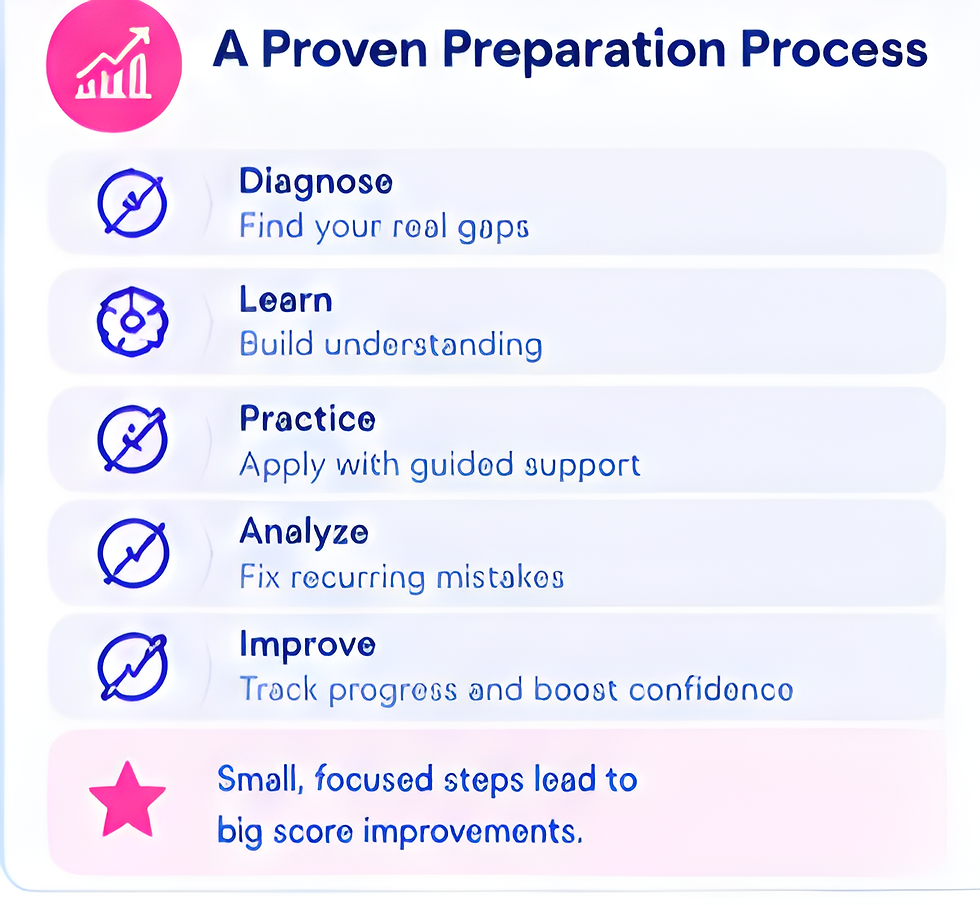
Diagnostic Phase
Establish:
Current score
Domain strengths
Domain weaknesses
Timing patterns
Error categories
Target timeline
Foundation Phase
Repair important mathematical gaps.
Strategy Phase
Develop efficient approaches for recurring SAT question types.
Targeted Practice Phase
Work specifically on weak skills.
Mixed Practice Phase
Combine domains so the student must identify the method independently.
Official Practice Phase
Use full-length Bluebook tests under realistic conditions.
Final Refinement Phase
Focus on recurring errors, timing, confidence, and consistency.
This is more individualized than simply following a generic “six-week SAT plan.”
What a One-to-One SAT Math Tutoring Session Can Look Like
A productive session might begin with a short review of the student's recent practice.
The tutor identifies one or two recurring problems.
The student then works through a representative question.
Instead of immediately correcting the mistake, the tutor asks:
“What were you thinking here?”
That question is extremely valuable.
It reveals the student's reasoning.
Then the tutor can determine whether the issue is:
Conceptual
Procedural
Strategic
Reading-related
Timing-related
The student then attempts a similar problem.
Finally, the tutor introduces a slightly different version to test whether the understanding transfers.
That last step is where learning becomes more durable.
Why Parents Should Look Beyond “SAT Tutor”
When choosing an online SAT Math tutor, parents should ask what the tutor actually does.
Does the tutor:
Diagnose weaknesses?
Use official practice data?
Track errors?
Adapt the plan?
Teach multiple approaches?
Analyze timing?
Work with digital SAT tools?
Teach calculator strategy?
Practice student-produced responses?
Connect SAT preparation to school mathematics?
Measure progress over time?
The label “SAT tutor” alone does not answer those questions.
What Personalized SAT Math Tutoring Should Not Become
Tutoring can become ineffective when it turns into:
Endless worksheets
Answer explanation without student participation
Memorization of tricks
Constant full-length tests without analysis
Repeating topics the student already understands
Teaching only the tutor's preferred method
Doing homework for the student
The student should remain the person doing the mathematical thinking.
The tutor's job is to make that thinking more accurate, more flexible, and more independent.
The IMRSB Approach to SAT Math
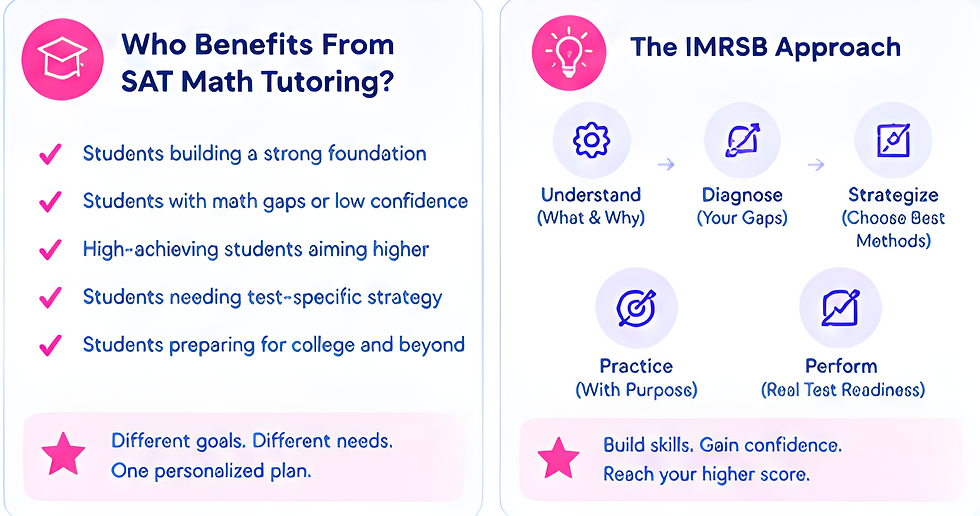
At IMRSB, SAT Math preparation can be organized around five habits:
Understand
Build the mathematical concept rather than memorize a trick.
Diagnose
Identify exactly where points are being lost.
Strategize
Choose efficient approaches for different question types.
Practice
Apply the skill repeatedly in varied forms.
Perform
Transfer the skill into realistic timed conditions.
This creates a preparation cycle that connects school mathematics → SAT mathematics → independent problem solving.
SAT Math Is Also About Confidence
Confidence is sometimes treated as a motivational issue.
But mathematical confidence can be built through evidence.
A student becomes more confident when they repeatedly experience:
“I know what this question is testing.”
Then:
“I know which method to try.”
Then:
“I can solve it.”
Then:
“I can recognize this even when the question looks different.”
That is much stronger than simply telling a student to “believe in yourself.”
Confidence built through competence tends to be more durable.
How Parents Can Tell Whether SAT Math Tutoring Is Working
Do not look only at the total score.
Watch for smaller indicators.
Is the student:
Making fewer repeated errors?
Solving familiar questions faster?
Recognizing question types sooner?
Explaining solutions more clearly?
Using the calculator more strategically?
Spending less time stuck?
Checking answers more effectively?
Performing more consistently?
Improving in specific content domains?
Official Bluebook practice reports can provide domain-level information that helps identify strengths and challenge areas.
A score increase is useful.
But better mathematical decision-making is often the deeper improvement.
How Much SAT Math Tutoring Does a Student Need?
There is no universal number of sessions.
A student with strong mathematics and a few strategic weaknesses may need relatively focused support.
A student with substantial Algebra or Advanced Math gaps may need a longer foundation-building period.
A student close to a test date may need an intensive review.
The right amount depends on:
Current score
Target score
Mathematics background
Number of content gaps
Test date
Available study time
Practice consistency
Learning pace
The important principle is:
Tutoring frequency should follow the student's needs rather than an arbitrary package.
When Should SAT Math Preparation Begin?
There is no single ideal starting point for every student.
Starting earlier can allow SAT-relevant mathematics to develop alongside school coursework.
Starting later can still be productive when the student already has a strong mathematical foundation and the remaining work is primarily test-specific.
The important question is not simply:
“How many months do I have?”
It is:
“What can realistically improve during that time?”
A diagnostic assessment makes that question much easier to answer.
Online SAT Math Tutoring Can Be Especially Useful for Busy Students
Students often balance SAT preparation with:
School
AP classes
Sports
Extracurricular activities
Competitions
Homework
College planning
Family commitments
A personalized online format can make scheduling more flexible while allowing the tutoring to focus specifically on the student's highest-priority mathematical needs.
Instead of spending two hours reviewing material the student already knows, a targeted session can focus on a narrow weakness.
That makes preparation more efficient.
Ready to make SAT Math preparation personalized?
IMRSB provides personalized online SAT Math tutoring based on a student's current performance, mathematical strengths, learning gaps, target, and timeline.
The Bigger Goal: Mathematical Independence
The most valuable outcome of SAT Math tutoring is not simply a higher practice-test score.
It is the student's ability to look at an unfamiliar problem and think:
“I know how to start.”
Then:
“I know why this method works.”
And finally:
“I can check whether my answer makes sense.”
Those habits extend beyond the SAT.
They help in Algebra II.
They help in Precalculus.
They help in AP Calculus.
They help in college mathematics.
And they help students become more independent learners.

Frequently Asked Questions
What is online SAT Math tutoring?
Online SAT Math tutoring is personalized mathematics instruction delivered remotely, with sessions focused specifically on the student's SAT Math strengths, weaknesses, goals,
timing, and preparation needs.
Is SAT Math tutoring different from regular math tutoring?
Yes. Regular math tutoring may focus primarily on school coursework. SAT Math tutoring also addresses test-specific skills such as question interpretation, pacing, strategic problem solving, digital tools, calculator use, and official SAT-style practice.
Can an SAT tutor help if I am already good at math?
Yes. Strong mathematics students may benefit from SAT-specific strategy, timing analysis, difficult-question practice, error reduction, and efficient use of digital tools.
Can tutoring help a student who struggles with Algebra?
Yes. Algebra is one of the four major SAT Math domains, and foundational Algebra skills are important throughout the section.
How important is Advanced Math on the SAT?
Advanced Math is one of the four Math content domains and includes nonlinear equations, functions, equivalent expressions, and related concepts. College Board identifies these skills as important for progression into more advanced mathematics.
Does the SAT Math section allow calculators?
Yes. Students can use an approved calculator throughout the Math section, subject to College Board's calculator policy. The digital testing environment also provides calculator functionality.
Should students use Desmos on every SAT Math question?
No. The best tool depends on the problem. Students should learn when graphing, algebraic manipulation, estimation, mental math, or direct calculation is most efficient.
Are official SAT practice tests important?
Yes. College Board provides full-length adaptive digital practice tests through Bluebook,
along with score reporting and additional targeted practice resources.
How often should I work with an SAT Math tutor?
That depends on the student's current level, target, timeline, and gaps. A diagnostic-first approach is more useful than choosing a universal number of sessions.
Can SAT Math tutoring help with a higher overall SAT score?
Math tutoring directly addresses the Math section. Improvement in the overall SAT score also depends on performance in Reading and Writing, so students seeking broader improvement may need preparation for both sections.
Final Takeaway
SAT Math preparation should not be a race to complete the most practice questions.
It should be a process of discovering exactly what is preventing the student from converting mathematical knowledge into points.
Sometimes the issue is Algebra.
Sometimes it is Advanced Math.
Sometimes it is data interpretation.
Sometimes it is geometry.
Sometimes the mathematics is already strong and the real problem is strategy, timing, or repeated execution errors.
That is why personalized preparation matters.
The strongest tutoring process is:
Diagnose the gaps.
Understand the mathematics.
Choose better strategies.
Practice deliberately.
Analyze mistakes.
Measure progress.
Build independence.
At IMRSB, the objective is not simply to prepare a student for one SAT sitting.
It is to help the student become a more confident, flexible, and independent mathematical
problem solver—while preparing specifically for the demands of the Digital SAT.
Better preparation is not about doing more mathematics. It is about doing the right mathematics, in the right way, for the right student.
Related IMRSB SAT Resources
Students beginning SAT preparation can also explore IMRSB's Digital SAT guide for an overview of the current test, followed by our SAT Math Guide for a broader breakdown of the mathematics students need to master.
Students who want a complete preparation strategy can also use the SAT Reading & Writing Guide alongside Math preparation.
For students comparing individualized instruction with other preparation formats, IMRSB's Online SAT Tutor vs. SAT Prep Course: Which Is Better? explores the differences between personalized tutoring and broader SAT preparation programs.
Students thinking about the SAT in an Ivy League context can continue with Does SAT Still Matter for Ivy League Admissions?, SAT Score Needed for Ivy League Schools, and Ivy League SAT Scores: What Score Should You Target?
Related IMRSB Guides
College Admissions
SAT Preparation
Advanced Placement
School Math
About IMRSB
At IMRSB, mathematics is not about memorizing procedures and hoping the next question looks familiar. Our approach focuses on:
Understanding → Reasoning → Representation → Application → Confidence
For SAT students, that means preparing not only for familiar calculus exercises, but also for the unfamiliar problems that separate procedural knowledge from genuine mathematical understanding.
Comments