AP Classes for Ivy League Admissions: How Many Should You Take?

How many AP classes should you take if you want to apply to an Ivy League school?

In this guide
The honest answer is: there is no magic number.
You do not need 8 APs, 10 APs, or 12 APs simply because you are applying to an Ivy League university. What matters much more is whether you have challenged yourself appropriately within the opportunities available at your school, performed strongly in those courses, and built an academic program that makes sense for your interests and goals.
Yale's current admissions guidance is especially clear: students should take the most rigorous coursework available in their high school, but Yale explicitly says it is not looking for students who take the maximum possible number of AP courses or one more AP than everyone else.
Harvard similarly says there is no one-size-fits-all curriculum and advises students to challenge themselves with courses appropriate to their preparation, interests, and goals.
Harvard also emphasizes that students should master foundational mathematics rather than rushing into advanced courses simply for the label.
So instead of asking:
“How many AP classes do Ivy League students take?”
a better question is:
“What is the most rigorous, balanced, and sustainable course schedule I can realistically succeed in?”
That shift in thinking can completely change how you plan high school.
The short answer: How many AP classes should you take?

There is no official Ivy League AP requirement or universal AP target.
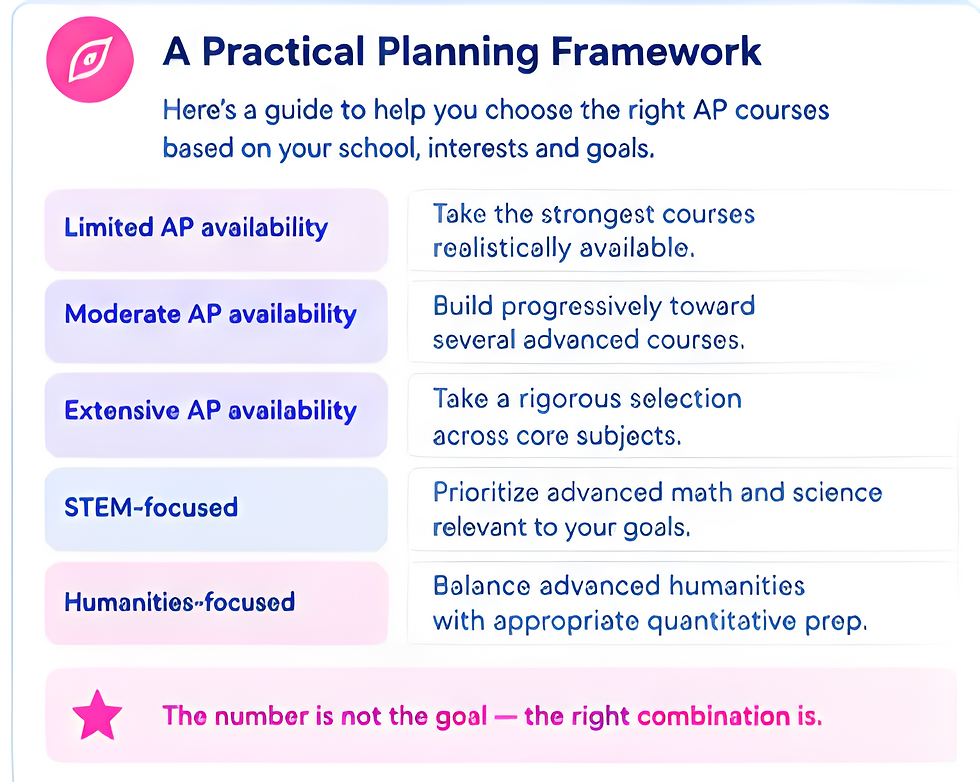
As a planning framework—not an admissions requirement, a student at a school with extensive AP availability might think about their curriculum roughly like this:
High school context | Reasonable planning approach |
Limited AP availability | Take the strongest courses realistically available |
Moderate AP availability | Build progressively toward several advanced courses |
Extensive AP availability | Take a rigorous selection across core subjects |
Highly advanced student | Add APs where they genuinely fit preparation and interests |
STEM-focused student | Prioritize advanced math/science relevant to the intended direction |
Humanities-focused student | Balance advanced humanities/social science with appropriate quantitative preparation |
These are planning ranges, not Ivy League admissions thresholds.
A student taking five highly demanding AP/advanced courses with excellent grades and meaningful activities may present a stronger academic story than a student taking ten APs while struggling academically and having little time for anything else.
Yale's admissions officers have explicitly said that taking one more AP than another student is not what sets an application apart.
Ivy League admissions is not an AP counting contest
One of the biggest misconceptions about selective college admissions is that admissions officers simply count advanced courses.
Imagine two students.
Student A
10 AP courses
Several Bs and Cs
Little time for extracurricular interests
Constantly overloaded
Took courses primarily because they were weighted
Student B
6 AP/advanced courses
Consistently strong grades
Took the most challenging courses available in their school
Developed a serious interest in mathematics and computer science
Built meaningful projects
Participated in activities over several years
Maintained interests outside STEM
The number of AP courses alone does not tell the whole story.
Harvard says its strongest applicants take the most rigorous secondary-school curriculum available to them, while also emphasizing that there is no single academic path expected of every student.
That distinction is extremely important.
Rigor matters.Context matters.Performance matters.Course selection matters.The number printed next to “AP” is only one piece of the picture.
What Ivy League schools actually mean by “rigorous”
The phrase “most rigorous curriculum available” can sound intimidating.

It does not necessarily mean:
Take every AP course your school offers.
It means something closer to:
Make thoughtful use of the strongest academic opportunities reasonably available to you.
Yale explains that there may be multiple ways for students at the same high school to demonstrate strong academic preparation. The most rigorous pathway for one student does not necessarily have to look identical to another student's schedule.
This matters because high schools differ dramatically.
One school might offer:
25 AP courses
Honors courses
Dual enrollment
Advanced mathematics
Independent research opportunities
Another might offer:
5 AP courses
A few honors classes
No calculus
No AP Physics
No AP Computer Science
An Ivy League admissions office knows that difference.
Your transcript is evaluated within the context of your educational environment rather than as though every student attended the same high school.
Your school’s AP availability matters
Suppose your high school offers only:
AP English Language
AP U.S. History
AP Biology
AP Calculus AB
You cannot reasonably be expected to take AP Physics C, AP Computer Science A, AP Statistics, AP Chemistry, and AP Calculus BC if those courses do not exist at your school.
Princeton explicitly states that its recommended course of study is not an admissions requirement and that it understands that schools provide different academic opportunities. It encourages students to challenge themselves with rigorous courses such as honors, AP, and dual-enrollment courses when available.
This is why families should stop comparing raw AP totals without looking at the underlying school context.
The AP courses you choose matter more than the raw number
Not all AP courses serve the same purpose for every student.
A future engineering applicant might reasonably prioritize a progression such as:
Advanced Mathematics → Calculus → Physics → Computer Science
A prospective biology student might build around:
Advanced Mathematics → Biology → Chemistry → Physics
A humanities-focused student might emphasize:
Advanced English → History → Government → Economics → Language
That doesn't mean an applicant must follow one of these exact paths.
It means your courses should form an academically coherent program.
Harvard specifically gives examples of rigorous and relevant preparation including computer science, statistics, mathematical modeling, calculus, and other advanced mathematics, while noting that students should choose courses aligned with their interests and goals.
For STEM students, math and science deserve special attention
If you are considering:
Engineering
Computer science
Mathematics
Physics
Statistics
Data science
Other quantitative fields
your mathematics progression becomes particularly important.
But even here, “more advanced” does not automatically mean “better.”
Harvard makes an important point: students interested in fields where calculus is useful may benefit from taking calculus in high school, but students should prioritize mastering foundational mathematics rather than rushing through advanced courses.
Princeton similarly recommends four years of mathematics and specifically notes calculus for students interested in engineering.
So a strong STEM pathway might look like:
Algebra → Geometry → Algebra II → Precalculus → Calculus
rather than attempting to skip foundational concepts simply to reach calculus earlier.
IMRSB Learning Tip
Depth beats acceleration when acceleration creates gaps.
A student who genuinely understands calculus is better prepared than a student who raced into calculus but never developed strong algebraic and conceptual foundations.
AP Calculus can be valuable—but it is not universally required
One of the most persistent misconceptions is:
“If I want an Ivy League education, I must take AP Calculus.”
That is too simplistic.
Harvard explicitly states that calculus is not an admission requirement and that students' mathematics records are evaluated holistically. At the same time, Harvard notes that students intending to study engineering, computer science, physics, mathematics, statistics, or related fields may benefit from calculus in high school.
Princeton recommends four years of mathematics and calculus for students interested in engineering, but again describes its recommendations as preparation rather than universal admission requirements.
The important question is therefore not:
“Did you take calculus?”
It is:
“What mathematics was available to you, what did you choose, how well did you perform, and how does that preparation fit your academic direction?”
Should you take AP classes in every subject?
Not necessarily.

A common mistake is trying to create an impressive-looking transcript by taking advanced courses in every possible subject.
You could end up with:
AP Calculus
AP Statistics
AP Physics
AP Chemistry
AP Biology
AP English
AP Literature
AP U.S. History
AP World History
AP Psychology
and still have an academic program that says very little about who you are as a learner.
A stronger approach is to think about breadth plus depth.
You want evidence that you can handle demanding academics across important areas while also developing genuine intellectual interests.
Yale's course-selection guidance specifically warns against treating course selection as a numbers game and says students do not need to take the maximum number of AP courses physically possible.
What about taking seven or eight AP classes?
If your school offers many AP courses, you may reasonably wonder whether taking seven or eight makes you more competitive.
There is no universal answer.
For one student, eight advanced courses might be an appropriate and successful workload.
For another student, eight could produce:
chronic overload
weaker grades
reduced extracurricular involvement
less time for meaningful projects
less sleep
burnout
shallow learning
The number itself doesn't tell an admissions officer whether the schedule was wise.
Yale has explicitly said that students do not need to load up on seven APs simply because they are applying to selective colleges.
That is an important message for families who have turned AP accumulation into a competition.
Is it better to get an A in a regular class or a B in an AP class?
This is one of the most complicated questions.
There is no universal rule that:
A in regular > B in AP
or:
B in AP > A in regular
Yale's current guidance emphasizes both challenge and strong performance. It says the goal is to see students challenge themselves while doing well in those courses.
The better long-term strategy is usually:
Challenge yourself without creating an academic workload you cannot successfully manage.
If you are consistently earning strong grades in challenging courses, you are building exactly the combination you want.
If an advanced course is genuinely beyond your current preparation, the answer is not necessarily “take it anyway because Ivy League.”
It may be better to strengthen the foundation first.
AP Classes by Grade: A Practical Framework
There is no universal AP schedule that every Ivy League applicant should follow.
But a progression framework can help families think strategically.
Grade 9: Build the foundation
Freshman year should primarily be about establishing:
Strong study habits
Mathematical foundations
Writing ability
Reading ability
Time management
Academic curiosity
Some schools allow freshmen to take AP courses. Others do not.
If your school does not allow APs in ninth grade, that is not automatically a disadvantage.
Your goal is to establish a trajectory.
Grade 10: Begin increasing rigor
Sophomore year can be a good time to introduce advanced coursework if you are prepared.
Possible areas include:
AP World History
AP Biology
AP Computer Science
AP Statistics
AP European History
AP English
Other honors/advanced courses
The specific options depend entirely on your school.
The important question is:
Are you moving appropriately beyond the level of coursework you handled previously?
Grade 11: Academic depth becomes especially important
Junior year is often the year when students have access to their most advanced high-school coursework.
This may include:
AP Calculus AB/BC
AP Physics
AP Chemistry
AP Biology
AP Computer Science
AP English Language
AP U.S. History
AP Statistics
Advanced humanities courses
But again, don't interpret this as a checklist.
Your junior-year schedule should represent a meaningful academic progression.
For a STEM student, that might mean advanced mathematics and laboratory science.
For another student, it may mean advanced literature, history, economics, languages, mathematics, or another discipline.
Grade 12: Do not slow down unnecessarily
One mistake is treating senior year as though the hard work is finished after submitting applications.
Yale specifically says students should maintain a consistently strong schedule through senior year.
That does not mean every senior needs to take the maximum possible AP load.
It means you should continue demonstrating appropriate academic engagement.
A thoughtful senior schedule might include:
AP Calculus BC
AP Physics
AP Literature
Advanced economics
Advanced language
Independent research
A meaningful elective
The right combination depends on your interests and school.
How many AP classes should a STEM student take?
For STEM-focused applicants, think less about the AP count and more about the mathematical and scientific progression.
For example:
Strong STEM preparation
Algebra↓Geometry↓Algebra II↓Precalculus↓Calculus↓Advanced mathematics / statistics / additional quantitative coursework
Alongside:
Biology↓Chemistry↓Physics↓Advanced science
Not every student will have access to this exact sequence.
And not every STEM applicant needs every AP science.
But the underlying principle is powerful:
Your advanced courses should demonstrate increasing intellectual depth, not simply an increasing number of AP labels.
How many AP classes should a humanities student take?
The same principle applies.
A future history, political science, economics, literature, or international-relations student should not feel compelled to build a transcript that looks like an engineering curriculum.
A rigorous humanities-oriented program might emphasize:
AP English Language
AP English Literature
AP U.S. History
AP World History
AP Government
AP Economics
Advanced language study
while maintaining appropriate mathematics and science preparation.
Harvard's current guidance reinforces the broader principle: students should choose challenging courses that are appropriate for their preparation and aligned with their interests and goals.
What if your school has very few AP classes?
Don't panic.
This is one of the most important messages for students at schools with limited advanced-course offerings.
If your school offers:
3 AP courses
and you take:
3 AP courses
that does not mean your transcript is automatically weaker than someone who attends a school offering 25 AP courses and takes 10.
Admissions offices receive school information that helps them understand course availability and school context. Harvard's school reporting materials, for example, include information about how many AP, IB, Honors, and other advanced courses a school offers and whether school policy limits the number a student can take.
Your job is to use the opportunities you actually have.
What if your school has no AP courses?
This is also not an automatic problem.
Students may demonstrate academic preparation through:
Honors courses
IB
A-Levels
Dual enrollment
Advanced school-specific courses
Independent academic work
Research
Competitions
Meaningful projects
Yale explicitly says there is not one single way to demonstrate academic preparation and that it evaluates students from a wide range of secondary schools and curricula.
The label matters less than many families think.
Academic substance matters.
Should you take AP classes outside your school?
Sometimes students hear:
“If my school doesn't offer AP Calculus BC, I should take it at a community college.”
That is not automatically necessary.
Yale's current course-selection guidance specifically says students do not need to go outside their high school during the summer or attend a local community college simply to accumulate additional advanced coursework.
If an outside course genuinely makes sense for your education, that's different.
But don't create an unnecessarily complicated schedule just to manufacture an impressive AP total.
Don't take AP classes just because they are weighted
This is one of the most important mindset changes families can make.
A weighted GPA can make students think:
“This class gives me an extra point, so I should take it.”
That is not a sound academic strategy by itself.
Instead ask:
Will this course help me become a stronger student?
Does it fit my preparation?
Does it connect to my interests?
Can I perform strongly in it?
Does it allow enough time for meaningful activities outside the classroom?
Does it strengthen the academic story I am building?
Those questions are much more useful than simply asking how much the class increases your GPA.
AP classes and extracurricular activities must coexist
Your high school schedule is not your entire application.
Suppose you take:
10 AP courses
but have no time for:
robotics
research
music
athletics
volunteering
entrepreneurship
debate
family responsibilities
creative projects
meaningful community involvement
because your entire life revolves around homework.
That may not produce the balanced educational experience you intended.
Yale's admissions guidance emphasizes that strong applicants stand out across multiple areas, not simply through course rigor.
The goal is not:
Maximum academic workload.
The goal is:
Maximum meaningful growth within your realistic capacity.
The AP “Depth Ladder”
Instead of thinking:
AP 1 + AP 2 + AP 3 + AP 4 + AP 5...
think:
Explore → Learn → Apply → Build → Contribute
For example:
Explore
You discover an interest in computer science.
↓
Learn
You take computer science coursework.
↓
Apply
You build small programs.
↓
Build
You create a meaningful project that solves a real problem.
↓
Contribute
You teach younger students, contribute to a community project, publish your work, or develop something others can use.
That story can be far more meaningful than simply adding another AP course to the transcript.
The biggest AP mistakes students make
Taking every AP available
More advanced courses are not automatically better if they damage performance and well-being.

Choosing courses entirely for GPA weighting
A weighted GPA should not become the purpose of your education.
Ignoring foundational subjects
Advanced coursework cannot compensate for weak fundamentals.
Taking advanced courses unrelated to your interests simply for prestige
A transcript should look intellectually coherent rather than manufactured.
Comparing AP totals with classmates
Your school's offerings, policies, schedule, and circumstances may be completely different.
Sacrificing meaningful activities
An AP-heavy schedule that leaves no time for genuine interests may not produce the application you intended.
Believing there is an Ivy League AP cutoff
There isn't one universal number.
Rushing into advanced mathematics
Harvard specifically advises students to master foundational mathematical material rather than simply racing toward advanced courses.
A Better Way to Plan Your AP Schedule
Before registering for another AP class, ask yourself these questions.
What is the most rigorous coursework available to me?
Look at your school's actual offerings.
Don't compare yourself with a student at another school without understanding the differences.
Which courses fit my academic interests?
If you're interested in engineering, your mathematics and science choices may look different from those of a future literature student.
Can I succeed in the course?
Rigor without adequate preparation can become counterproductive.
What happens to the rest of my schedule?
Consider extracurriculars, family responsibilities, athletics, employment, creative activities, and personal time.
Am I building depth or simply accumulating labels?
This is perhaps the most important question.
A Four-Year AP Planning Model

Here is a useful way to think about your overall trajectory:
Early high school
Build strong foundations and explore interests.
Middle of high school
Introduce appropriately challenging coursework.
Junior year
Develop substantial academic depth.
Senior year
Continue challenging yourself while demonstrating consistency and maturity.
This creates something admissions readers can understand:
Growth over time.
And growth is much more meaningful than a giant collection of course labels.
What does a strong AP transcript look like?
It doesn't necessarily look like:
“The student took the most AP classes in the school.”
It may look more like:
“This student consistently challenged herself with the strongest coursework available, performed well, developed a clear interest in mathematics and science, pursued that interest outside the classroom, and continued challenging herself through senior year.”
That is a much richer academic story.
The IMRSB AP Strategy
At IMRSB, we would encourage students to think about advanced coursework using five questions:

Rigor
Are you challenging yourself?
Readiness
Are you academically prepared for the challenge?
Results
Can you perform strongly?
Relevance
Does the course fit your interests and goals?
Resilience
Can you sustain the workload without sacrificing everything else?
When those five factors align, an AP course can become much more valuable than its weighted-GPA label.
What Ivy League applicants should remember
There is no magic AP number.
There is no universal:
“Take 8 APs and you're competitive.”
There is no:
“Take 12 APs and you're Ivy-ready.”
And there is no official Ivy League AP threshold.
Instead, the major Ivy League admissions guidance consistently points toward challenging coursework considered in the context of the opportunities available to each student.
Yale explicitly rejects the idea that students should treat AP selection as a numbers game, while
Harvard emphasizes rigorous preparation that is appropriate to the student's interests and
circumstances. Princeton likewise encourages rigorous courses while recognizing differences in school offerings.
The real goal
Don't try to build the transcript with the largest number of AP labels.
Build the transcript that tells the strongest academic story.
That might mean:
4 APs at one school
6 at another
8 at another
Or a different combination of AP, IB, honors, dual enrollment, and advanced coursework.
The number is not the story.
Your preparation is the story.Your performance is the story.Your intellectual curiosity is the story.Your growth is the story.
And your AP classes should support that story—not become the story themselves.
Frequently Asked Questions
Is there a minimum number of AP classes required for Ivy League admission?
No. Ivy League universities do not have a universal AP-course minimum for first-year admission.
The relevant question is how rigorously you challenged yourself within your educational context.
Is taking 10 AP classes enough for Ivy League admission?
There is no number of AP classes that guarantees admission.
Ten APs could represent an extremely rigorous schedule at one school and a completely different academic situation at another.
Is 5 AP classes enough?
It can be, depending on the student's school, grade level, available courses, academic performance, and overall curriculum.
Five APs should not be interpreted as either automatically sufficient or automatically insufficient.
Do Ivy League schools prefer students with the most AP classes?
Official admissions guidance does not support treating AP totals as a competition.
Yale specifically says it does not expect students to take the maximum number of AP courses and warns against treating course selection as a numbers game.
Should I take AP Calculus for Ivy League admissions?
It depends on your preparation, school offerings, academic interests, and intended direction.
For students interested in quantitative fields, calculus can provide useful preparation. Harvard explicitly says calculus can benefit students intending to study engineering, computer science, physics, mathematics, statistics, and related fields, while also stating that calculus itself is not an admission requirement.
Do I need AP classes if my school doesn't offer them?
No.
Admissions offices evaluate students within the context of their available opportunities. Honors, IB, A-Level, dual-enrollment, and other advanced coursework can also demonstrate academic preparation.
Should I take AP classes outside my high school?
Not simply to increase your AP count.
Yale explicitly says students do not need to go outside their high school to accumulate additional advanced coursework.
Should STEM students take more APs than other students?
Not necessarily.
STEM students should focus particularly on building appropriate mathematical and scientific preparation, but the right curriculum depends on the student's interests, preparation, school offerings, and goals.
Is a 4.0 GPA more important than taking AP classes?
It is better to think about academic performance and rigor together rather than treating one as universally more important.
The strongest approach is to challenge yourself appropriately while maintaining strong performance.
Final Takeaway
How many AP classes should you take for Ivy League admissions?
Take as many rigorous courses as you can handle well and that make sense for your academic goals—not as many as physically possible.
If your school offers 20 AP courses, you do not automatically need 15.
If your school offers 5, you do not need to feel disadvantaged because another student has 10.
If you are a STEM student, build strong mathematics and science preparation.
If you are a humanities student, build meaningful depth in the humanities while maintaining strong preparation across the curriculum.
And whatever your path, remember this:
The goal isn't to collect AP classes. The goal is to become the kind of student those classes are supposed to prepare you to be.
That is a much better foundation for Ivy League applications—and for college itself.
Related IMRSB guides
If you are building an Ivy League preparation strategy, this article works especially well alongside our Complete Ivy League Admissions Guide, which provides the broader admissions roadmap; our Ivy League Student Profile guide, which looks at academics, activities, leadership, and intellectual development together; and our Ivy League Application Timeline, which helps families understand how academic preparation develops across Grades 8–12.
For students focused on STEM, also read What Ivy League Admissions Officers Look for in STEM Applicants and Ivy League STEM Admissions: How to Build a Strong Applicant Profile to connect course selection with mathematics, science, projects, intellectual curiosity, and meaningful engagement.
Ready to continue your college admissions journey?
Explore IMRSB's SAT, AP, and Mathematics guides to strengthen the academic foundation that supports competitive university applications.
In future guides, we'll dive deeper into topics such as Ivy League essays, extracurricular planning, research opportunities, interviews, financial aid, and individual university profiles.
Related IMRSB Guides
College Admissions
SAT Preparation
Advanced Placement
Mathematics
About IMRSB
At IMRSB, we believe that college preparation is about more than achieving high scores.
It is about developing knowledge, curiosity, resilience, and confidence over time.
Our goal is to help students make informed decisions, strengthen their academic foundations, and prepare thoughtfully for the opportunities ahead.
Comments