How to Get Into an Ivy League School (2026): GPA, SAT, AP, Essays & Admissions Strategy

Updated: Sep 8
A Step-by-Step Guide to Building a Competitive College Application

In this guide
How to Get Into an Ivy League School
A Practical Roadmap for Students and Parents
Every year, thousands of talented students apply to Ivy League universities. While no application can guarantee admission, students can strengthen their chances by developing academic excellence, meaningful extracurricular involvement, authentic personal stories, and strong character over time.
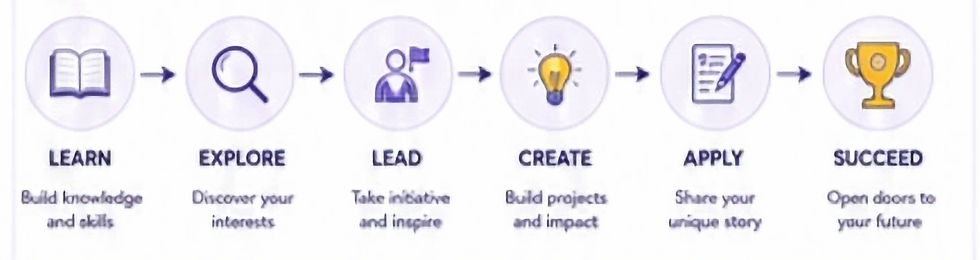
This guide explains the major components of a competitive application and how students can prepare thoughtfully throughout high school. We also have a Complete Ivy League Admissions Guide for zooming out.
Can Anyone Get Into an Ivy League
School?

One of the most common misconceptions is that Ivy League universities only admit "geniuses."
In reality, admitted students come from a wide range of backgrounds, interests, schools, and life experiences.
What they often have in common is a consistent record of learning, growth, and meaningful contribution.
There is no perfect applicant, so called "Ivy League Student Profile"
Instead, admissions committees evaluate how students have used the opportunities available to them and how they may contribute to the university community.
Understanding Holistic Admissions
Ivy League universities generally review applications using a holistic process.
Rather than focusing on a single number or achievement, they consider many parts of an application together.

These often include:
Academic performance
Course rigor
Standardized testing (where applicable)
Extracurricular activities
Leadership
Essays
Letters of recommendation
Interviews (where offered)
Personal qualities
Context and available opportunities
No single factor determines the outcome.
The 9-Step Admissions Roadmap

Step 1 — Build Strong Academic Foundations
Academic performance remains one of the most important parts of an application.
Admissions officers typically review:
Grades over several years
Course selection
Academic consistency
Intellectual curiosity
Performance in challenging subjects
Students should focus on learning deeply rather than chasing perfect numbers alone.
Strong academic habits developed early often produce better long-term results than last-minute preparation.
Course Rigor Matters
Universities often evaluate not only how well students performed but also which opportunities they chose to pursue.
Depending on what is available at a student's school, this might include:
Honors classes
AP courses
IB courses
Dual-enrollment programs
Advanced electives
Students should select courses that challenge them while remaining realistic about their workload and well-being.
Step 2 — Prepare for Standardized Tests
Testing policies continue to evolve, so students should always verify the current requirements of each university they plan to apply to.
If taking the SAT or ACT, students benefit from:
Starting preparation early
Taking full-length practice tests
Reviewing mistakes carefully
Improving gradually over time
Developing test-taking confidence
A strong test score can strengthen an application when considered, but it is only one part of the overall picture. Students ask IMRSB, Does SAT Still Matter for Ivy League Admissions?
Step 3 — Develop Meaningful Extracurricular Activities
One of the biggest misconceptions is that students need to participate in as many activities as possible.
Admissions committees often value:
Long-term commitment
Growth over time
Leadership
Initiative
Positive impact
Examples include:
Academic clubs
Robotics
Debate
Student government
Music
Athletics
Entrepreneurship
Community service
Independent research
Creative projects
Depth is generally more meaningful than quantity.
Quality Over Quantity
A student who spends four years making a meaningful contribution to one organization may demonstrate greater commitment than someone who briefly joins many unrelated activities.
Admissions committees often appreciate sustained involvement and evidence of personal growth.
Step 4 — Demonstrate Leadership
Leadership is one of the qualities many universities value, but leadership can take many forms.
It is not limited to titles such as club president or team captain.
Students demonstrate leadership when they:
Solve problems.
Take initiative.
Help others succeed.
Create new opportunities.
Improve their community.
Inspire positive change.
Admissions officers often care more about impact than titles.
Examples of Leadership
Leadership can be demonstrated through many activities, including:
Organizing a charity fundraiser
Starting a tutoring program
Leading a robotics or coding team
Captaining a sports team
Creating an educational YouTube channel
Founding a nonprofit initiative
Launching a small business
Mentoring younger students
Organizing community events
Leading school projects
Strong leadership often develops over time through consistent commitment.
Step 5 — Explore Research and Intellectual Curiosity
One characteristic shared by many successful applicants is a genuine love of learning.
Universities appreciate students who continue learning beyond classroom requirements.
Examples include:
Independent research projects
Science fairs
Coding applications
Building websites
Writing articles
Publishing educational content
Reading university-level books
Academic competitions
Mathematics Olympiads
Robotics competitions
The goal is not to collect achievements but to explore subjects that genuinely interest you.
Passion Projects
A passion project is a long-term effort that reflects a student's interests and initiative.
Examples include:
Building a mobile app
Creating a nonprofit organization
Developing an educational website
Publishing a research paper
Writing a book
Starting a podcast
Producing educational videos
Designing engineering projects
Creating an AI application
Passion projects often demonstrate creativity, persistence, and independent thinking.
Step 6 — Write Strong College Essays
Essays allow admissions officers to understand the person behind the grades and activities.
Rather than listing achievements, effective essays often focus on:
Personal growth
Challenges overcome
Curiosity
Values
Reflection
Goals
Lessons learned
Authenticity is generally more powerful than trying to sound impressive.
What Makes a Strong Essay?
Many successful essays share common characteristics:
Honest storytelling
Clear structure
Specific details
Personal reflection
Strong writing
A genuine voice
Students should focus on explaining why an experience mattered, not simply describing what happened.
Step 7 — Build Strong Relationships with Teachers
Recommendation letters can provide valuable insight into a student's classroom experience.
Teachers who know a student well can often describe qualities such as:
Curiosity
Academic engagement
Collaboration
Leadership
Integrity
Resilience
Kindness
Students can build these relationships by participating actively, asking thoughtful questions, and showing consistent effort over time.
Step 8 — Prepare for Interviews
Some universities invite applicants to participate in interviews.
Interviews are generally conversations rather than examinations.
Students should be prepared to discuss:
Academic interests
Extracurricular experiences
Future goals
Favorite books
Personal challenges
Community involvement
Why they are interested in the university
Good interviews often feel like thoughtful conversations rather than rehearsed performances.
Step 9 — Build Character, Not Just a Résumé
One of the biggest misconceptions about Ivy League admissions is that students need to create a perfect résumé.
In reality, universities are admitting people—not lists of accomplishments.
Qualities that often stand out include:
Curiosity
Kindness
Humility
Initiative
Responsibility
Resilience
Integrity
Collaboration
These qualities are demonstrated through everyday actions and long-term habits.
Building a Balanced Student Profile
Instead of trying to maximize every category, aim to build a balanced profile over time.
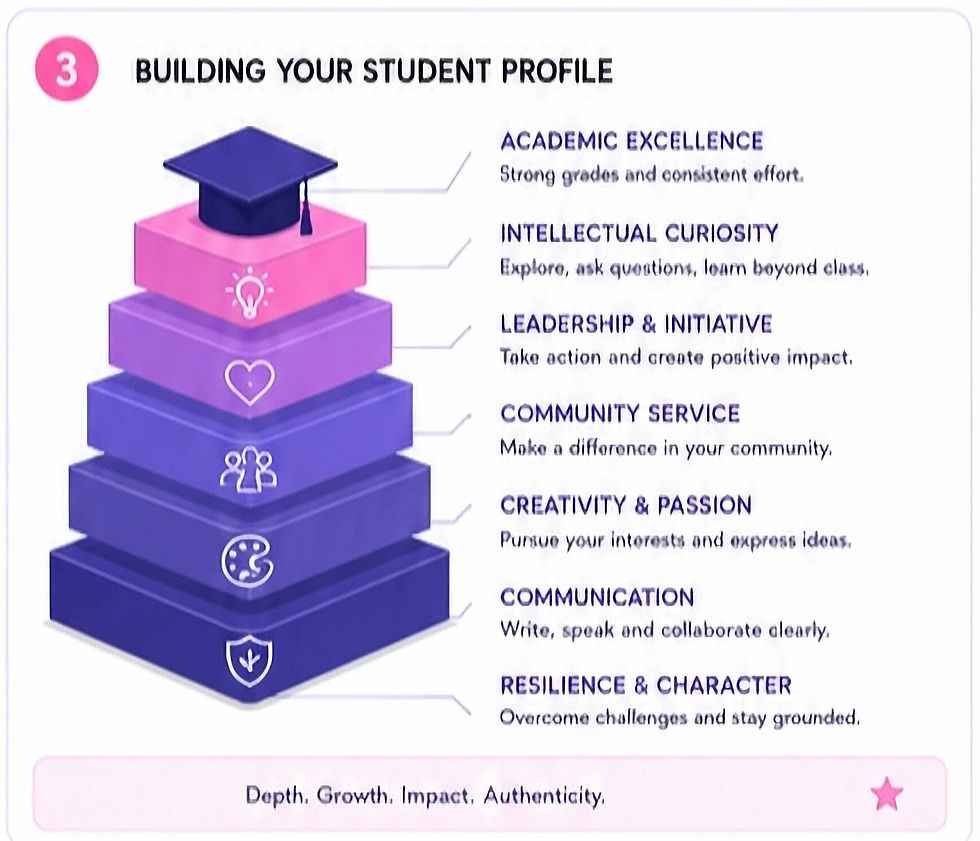
A strong application often combines:
Academic excellence
Intellectual curiosity
Meaningful extracurricular activities
Leadership
Community engagement
Effective communication
Personal growth
Authenticity
Students do not need to be exceptional in every area. What matters is presenting a genuine and well-developed picture of who they are. SAT Score Needed for Ivy League Schools
Common Myths About Ivy League Admissions
Myth 1: You Need Perfect Grades
Reality: Strong academic performance is important, but admissions decisions consider many factors beyond grades alone.
Myth 2: You Must Be Good at Everything
Reality: Students often have different strengths. Universities seek diverse talents and perspectives.
Myth 3: More Activities Are Always Better
Reality: Long-term commitment and meaningful impact are generally more valuable than participating briefly in many unrelated activities.
Myth 4: One Low Score Ends Your Chances
Reality: Applications are reviewed holistically, and no single element typically determines the outcome on its own.
Myth 5: You Should Build Your Application Around What Admissions Officers Want
Reality: Authentic interests and sustained effort often create a stronger application than trying to match a perceived ideal.
Common Mistakes Students Make
Even talented students can weaken their applications by making avoidable mistakes. Understanding these pitfalls early can help you build a stronger and more authentic profile.
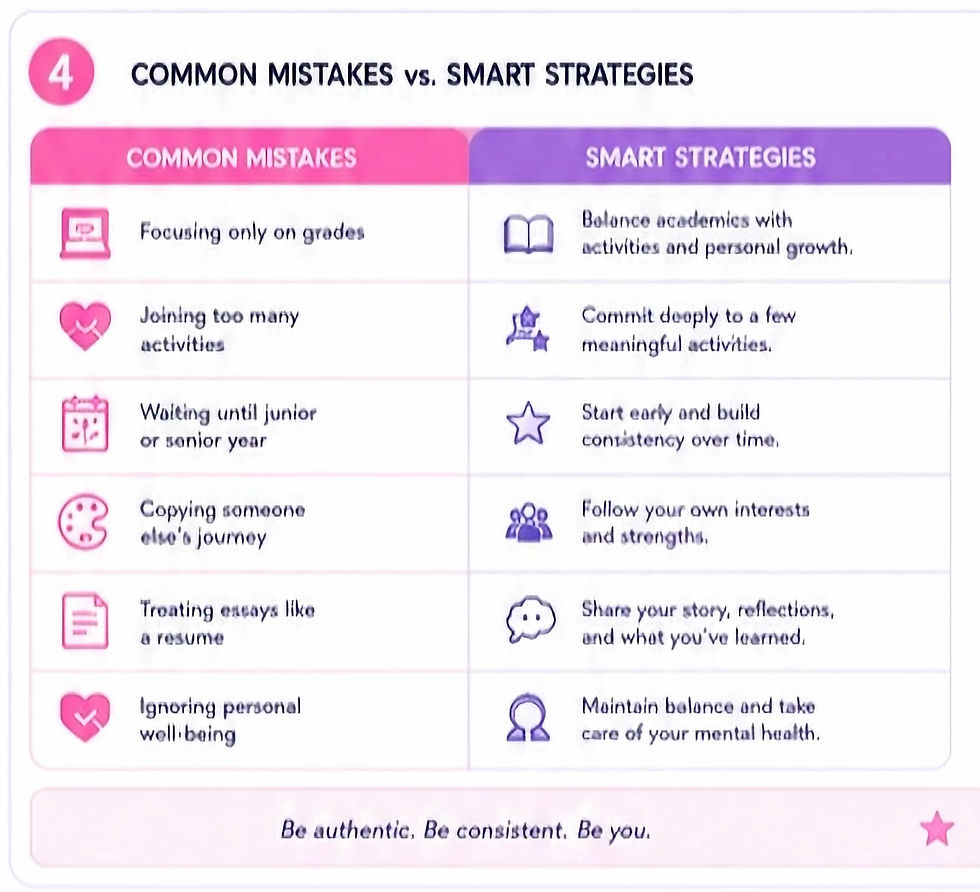
Mistake 1 — Focusing Only on Grades
Excellent grades are important, but they are only one part of the admissions process.
Students who focus exclusively on academics while neglecting leadership, communication, or extracurricular growth may miss opportunities to demonstrate a well-rounded profile.
A balanced application reflects both academic ability and personal development.
Mistake 2 — Joining Too Many Activities
Many students believe that participating in as many clubs as possible will impress admissions officers.
In reality, universities often value:
Long-term commitment
Meaningful contributions
Leadership
Growth over time
Depth usually matters more than quantity.
Mistake 3 — Waiting Until Junior or Senior Year
Building a competitive application takes time.
Waiting until the final years of high school often limits opportunities to develop leadership, pursue long-term projects, or improve academic performance.
Small, consistent efforts beginning in Grade 9 can make a significant difference.
Mistake 4 — Copying Someone Else's Journey
Every successful applicant has a unique story.
Trying to imitate another student's activities or achievements may lead to an application that feels less genuine.
Instead, focus on your own interests, strengths, and goals.
Mistake 5 — Treating the Essay Like a Resume
Your essay should not simply repeat your accomplishments.
Instead, use it to show:
How you think
What motivates you
What challenges shaped you
How you've grown
What you hope to contribute
Admissions officers want to understand the person behind the application.
Mistake 6 — Ignoring Personal Well-Being
Preparing for college should not come at the expense of physical or mental health.
Maintaining balance through healthy routines, rest, and meaningful relationships can support both academic success and long-term personal growth.
Frequently Asked Questions (FAQ)
1. What GPA do Ivy League schools expect?
There is no universal GPA requirement.
Admissions committees evaluate academic performance within the context of each student's school, available courses, and overall application.
Students should aim for consistent academic excellence while challenging themselves appropriately.
2. Is the SAT required?
Testing policies vary by university and can change over time.
Always review the official admissions requirements for each institution before applying.
If submitting scores, thoughtful preparation and consistent practice can help students perform to the best of their abilities.
3. How many extracurricular activities should I have?
There is no ideal number.
Meaningful involvement in a few activities over several years is often more valuable than brief participation in many unrelated clubs.
4. Can international students get into Ivy League universities?
Yes.
Each year, Ivy League institutions admit students from many countries around the world.
International applicants should carefully review each university's admissions, financial aid, and visa requirements.
5. Do I need research experience?
Not necessarily.
Research can strengthen an application for students who are genuinely interested in it, but universities also value achievements in the arts, athletics, entrepreneurship, community service, leadership, and many other areas.
6. What should I write about in my essay?
Write about experiences that genuinely mattered to you.
The strongest essays often demonstrate reflection, growth, and authenticity rather than trying to impress readers with dramatic stories.
7. Is leadership required?
Leadership can strengthen an application, but it does not always mean holding an official title.
Students demonstrate leadership by taking initiative, helping others, solving problems, and making meaningful contributions.
8. Is there a guaranteed formula for admission?
No.
There is no checklist that guarantees acceptance to any university.
Students should focus on becoming curious learners, responsible community members, and authentic individuals while presenting the strongest application they can.
Ivy League Preparation Checklist
By the time you apply, ask yourself:

☐ Have I challenged myself academically?
☐ Have I maintained consistent grades?
☐ Have I explored subjects beyond the classroom?
☐ Have I developed meaningful extracurricular commitments?
☐ Have I demonstrated leadership or initiative?
☐ Have I built strong relationships with teachers?
☐ Have I reflected thoughtfully on my experiences?
☐ Have I researched the universities I'm applying to?
☐ Have I prepared my essays carefully?
☐ Does my application genuinely represent who I am?
Key Takeaways
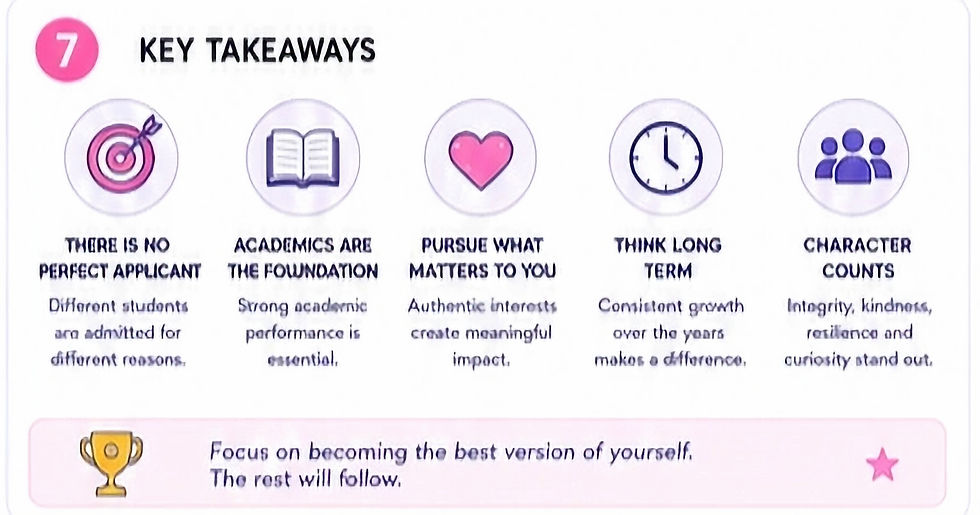
1. There Is No Perfect Applicant
Students are admitted for many different reasons.
Admissions committees seek diverse perspectives, talents, and experiences.
2. Academics Form the Foundation
Strong academic performance remains one of the most important parts of a competitive application.
Consistent effort over time often matters more than short-term improvement.
3. Pursue What Matters to You
Rather than trying to build an application around trends or expectations, invest your time in activities that genuinely interest you.
Authenticity often leads to deeper learning and stronger contributions.
4. Think Long Term
Competitive applications are built over several years through consistent growth.
Developing good habits early provides more opportunities to explore, improve, and reflect.
5. Character Matters
Curiosity, integrity, resilience, kindness, and initiative are qualities that can shape not only a strong application but also a meaningful educational journey.
Ready to build your college admissions roadmap?
Explore IMRSB's SAT, AP, Mathematics, and College Admissions guides to strengthen every part of your application.
In upcoming guides, we'll cover Ivy League application timelines, student profiles, essays, interviews, financial aid, research opportunities, and detailed guides for individual universities.
Final Conclusion
Getting into an Ivy League school is not about following a secret formula. It is about making thoughtful choices, developing your strengths, and growing consistently throughout high school.

Strong academics, meaningful extracurricular involvement, authentic essays, and genuine personal development all contribute to a compelling application.
No university defines your future. However, the habits you build while preparing—discipline, curiosity, resilience, and integrity—will benefit you wherever your educational journey leads.
Related IMRSB Guides
College Admissions
SAT Preparation
Advanced Placement
School Math
About IMRSB
At IMRSB, we believe that preparing for university is about more than building a competitive application. It is about becoming a lifelong learner—someone who is curious, resilient, thoughtful, and ready to contribute meaningfully to the world. Our resources are designed to help students strengthen their academic foundations, make informed decisions, and pursue their educational goals with confidence.
Comments